FUEL TANK INSTALLATION

-
INSTALL FUEL TANK STAY
-
Install the 2 fuel tank stays with the 8 bolts and 8 nuts.
- Torque:
- 66 N*m { 673 kgf*cm, 49 ft.*lbf }
-
-
INSTALL NO. 1 FUEL TANK BAND SUB-ASSEMBLY
-
Install the 2 No. 1 fuel tank bands with the 2 pins.
-
-
INSTALL FUEL TANK VENT TUBE SUB-ASSEMBLY
-
Install the fuel tank vent tube sub-assembly and a new gasket with the 5 bolts.
- Torque:
- 1.5 N*m { 15 kgf*cm, 13 in.*lbf }
-
-
INSTALL FUEL CUT OFF VALVE ASSEMBLY
-
Install the fuel tank support tube plate, fuel cut off valve assembly, 2 new gaskets and No. 1 fuel evaporation tube sub-assembly with the 5 screws.
- Torque:
- 1.5 N*m { 15 kgf*cm, 13 in.*lbf }
-
-
INSTALL FUEL SENDER GAUGE ASSEMBLY
-
Install the fuel sender gauge assembly and a new gasket with the 5 screws.
- Torque:
- 1.5 N*m { 15 kgf*cm, 13 in.*lbf }
-
Connect the fuel sender gauge connector.
-
-
INSTALL FUEL TANK ASSEMBLY
-
Set the fuel tank on an engine lifter and lift up the fuel tank.
-
While supporting the fuel tank, install the fuel tank assembly to the fuel tank stays.
-
Connect the 2 fuel tank bands with the 4 nuts.
- Torque:
- 13 N*m { 130 kgf*cm, 9 ft.*lbf }
-
-
CONNECT NO. 2 RETURN TUBE FUEL HOSE
-
Connect the No. 2 return tube fuel hose to the fuel tank vent tube sub-assembly and slide the clip to secure the hose.
-
-
CONNECT NO. 2 MAIN TUBE FUEL HOSE
-
Connect the No. 2 main tube fuel hose to the fuel tank vent tube sub-assembly and slide the clip to secure the hose.
-
-
CONNECT FUEL EMISSION HOSE
-
Connect the fuel emission hose to the No. 1 fuel evaporation tube sub-assembly and slide the clip to secure the hose.
-
Connect the vent tube clamp to the fuel emission hose and fuel tank vent tube sub-assembly.
-
-
CONNECT FUEL SENDER GAUGE CONNECTOR
-
Attach the 2 wire harness clamps.
-
Connect the fuel sender gauge connector.
-
-
ADD FUEL
-
INSTALL FUEL TANK CAP ASSEMBLY
-
BLEED AIR FROM FUEL SYSTEM
-
Confirm that the drain plug and air bleeder plug of the fuel filter assembly and fuel prefilter assembly are completely closed.
-
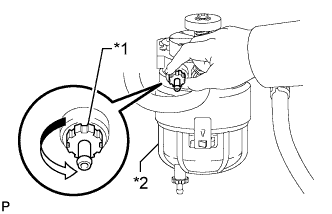
Text in Illustration *1 Air Bleeder Plug *2 Fuel Filter Assembly Loosen the air bleeder plug of the fuel filter assembly.
Note
Do not loosen the air bleeder plug of the fuel prefilter assembly.
-
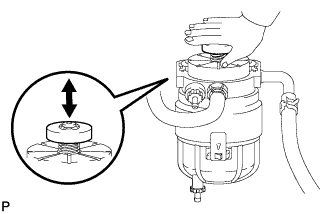
Pump the priming pump until air stops coming out of the pipe of the air bleeder plug.
Note
-
Place a container, etc. underneath the fuel filter to prevent fuel from spraying.
-
The hand pump must be pushed with a full stroke during pumping.
-
The maximum hand pump pumping speed is 2 strokes per second.
-
When the fuel pressure at the supply pump inlet port reaches a saturated pressure, the hand pump resistance increases.
-
If pumping is interrupted during the air bleeding process, fuel in the fuel line may return to the fuel tank. Continue pumping until the hand pump resistance increases.
-
If the hand pump resistance does not increase despite consecutively pumping 200 times or more, there may be a fuel leak between the fuel tank and fuel filter, the hand pump may be malfunctioning, or the vehicle may have run out of fuel.
-
If air bleeding using the hand pump is incomplete, the common rail pressure does not rise to the pressure range necessary for normal use and the engine cannot be started.
-
-
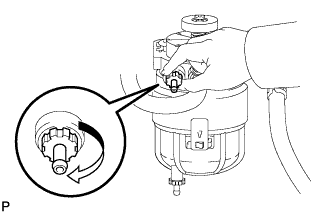
Tighten the air bleeder plug.
Note
Do not use any tools.
-
Check if the engine starts.
Note
-
Even if air bleeding using the hand pump has been completed, the starter may need to be cranked for 10 seconds or more to start the engine.
-
Do not crank the engine continuously for more than 20 seconds. The battery may be discharged.
-
Use a fully-charged battery.
-
When the engine can be started, proceed to the next step.
Tech Tips
If the engine cannot be started, bleed air again using the hand pump until the hand pump resistance increases (refer to the procedures above). Then start the engine.
-
-
Turn the ignition switch off.
-
Connect the intelligent tester to the DLC3.
-
Turn the ignition switch to ON and turn the intelligent tester on.
-
Clear the DTCs Click here.
-
Start the engine.*1
-
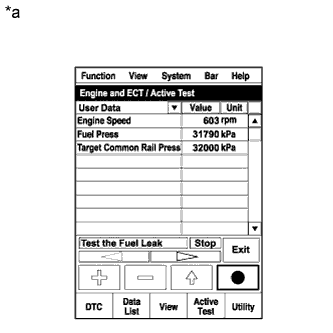
Text in Illustration *a Reference
(Active Test operation)
Enter the following menus: Powertrain / Engine and ECT / Active Test / Test the Fuel Leak.*2
-
Perform the following test 5 times with on/off intervals of 10 seconds: Active Test / Test the Fuel Leak.*3
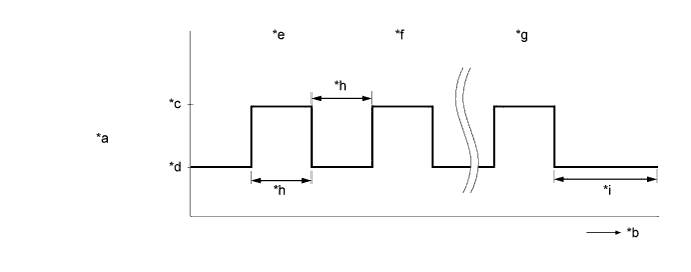
Text in Illustration *a Active Test operation *b Time *c ON *d OFF *e 1st time *f 2nd time *g 5th time *h 10 seconds *i 3 minutes or more - - -
Allow the engine to idle for 3 minutes or more after performing the Active Test for the 5th time.
-
Enter the following menus: Powertrain / Engine and ECT / DTC.
-
Read Current DTCs.
-
If no DTCs are output, air bleeding is completed.
-
If DTCs are output, perform the following procedure.
-
-
Clear the DTCs Click here.
-
Repeat steps *1 to *3.
-
Enter the following menus: Powertrain / Engine and ECT / DTC.
-
Read Current DTCs.
OK No DTCs are output
-
-
INSPECT FOR FUEL LEAK
-
Perform the Active Test.
-
Replace the normal DLC3 cable (12 V specification) for the intelligent tester with the 24 V DLC3 cable.
Note
Be sure to use the 24 V DLC3 cable when connecting the intelligent tester to the DLC3. Using the normal DLC3 cable (12 V specification) will cause damage to the tester.
-
Connect the intelligent tester to the DLC3.
-
Start the engine.
-
Turn the intelligent tester on.
-
Enter the following menus: Powertrain / Engine and ECT / Active Test.
-
Perform the Active Test.
Tester Display Test Part Control Range Diagnostic Note Test the Fuel Leak Pressurizes common rail interior and checks for fuel leaks Stop or Start
-
The fuel pressure inside the common rail is increased to a specified value and the engine speed is increased to 2000 rpm when Start is selected
-
The above conditions are preserved while the control parameter of the test is Start
-
-
-
Check for leaks from the fuel system while performing the Active Test (with a fuel pressure applied).
-