FUEL INJECTOR INSTALLATION

-
REMOVE INJECTION NOZZLE SEAT GASKET
-
Install 4 new injection nozzle seat gaskets to the cylinder head.
-
-
INSTALL INJECTOR ASSEMBLY
Note
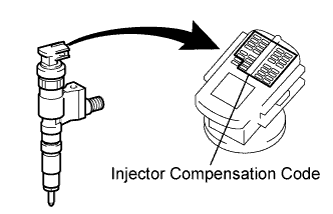
Register the injector compensation code of a new fuel injector in the ECM when replacing the fuel injector. Register the injector compensation code in advance so that it can be installed in the correct position Click here.
-
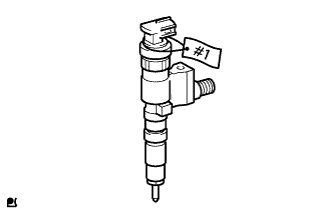
Attach tags to identify the cylinder (#1 to #4) to the new injector assemblies so that each injector assembly can be inserted into the correct cylinder during installation.
-
Apply a small amount of clean engine oil to 4 new O-rings.
-
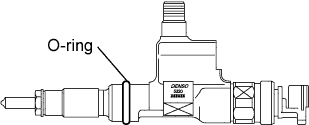
Install the O-ring to each injector as shown in the illustration.
-
Install a new No. 2 cylinder head cover gasket to each injector.
-
Referring to each cylinder number identification tag attached to the fuel injector assemblies, insert the fuel injector assembly, nozzle holder clamp, and nozzle holder clamp bolt for each cylinder.
Note
-
Check that the tip of the fuel injector has no foreign matter attached.
-
When reusing the fuel injectors, reinstall them to the same cylinder they were removed from. Otherwise, it could cause the engine to malfunction.
-
Carefully insert the fuel injector so that the O-ring is not caught between the cylinder head and the injector.
-
-

Temporarily install the 4 nozzle holder clamps with the 4 clamp bolts.
Note
Be sure to install the holder clamps and bolts in their original positions.
-
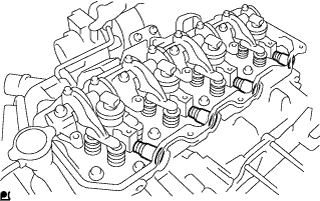
Install 4 new holder seals.
Note
Securely insert the tip of each holder seal into each fuel injector.
-
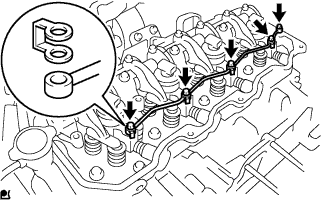
Temporarily install the nozzle leakage pipe assembly through 5 new gaskets by hand with the union bolt and the 5 hollow screws.
Note
Make sure that the hollow screws and nozzle leakage pipe assembly are not deformed or damaged.
-
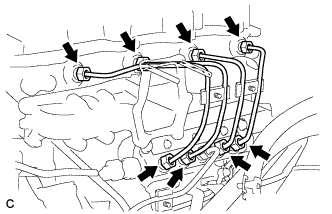
Temporarily tighten the union nuts of new injection pipes No. 1, No. 2, No. 3 and No. 4 by hand.
Note
If an injector has been replaced, the corresponding injection pipe must also be replaced.
-
Tighten the 4 nozzle holder clamp bolts.
- Torque:
- 25 N*m { 255 kgf*cm, 18 ft.*lbf }
Note
After tightening the nozzle holder clamp bolts, check that the fuel injector and the nozzle holder clamp do not interfere with the valve spring.
-
Tighten the 5 hollow screws.
- Torque:
- 12 N*m { 125 kgf*cm, 9 ft.*lbf }
Note
Do not reuse the nozzle leakage pipe assembly that has been tightened to more than the specified torque.
-
Using a union nut wrench (17 mm), tighten the 8 union nuts.
- Torque:
- 35 N*m { 360 kgf*cm, 26 ft.*lbf }
Note
Refer to the torque above when not using SST. When using SST, calculate the torque in accordance with the lengths of SST and the torque wrench Click here.
-
-
INSTALL INJECTION PIPE CLAMP
-
Install a new O-ring to the oil level gauge guide.
Note
Apply a small amount of clean engine oil to the new O-ring.
-

Temporarily install the 2 pipe clamps and oil level gauge guide to the intake manifold.
-
Install the 2 injection pipe clamps with the 2 nuts. Tighten the 2 nuts until the clamp edges make contact with the engine side clamp edges.
-
-
INSTALL NO. 2 CYLINDER HEAD COVER SUB-ASSEMBLY
-
Install a new cylinder head cover gasket onto the No. 2 cylinder head cover.
-

Install the No. 2 cylinder head cover sub-assembly with the 2 bolts.
- Torque:
- 29 N*m { 290 kgf*cm, 21 ft.*lbf }
-
Install the cylinder head cover cushion rubber.
-
Connect the ventilation hose.
-
-
INSTALL CYLINDER HEAD COVER SUB-ASSEMBLY
-
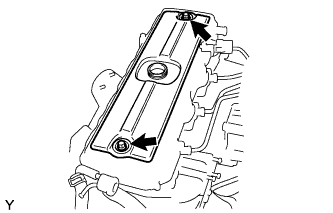
Install the cylinder head cover sub-assembly with a new gasket and the 2 bolts.
- Torque:
- 29 N*m { 290 kgf*cm, 21 ft.*lbf }
-
-
INSTALL OIL FILLER CAP SUB-ASSEMBLY
-

Install the oil filler cap sub-assembly.
-
-
INSTALL VENTURI ASSEMBLY
-
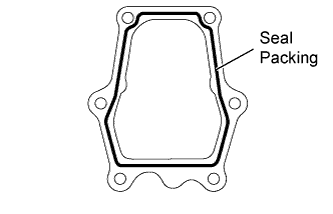
Apply seal packing in a continuous line (width: 1.5 to 2.5 mm (0.06 to 0.10 in. )) as shown in the illustration.
Seal packing Toyota Genuine Seal Packing Black, Three Bond 1207B or equivalent Note
-
Remove any oil from the contact surface.
-
Install the intake pipe with the EGR valve within 3 minutes, and tighten the bolts within 15 minutes of applying the seal packing.
-
-
Install the venturi assembly with the 4 bolts.
- Torque:
- 29 N*m { 290 kgf*cm, 21 ft.*lbf }
-
-
INSTALL DIESEL THROTTLE BODY
-
Remove any seal packing material from the contact surface.
-
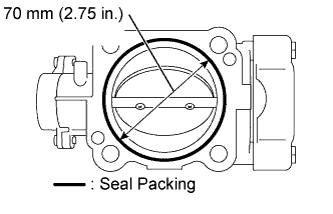
Apply a continuous bead of seal packing (width: 1.5 to 2.5 mm (0.06 to 0.10 in. )) as shown in the illustration.
Tech Tips
-
Remove any oil from the contact surface.
-
Install the diesel throttle body assembly within 3 minutes of applying the seal packing.
-
Do not run the engine for at least 2 hours after installing.
-
-
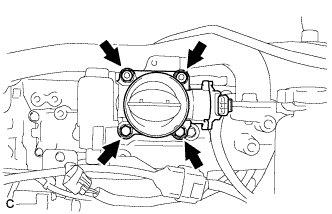
Install the diesel throttle body with the 2 bolts and 2 nuts.
- Torque:
- 29 N*m { 290 kgf*cm, 21 ft.*lbf }
-
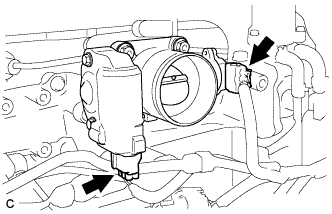
Connect the 2 diesel throttle body connectors.
-
-
INSTALL WATER BY-PASS PIPE SUB-ASSEMBLY
-
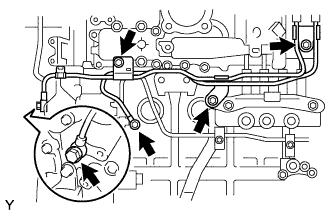
Install 4 new gaskets and water by-pass pipe sub-assembly with the 2 union bolts and 3 bolts.
- Torque:
- for Union Bolt
- 25 N*m { 255 kgf*cm, 18 ft.*lbf }
- for Bolt
- 29 N*m { 29 kgf*cm, 21 ft.*lbf }
-
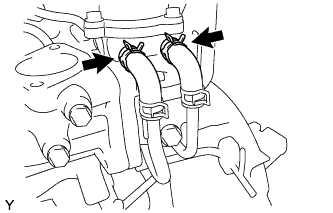
Connect the 2 hoses to the EGR valve.
-
-
INSTALL EGR VALVE BRACKET
-
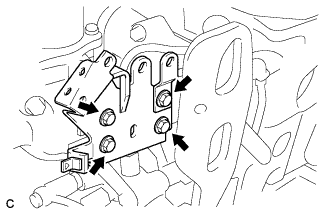
Install the EGR valve bracket with the 4 bolts.
- Torque:
- 29 N*m { 291 kgf*cm, 21 ft.*lbf }
-
-
INSTALL WIRE HARNESS AND CONNECTORS
-
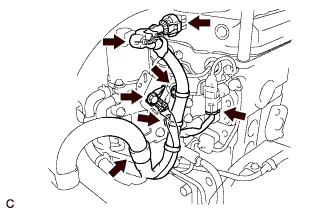
Connect the 3 connectors and 3 connector clamps and then install the bolt.
- Torque:
- 5.0 N*m { 51 kgf*cm, 44 in.*lbf }
-
-
INSTALL EGR COOLER SUB-ASSEMBLY
-
Install the EGR cooler with a new gasket and the 2 bolts.
- Torque:
- Flange
- 55 N*m { 560 kgf*cm, 41 ft.*lbf }
- Engine
- 69 N*m { 700 kgf*cm, 51 ft.*lbf }
-
Connect the water by-pass hose.
-
-
INSTALL NO. 4 AIR HOSE
-
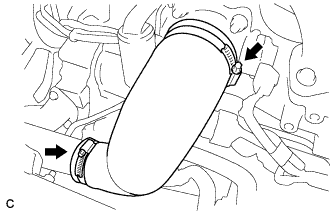
Install the No. 4 air hose with 2 new clamps.
-
-
INSTALL NO. 1 AIR HOSE
-
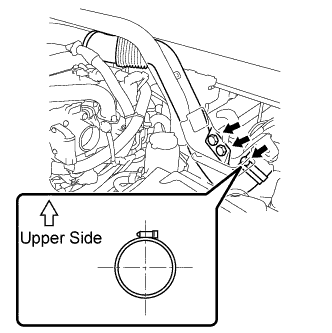
Install the No. 1 air hose with the 2 bolts and a new hose clamp as shown in the illustration.
- Torque:
- 18 N*m { 184 kgf*cm, 13 ft.*lbf }
-
-
INSTALL NO. 2 INTAKE PIPE
-

Install the No. 2 intake pipe with the 3 bolts and 2 bands.
- Torque:
- 29 N*m { 291 kgf*cm, 21 ft.*lbf }
-
-
ADD ENGINE COOLANT
-
Add engine coolant.
Specified capacity 14.7 liters (15.5 US qts, 12.9 Imp. qts) Note
Never use water as a substitute for engine coolant.
Tech Tips
-
TOYOTA vehicles are filled with TOYOTA SLLC at the factory. In order to avoid damage to the engine cooling system and other technical problems, only use TOYOTA SLLC or similar high quality ethylene glycol based non-silicate, non-amine, non-nitrite, non-borate coolant with long-life hybrid organic acid technology (coolant with long-life hybrid organic acid technology consists of a combination of low phosphates and organic acids).
-
Contact your TOYOTA dealer for further details.
-
-
Check the coolant level inside the radiator by squeezing the inlet and outlet radiator hoses several times by hand. If the coolant level goes down, add coolant.
-
Install the radiator cap.
-
Slowly pour coolant into the radiator reservoir until it reaches the FULL line.
-
Bleed air from the cooling system.
-
Warm up the engine until the thermostat opens.
While the thermostat is open, circulate the coolant for several minutes.
-
Press the inlet and outlet radiator hoses several times by hand to bleed air.
Note
-
Be careful as the radiator hoses are hot.
-
Keep your hands away from the radiator fan.
-
-
-
Stop the engine and wait until the coolant cools down.
-
Remove the radiator cap and check the coolant level.
-
If the coolant level has dropped, add coolant.
-
Check the coolant level inside the radiator reservoir tank again. If it is below the full level, add coolant.
-
-
CONNECT CABLE TO NEGATIVE BATTERY TERMINAL
-
REGISTER INJECTOR COMPENSATION CODE
-
Register the injector compensation code Click here.
-
-
INSPECT FOR INJECTOR COMPENSATION CODE
-
BLEED AIR FROM FUEL SYSTEM
Tech Tips
-
INSPECT FOR FUEL LEAK
-
Perform the Active Test.
-
Connect the intelligent tester to the DLC3.
-
Start the engine.
-
Turn the intelligent tester on.
-
Select the following menu items: Powertrain / Engine / Active Test.
-
Perform the Active Test.
Intelligent Tester Display Test Details Control Range Diagnostic Notes Test the Fuel Leak Fuel leaks (common rail internal fuel pressure is raised) Stop/Start
-
Fuel pressure inside common rail pressurized to specified value and engine speed increased to 2000 rpm when Start is selected.
-
Above conditions preserved while Start is selected.
-
-
-
-
INSPECT FOR COOLANT LEAK
-
Remove the radiator cap.
CAUTION:
Do not remove the radiator cap while the engine and radiator are still hot. Pressurized, hot engine coolant and steam may be released and cause serious burns.
-
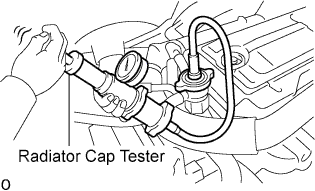
Fill the radiator with coolant and attach a radiator cap tester.
-
Warm up the engine.
-
Using a radiator cap tester, increase the pressure inside the radiator to 137 kPa (1.4 kgf/cm2, 19.9 psi), and check that the pressure does not drop.
If the pressure drops, check the hoses, radiator and water pump for leaks. If no external leaks are found, check the heater core, cylinder block and cylinder head.
-
Install the radiator cap.
-
-
INSPECT FOR OIL LEAK
-
PERFORM INITIALIZATION
Tech Tips