CYLINDER HEAD INSPECTION

-
INSPECT CYLINDER HEAD FOR WARPAGE
-
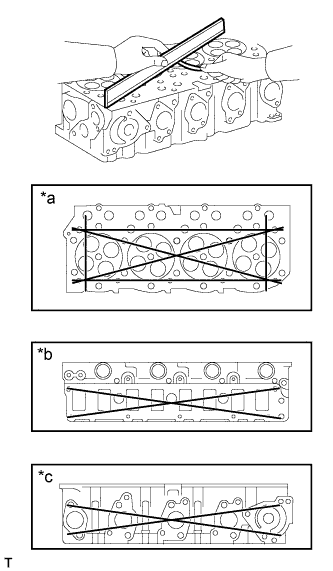
Text in Illustration *a Cylinder Block Side *b Intake Manifold Side *c Exhaust Manifold Side Using a precision straight edge and feeler gauge, measure the warpage on the cylinder block side and the intake and exhaust manifold sides.
Maximum warpage 0.10 mm (0.00394 in.)
-
-
INSPECT CYLINDER HEAD FOR CRACKS
-
Using a dye penetrant, check the cylinder head for cracks.
-
-
INSPECT INNER COMPRESSION SPRING
-
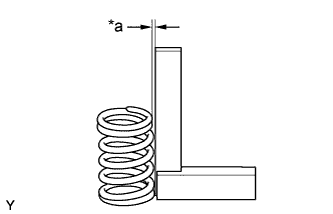
Text in Illustration *a Deviation Using a steel square, measure the deviation of the compression spring.
Maximum deviation 2.0 mm (0.0787 in.) If the deviation is greater than the maximum, replace the inner compression spring.
-
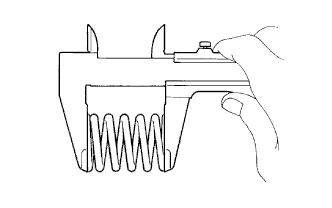
Using a vernier caliper, measure the free length of the compression spring.
Standard free length 85.1 mm (3.350 in.) Minimum free length 82.1 mm (3.232 in.) If the free length is less than minimum, replace the inner compression spring.
-
-
INSPECT INTAKE VALVE
-
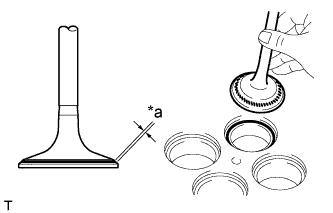
Text in Illustration *a Width Visually check the valves for damage, burns, carbon or warpage, and check the valve heads, valve stems and valve stem grooves for cracks.
If excessive wear, burns, warpage or cracks are present, replace the valves.
-
Check the valve seating condition.
-
Lightly apply prussian blue marking compound to the valve face.
-
Tapping the valve against the seat, check the seating condition.
Standard width 1.24 mm (0.0488 in.) or more If the prussian blue mark is not concentric or the compound is scattered all around the valve face or seat, repair the valve face or the valve seat.
-
-
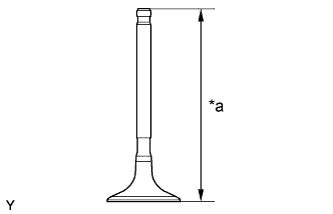
Text in Illustration *a Overall Length Using a vernier caliper, measure the overall length of the intake valve.
Standard overall length 129.8 mm (5.1102 in.) If the overall length is not as specified, replace the intake valve.
-
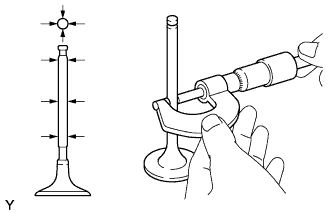
Using a micrometer, measure the diameter of the valve stem.
Standard valve stem diameter 6.957 to 6.972 mm (0.2739 to 0.2745 in.)
-
-
INSPECT EXHAUST VALVE
-
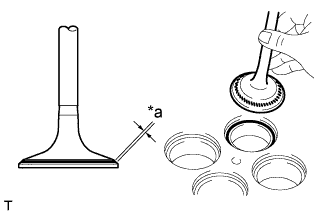
Text in Illustration *a Width Visually check the valves for damage, burns, carbon or warpage. Check the valve heads, valve stems and valve stem grooves for cracks.
If excessive wear, burns, warpage or cracks are present, replace the valves.
-
Check the valve seating condition.
-
Lightly apply prussian blue marking compound to the valve face.
-
Tapping the valve against the seat, check the seating condition.
Standard width 1.24 mm (0.0488 in.) or more If the prussian blue mark is not concentric or the compound is scattered all around the valve face or seat, repair the valve face or the valve seat.
-
-
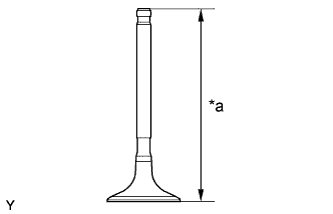
Text in Illustration *a Overall Length Using a vernier caliper, measure the overall length of the exhaust valve.
Standard overall length 128.8 mm (5.0709 in.) If the overall length is not as specified, replace the exhaust valve.
-
Using a micrometer, measure the diameter of the valve stem.
Standard valve stem diameter 6.932 to 6.947 mm (0.2729 to 0.2735 in.)
-
-
INSPECT VALVE GUIDE BUSH OIL CLEARANCE
-
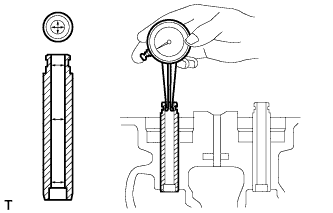
Using a caliper gauge, measure the internal diameter of the valve guide bush.
Standard inside diameter 7.000 to 7.015 mm (0.2756 to 0.2762 in.) If the bore diameter is not as specified, replace the valve guide bush.
-
Subtract the valve stem diameter measurement from the bore diameter measurement of the valve guide bush to calculate the oil clearance.
Standard Oil Clearance Item Specified Condition Intake 0.028 to 0.058 mm (0.00110 to 0.00228 in.) Exhaust 0.053 to 0.083 mm (0.00209 to 0.00327 in.)
-
-
INSPECT INTAKE VALVE SINK
-
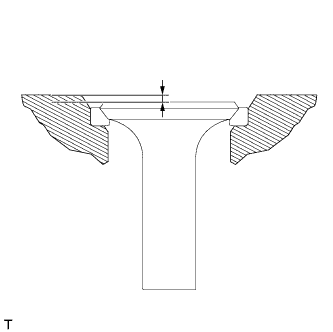
Using a vernier caliper, measure the valve sink.
Standard 0.8 to 1.0 mm (0.0315 to 0.0394 in.) Maximum 1.1 mm (0.0433 in.) If the sink is greater than the maximum, replace the valve and valve seat.
Note
-
If the valve heads are protruding from the cylinder head surface, the valve heads may hit the pistons when the engine is running.
-
When replacing the valve and valve seat, always recheck the seating condition.
-
-
-
INSPECT EXHAUST VALVE SINK
-
Using a vernier caliper, measure the valve sink.
Standard 1.8 to 2.0 mm (0.0709 to 0.0787 in.) Maximum 2.1 mm (0.0827 in.) If the sink is greater than the maximum, replace the valve and valve seat.
Note
-
If the valve heads are protruding from the cylinder head surface, the valve heads may hit the pistons when the engine is running.
-
When replacing the valve and valve seat, always recheck the seating condition.
-
-