CYLINDER BLOCK DISASSEMBLY

-
INSPECT CONNECTING ROD THRUST CLEARANCE
-
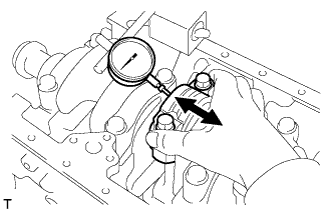
Using a dial indicator, measure the thrust clearance while moving the connecting rod back and forth.
Standard thrust clearance 0.200 to 0.520 mm (0.00787 to 0.0205 in.) Maximum thrust clearance 0.60 mm (0.0236 in.) If the thrust clearance is more than the maximum, replace the connecting rod sub-assembly. If necessary, replace the crankshaft.
-
-
REMOVE PISTON WITH CONNECTING ROD SUB-ASSEMBLY
-
Remove the piston with connecting rod sub-assembly from the cylinder block.
-
-
REMOVE CONNECTING ROD BEARING SET
-
REMOVE CYLINDER LINER
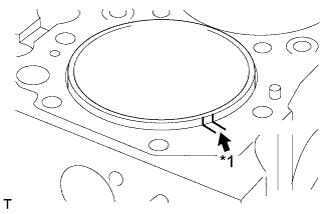
Note
When reusing the cylinder liner, misalignment with the cylinder block may concentrate stress on the thin part of the cylinder liner and the cylinder liner may break.
Tech Tips
Before removing the cylinder liner, put matchmarks on the cylinder liner and cylinder block.
Text in Illustration *1 Matchmark
-
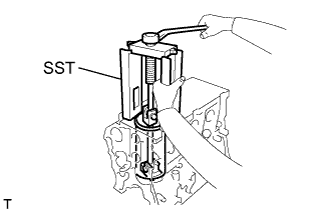
Using SST, remove the cylinder liner.
- SST
- S0942-01460
Tech Tips
Organize the parts so that each part location can be remembered for reassembly.
-
-
INSPECT CRANKSHAFT THRUST CLEARANCE
-
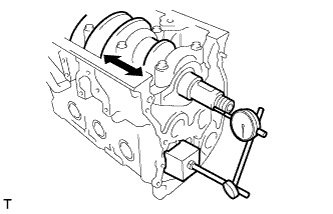
Using a dial indicator, measure the thrust clearance while prying the crankshaft back and forth.
Standard thrust clearance 0.050 to 0.220 mm (0.00197 to 0.00866 in.) Maximum thrust clearance 0.40 mm (0.0157 in.) If the thrust clearance is more than the maximum, replace the thrust washer set. If necessary, replace the crankshaft.
-
-
REMOVE CRANKSHAFT
-
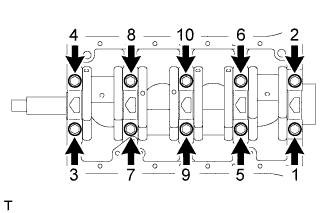
Remove the 10 crankshaft bearing cap set bolts in the order shown in the illustration.
-
Using a plastic-faced hammer, tap the crankshaft bearing caps to remove them.
Note
Be careful not to damage the crankshaft thrust washers and crankshaft bearings.
-
Remove the crankshaft.
-
-
REMOVE CRANKSHAFT THRUST WASHER SET
Tech Tips
Organize the parts so that each part location can be remembered for reassembly.
-
REMOVE CRANKSHAFT BEARING SET
Tech Tips
Organize the parts so that each part location can be remembered for reassembly.
-
REMOVE REAR CYLINDER BLOCK COVER
-
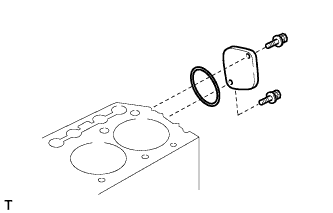
Remove the 2 bolts, rear cylinder block cover and O-ring.
-
-
REMOVE NO. 1 OIL NOZZLE SUB-ASSEMBLY
-
Remove the oil nozzle union bolt and No. 1 oil nozzle sub-assembly.
-
-
REMOVE PISTON RING SET
-
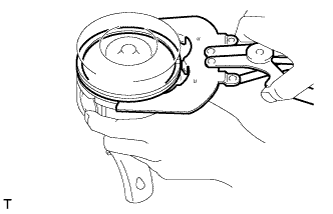
Using a piston ring expander, remove the piston rings.
Tech Tips
Arrange the piston rings in the correct order.
-
-
REMOVE PISTON PIN HOLE SNAP RING
-
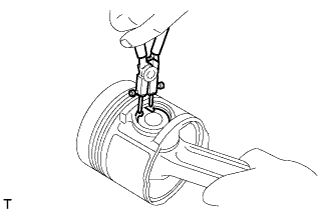
Using snap ring pliers, remove the 2 piston pin hole snap rings.
-
-
REMOVE PISTON
-
Gradually heat the piston to approximately 50°C (122°F).
-
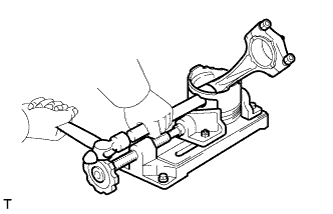
Using a plastic-faced hammer and brass bar, lightly tap out the piston pin and remove the connecting rod sub-assembly.
Note
Arrange the pistons, piston pins, piston rings, connecting rod sub-assemblies and connecting rod bearings in the correct order.
-
-
REMOVE CONNECTING ROD SMALL END BUSH
-
Prepare SST.
-
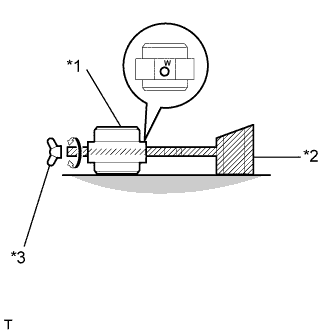
Text in Illustration *1 SST (Guide) *2 SST (Press Sub-assembly) *3 SST (Wing Nut) Install SST (press sub-assembly) to SST (guide) by inserting the pin of SST (press sub-assembly) into SST (guide), and then secure them together by installing SST (wing nut).
- SST
- S0940-21450
- S0948-11130
- S9233-10360
Tech Tips
Orient SST (guide) so that the letter W, which is stamped on SST (guide), is above the pin.
-
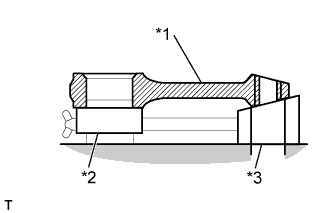
Text in Illustration *1 Connecting Rod Sub-assembly *2 SST (Guide) *3 SST (Press Sub-assembly) Set SST (Guide) and SST (Press Sub-assembly) on a level surface.
-
-
Using SST, remove the bush.
-
Set the connecting rod assembled without the crankshaft bearing on SST (Guide) and SST (Press Sub-assembly).
-
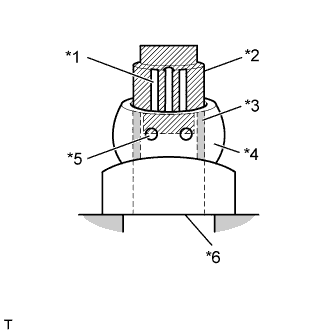
Text in Illustration *1 Groove *2 SST (Spindle) *3 Bush *4 Connecting Rod Sub-assembly *5 Oil Hole *6 SST (Press Sub-assembly) Install SST (Spindle) to the connecting rod bush.
- SST
- S0940-21470
Tech Tips
Align the groove of SST (Spindle) with the oil hole of the bush.
-
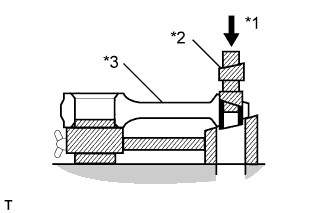
Text in Illustration *1 Press *2 SST (Spindle) *3 Connecting Rod Sub-assembly Using a press, remove the connecting rod bush.
Tech Tips
Always operate the press slowly and smoothly.
-
-
-
REMOVE CAMSHAFT BEARING
-
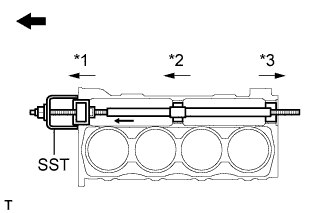
Text in Illustration *1 No. 1 Camshaft Bearing *2 No. 2 Camshaft Bearing *3 No. 3 Camshaft Bearing 
Front Using SST, remove the camshaft bearings in the directions indicated by the arrows in the illustration.
- SST
- 09215-00101 ( 09215-00130, 09215-00141, 09215-00150, 09215-00161 )
- 09215-00013 ( 09215-00021, 09215-00461 )
Note
Remove the No. 1 camshaft bearing, No. 2 camshaft bearing and No. 3 camshaft bearing, in that order.
-