ECD SYSTEM Fuel Injection System
INSPECTION PROCEDURE
Note
-
After replacing the ECM, the new ECM needs registration Click here and initialization Click here.
-
After replacing the injection or supply pump assembly, the ECM needs initialization Click here.
-
After replacing an injector assembly, the ECM needs registration Click here.
PROCEDURE
-
READ VALUE USING INTELLIGENT TESTER (FUEL PRESS AND TARGET COMMON RAIL PRESSURE) (PROCEDURE 1)
-
Replace the normal DLC3 cable (12 V specification) for the intelligent tester with the 24 V DLC3 cable.
Note
Be sure to use the 24 V DLC3 cable when connecting the intelligent tester to the DLC3. Using the normal DLC3 cable (12 V specification) will cause damage to the tester.
-
Connect the intelligent tester to the DLC3.
-
Turn the ignition switch to ON.
-
Turn the tester on.
-
Enter the following menus: Powertrain / Engine and ECT / Data List / Fuel Press and Target Common Rail Pressure.
-
Confirm the values for "Fuel Press" and "Target Common Rail Pressure" when the engine is started.
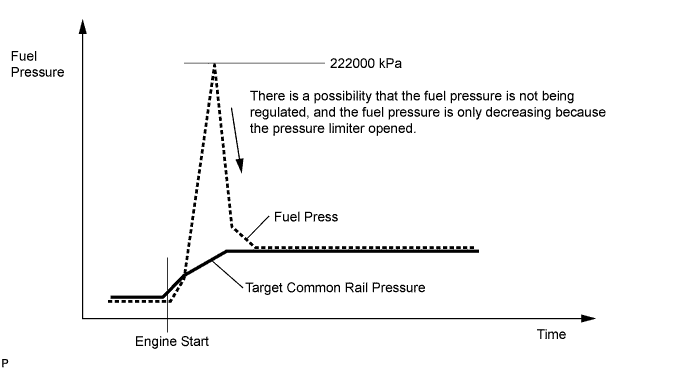
Result Result Proceed to Except below A "Fuel Press" exceeds 222000 kPa when the engine is started B Tech Tips
-
Normally, "Fuel Press" does not reach 222000 kPa when the engine is started.
-
If "Fuel Press" reaches 222000 kPa when the engine is started, the suction control valve may not be operating (current may not be reaching the suction control valve).
-
B 
CHECK COMMON RAIL ASSEMBLY (PRESSURE LIMITER) Click here
A 
-
-
READ VALUE USING INTELLIGENT TESTER (FUEL PRESS AND TARGET COMMON RAIL PRESSURE) (PROCEDURE 2)
-
Replace the normal DLC3 cable (12 V specification) for the intelligent tester with the 24 V DLC3 cable.
Note
Be sure to use the 24 V DLC3 cable when connecting the intelligent tester to the DLC3. Using the normal DLC3 cable (12 V specification) will cause damage to the tester.
-
Connect the intelligent tester to the DLC3.
-
Turn the ignition switch to ON.
-
Turn the tester on.
-
Enter the following menus: Powertrain / Engine and ECT / Data List / Fuel Press and Target Common Rail Pressure.
-
Confirm the values for "Fuel Press" and "Target Common Rail Pressure" when the engine is started, and when accelerating and decelerating the vehicle.
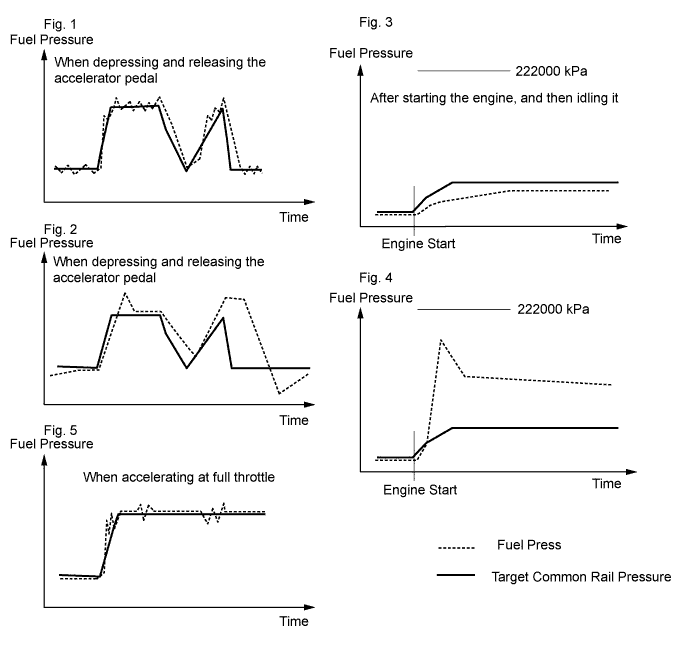
Result Result Proceed to Except below A "Fuel Press" is constantly fluctuating and differs from "Target Common Rail Pressure" as shown in figure 1 B "Fuel Press" greatly overshoots "Target Common Rail Pressure" and differs substantially from "Target Common Rail Pressure" as shown in figure 2 Engine does not start, takes a long time to start, or starts but "Fuel Press" is less than "Target Common Rail Pressure" as shown in figure 3 After the engine starts, "Fuel Press" becomes much higher than "Target Common Rail Pressure" and hardly decreases at all as shown in figure 4 "Fuel Press" fluctuates during acceleration or right after accelerating as shown in figure 5 C Tech Tips
-
The cases shown in figure 3 and 4 may occur when the learned value for the injection or supply pump assembly is incorrect immediately after the suction control valve, the injection or supply pump assembly, the fuel filter, or the ECM is replaced.
-
If "Fuel Press" fluctuates during acceleration as shown in figure 5, there may be air in the fuel system due to an increase in fuel suction vacuum.
-
B
PERFORM FUEL SUPPLY PUMP INITIALIZATION Click here
C
CHECK FOR CLOGS IN FUEL SUCTION PIPES AND AIR IN FUEL Click here
A
-
-
PERFORM ACTIVE TEST USING INTELLIGENT TESTER (TEST THE FUEL LEAK)
Tech Tips
By performing this Active Test, the engine speed is maintained at 2000 rpm and the common rail assembly internal fuel pressure is raised to the maximum operating pressure. As a result, a fuel leak check can be conducted while retaining a high common rail pressure.
-
Replace the normal DLC3 cable (12 V specification) for the intelligent tester with the 24 V DLC3 cable.
Note
Be sure to use the 24 V DLC3 cable when connecting the intelligent tester to the DLC3. Using the normal DLC3 cable (12 V specification) will cause damage to the tester.
-
Connect the intelligent tester to the DLC3.
-
Start the engine.
-
Turn the tester on.
-
Enter the following menus: Powertrain / Engine and ECT / Active Test / Test the Fuel Leak.
-
Visually check the injection or supply pump assembly, injector assembly and fuel line located between the injection or supply pump assembly and common rail assembly for fuel leaks and fuel pressure leaks. Also, perform the same check on the fuel line between the common rail assembly and the injector assembly.
Tech Tips
There may be fuel leaks inside the components, such as the injection or supply pump assembly.
Result Result Proceed to No fuel leaks exist A Fuel leaks exist B
B 
REPAIR FUEL LEAK
A
-
-
READ VALUE USING INTELLIGENT TESTER (FUEL PRESS AND TARGET COMMON RAIL PRESSURE) (PROCEDURE 4)
-
Replace the normal DLC3 cable (12 V specification) for the intelligent tester with the 24 V DLC3 cable.
Note
Be sure to use the 24 V DLC3 cable when connecting the intelligent tester to the DLC3. Using the normal DLC3 cable (12 V specification) will cause damage to the tester.
-
Connect the intelligent tester to the DLC3.
-
Turn the ignition switch to ON.
-
Turn the tester on.
-
Enter the following menus: Powertrain / Engine and ECT / Data List / Fuel Press and Target Common Rail Pressure.
-
Confirm the values for "Fuel Press" and "Target Common Rail Pressure" when the accelerator pedal is depressed and then released.
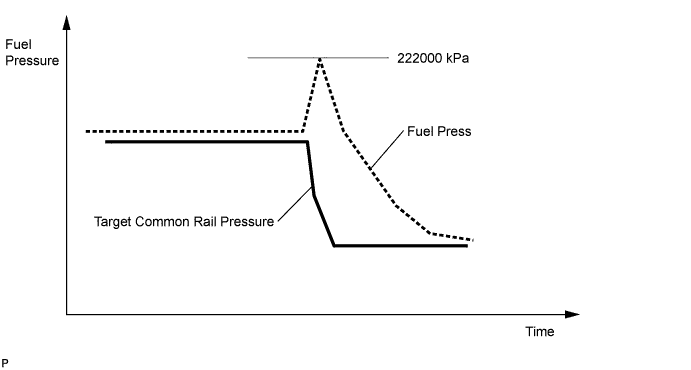
Result Result Proceed to After the accelerator pedal is depressed, "Fuel Press" exceeds 222000 kPa and then decreases A Except above B
B
READ VALUE USING INTELLIGENT TESTER (FUEL PRESS AND TARGET COMMON RAIL PRESSURE) (PROCEDURE 6) Click here
A
-
-
CHECK FOR CLOGS IN RETURN LINE FOR INJECTOR ASSEMBLY
-
Check for clogs in the return line for the injector assembly.
OK No clogs in the fuel line
NG
REPAIR FUEL PIPE CLOG OR REPLACE PARTS
OK
-
-
READ VALUE USING INTELLIGENT TESTER (FUEL PRESS AND TARGET COMMON RAIL PRESSURE) (PROCEDURE 6)
-
Replace the normal DLC3 cable (12 V specification) for the intelligent tester with the 24 V DLC3 cable.
Note
Be sure to use the 24 V DLC3 cable when connecting the intelligent tester to the DLC3. Using the normal DLC3 cable (12 V specification) will cause damage to the tester.
-
Connect the intelligent tester to the DLC3.
-
Turn the ignition switch to ON.
-
Turn the tester on.
-
Enter the following menus: Powertrain / Engine and ECT / Data List / Fuel Press and Target Common Rail Pressure.
-
Confirm the values for "Fuel Press" and "Target Common Rail Pressure" when the engine speed is gradually raised from idle to 3000 rpm.
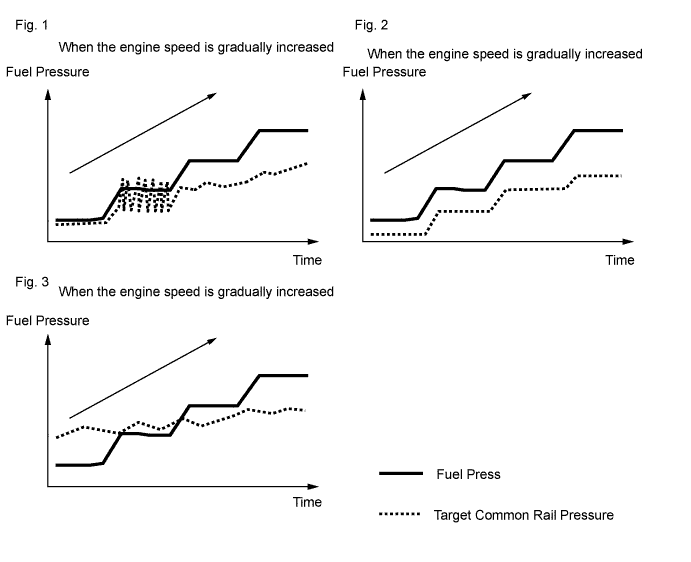
Result Result Proceed to "Fuel Press" becomes unstable in a certain engine speed range and stops following "Target Common Rail Pressure" as shown in figure 1 A "Fuel Press" is continually low and does not follow "Target Common Rail Pressure" as shown in figure 2 "Fuel Press" changes with no relation to "Target Common Rail Pressure" as shown in figure 3 B Except above C Tech Tips
-
The cases shown in figure 1 and 2 occur when the amount of fuel supplied by the injection or supply pump assembly is insufficient.
-
When the amount of fuel supplied is insufficient, the fuel filter or a fuel pipe being clogged is usually the cause.
-
B
CHECK HARNESS AND CONNECTOR (FUEL PRESSURE SENSOR - ECM) Click here
C
PERFORM FUEL SUPPLY PUMP INITIALIZATION Click here
A
-
-
CHECK FOR CLOGS IN FUEL SUCTION PIPES AND AIR IN FUEL
-
Check that there are no clogs in the fuel filter, fuel pipes and fuel suction port in the fuel tank.
-
Check that the amount of fuel is sufficient.
-
Inspect the fuel tank, the fuel pipes, the injection or supply pump assembly, the common rail assembly and the injector assemblies for fuel leaks and seepage.
-
Check if fuel waxing has occurred due to low temperatures.
Tech Tips
Once fuel waxing occurs, the engine needs to be run for a long time in order for the wax to melt.
-
Check if the fuel pipes are bent or deformed, preventing fuel from flowing.
OK
PERFORM FUEL SUPPLY PUMP INITIALIZATION Click here
NG
CHECK FOR FUEL PIPE CLOG (INCLUDING FUEL FREEZING) AND PERFORM REPAIRS
-
-
CHECK HARNESS AND CONNECTOR (FUEL PRESSURE SENSOR - ECM)
-
Disconnect the fuel pressure sensor connector.
-
Disconnect the ECM connector.
-
Measure the resistance according to the value(s) in the table below.
Standard Resistance (Check for Open) Tester Connection Condition Specified Condition E36-13 (VC) - C12-1 (VC1) Always Below 1 Ω E35-16 (PCR1) - C12-2 (PCR1) Always Below 1 Ω E36-14 (E2) - C12-3 (E1) Always Below 1 Ω E35-13 (VC2) - C12-6 (VC2) Always Below 1 Ω E35-2 (PCR2) - C12-5 (PCR2) Always Below 1 Ω E35-14 (E21) - C12-4 (E2) Always Below 1 Ω Standard Resistance (Check for Short) Tester Connection Condition Specified Condition E36-13 (VC) or C12-1 (VC1) - Body ground Always 10 kΩ or higher E35-16 (PCR1) or C12-2 (PCR1) - Body ground Always 10 kΩ or higher E35-13 (VC2) or C12-6 (VC2) - Body ground Always 10 kΩ or higher E35-2 (PCR2) or C12-5 (PCR2) - Body ground Always 10 kΩ or higher -
Reconnect the fuel pressure sensor connector.
-
Reconnect the ECM connector.
NG
REPAIR OR REPLACE HARNESS OR CONNECTOR
OK
-
-
CHECK COMMON RAIL ASSEMBLY (PRESSURE LIMITER)
OK Fuel does not return from the fuel line of the pressure limiter.
NG
REPLACE COMMON RAIL ASSEMBLY Click here
OK
-
CHECK HARNESS AND CONNECTOR (SUCTION CONTROL VALVE - ECM)
-
Disconnect the suction control valve connector.
-
Disconnect the ECM connector.
-
Measure the resistance according to the value(s) in the table below.
Standard Resistance (Check for Open) Tester Connection Condition Specified Condition E37-23 (PCV+) - S31-1 (SCV+) Always Below 1 Ω E37-12 (PCV-) - S31-2 (SCV-) Always Below 1 Ω Standard Resistance (Check for Short) Tester Connection Condition Specified Condition E37-23 (PCV+) or S31-1 (SCV+) - Body ground Always 10 kΩ or higher E37-12 (PCV-) or S31-2 (SCV-) - Body ground Always 10 kΩ or higher -
Reconnect the suction control valve connector.
-
Reconnect the ECM connector.
NG
REPAIR OR REPLACE HARNESS OR CONNECTOR
OK
-
-
PERFORM FUEL SUPPLY PUMP INITIALIZATION
-
Perform fuel supply pump initialization Click here.
NEXT
-
-
READ VALUE USING INTELLIGENT TESTER (FUEL PRESS AND TARGET COMMON RAIL PRESSURE)
-
Replace the normal DLC3 cable (12 V specification) for the intelligent tester with the 24 V DLC3 cable.
Note
Be sure to use the 24 V DLC3 cable when connecting the intelligent tester to the DLC3. Using the normal DLC3 cable (12 V specification) will cause damage to the tester.
-
Connect the intelligent tester to the DLC3.
-
Turn the ignition switch to ON.
-
Turn the tester on.
-
Enter the following menus: Powertrain / Engine and ECT / Data List / Fuel Press and Target Common Rail Pressure.
-
Perform procedures 1, 2, 4 and 6 and check if the problem symptom disappears.
Result Result Proceed to Problem symptom does not disappear A Problem symptom disappears B Tech Tips
-
If the problem symptom disappears, a fuel line may be clogged.
-
After checking for clogs in the fuel lines and performing repairs, perform fuel supply pump initialization Click here.
-
B
CHECK FOR CLOGS IN FUEL SUCTION PIPES AND AIR IN FUEL Click here
A 
REPLACE INJECTION OR SUPPLY PUMP ASSEMBLY Click here
-