ECD SYSTEM Black Smoke Emitted
INSPECTION PROCEDURE
Note
-
After replacing the ECM, the new ECM needs registration Click here and initialization Click here.
-
After replacing the injection or supply pump assembly, the ECM needs initialization Click here.
-
After replacing an injector assembly, the ECM needs registration Click here.
Tech Tips
Specified values in the following troubleshooting flowchart are for reference only. Variations in the Data List values may occur depending on the measuring conditions or the vehicle's age. Do not assume the vehicle to be normal when the Data List outputs standard values. There may be concealed factors causing the malfunction.
PROCEDURE
-
CHECK OUTPUT DTC (RELATED TO ENGINE)
-
Replace the normal DLC3 cable (12 V specification) for the intelligent tester with the 24 V DLC3 cable.
Note
Be sure to use the 24 V DLC3 cable when connecting the intelligent tester to the DLC3. Using the normal DLC3 cable (12 V specification) will cause damage to the tester.
-
Connect the intelligent tester to the DLC3.
-
Turn the ignition switch to ON.
-
Turn the tester on.
-
Enter the following menus: Powertrain / Engine and ECT / DTC.
-
Read the DTCs.
Result Result Proceed to DTC is not output A DTCs related to the engine B
B 
GO TO DTC CHART Click here
A 
-
-
READ VALUE USING INTELLIGENT TESTER (INJECTION VOLUME AND INJECTION FEED BACK VAL #1 TO #4)
-
Replace the normal DLC3 cable (12 V specification) for the intelligent tester with the 24 V DLC3 cable.
Note
Be sure to use the 24 V DLC3 cable when connecting the intelligent tester to the DLC3. Using the normal DLC3 cable (12 V specification) will cause damage to the tester.
-
Connect the intelligent tester to the DLC3.
-
Start the engine.
-
Turn the tester on.
-
Enter the following menus: Powertrain / Engine and ECT / Data List.
-
Enter the following menus in order and read the values.
-
Injection Volume
-
Injection Feedback Val #1, #2, #3, and #4
Standard Item Engine Speed* Reference Value Injection Volume Idling (No engine load) 5.0 to 16.0 mm3/st
Injection Feedback Val #1 Idling (No engine load) -7.0 to 7.0 mm3/st
Injection Feedback Val #2 Idling (No engine load) -7.0 to 7.0 mm3/st
Injection Feedback Val #3 Idling (No engine load) -7.0 to 7.0 mm3/st
Injection Feedback Val #4 Idling (No engine load) -7.0 to 7.0 mm3/st
Tech Tips
*: If no idling conditions are specified, the shift lever should be in the neutral position, and the A/C switch and all accessory switches should be off.
-
NG 
CHECK ECM TERMINAL VOLTAGE (THW TERMINAL) Click here
OK
-
-
PERFORM ENGINE SPEED ACCELERATION
Tech Tips
If the exhaust gas contains excessive black smoke, perform the following operations:
-
Accelerate the engine speed to the maximum speed with no load 20 times.
-
Check for black smoke in the exhaust gas.
Result Result Proceed to Black smoke is not present A Black smoke remains in the exhaust gas B Tech Tips
Soot deposits in the exhaust system may cause excessive black smoke.
B
CHECK AIR INTAKE SYSTEM AND EXHAUST SYSTEM Click here
A 
PROCEED TO NEXT SUSPECTED AREA SHOWN IN PROBLEM SYMPTOMS TABLE Click here
-
-
CHECK AIR INTAKE SYSTEM AND EXHAUST SYSTEM
-
Inspect the engine condition Click here.
NG
CHECK AND REPLACE LOCATIONS WHERE MALFUNCTIONS EXIST
OK
-
-
INSPECT EXHAUST RETARDER ASSEMBLY
-
Inspect the exhaust retarder assembly.
NG
REPLACE EXHAUST RETARDER ASSEMBLY
OK
-
-
CHECK TURBOCHARGER SUB-ASSEMBLY (PRESSURE)
-
Check the turbocharger sub-assembly pressure Click here.
NG
REPLACE TURBOCHARGER SUB-ASSEMBLY Click here
OK
-
-
READ VALUE USING INTELLIGENT TESTER
-
Replace the normal DLC3 cable (12 V specification) for the intelligent tester with the 24 V DLC3 cable.
Note
Be sure to use the 24 V DLC3 cable when connecting the intelligent tester to the DLC3. Using the normal DLC3 cable (12 V specification) will cause damage to the tester.
-
Connect the intelligent tester to the DLC3.
-
Start the engine and turn the tester on.
-
Enter the following menus: Powertrain / Engine and ECT / Data List.
-
Enter the following menus in order and read the values.
-
Fuel Press
-
Injection Volume
-
Main Injection Period
-
Pilot 2 Injection Period
-
Injection Feedback Val #1, #2, #3, and #4
Result Item Engine Speed* Reference Value Fuel Press Idling 25000 to 35000 kPa Injection Volume Idling 5.0 to 16.0 mm3/st
Main Injection Period Idling 650 to 800 μs Pilot 2 Injection Period Idling 500 to 600 μs Injection Feedback Val #1 Idling -7.0 to 7.0 mm3/st
Injection Feedback Val #2 Idling -7.0 to 7.0 mm3/st
Injection Feedback Val #3 Idling -7.0 to 7.0 mm3/st
Injection Feedback Val #4 Idling -7.0 to 7.0 mm3/st
Tech Tips
*: If no idling conditions are specified, the shift lever should be in the neutral position, and the A/C switch and all accessory switches should be off.
Result Result Proceed to Within reference value A One of Injection Feedback Val #1 to #4 is not within reference value B Other result C -
B
REPLACE INJECTOR ASSEMBLY Click here
C
CHECK ECM TERMINAL VOLTAGE (THW TERMINAL) Click here
A
-
-
CHECK CYLINDER COMPRESSION PRESSURE
-
Check the cylinder compression pressure Click here.
NG
CHECK ENGINE TO DETERMINE CAUSE OF LOW COMPRESSION
OK
-
-
CHECK HARNESS AND CONNECTOR (INJECTOR ASSEMBLY - INJECTOR DRIVER ASSEMBLY)
-
Check the wire harness between the injector assembly and injector driver assembly (INJ terminal).
-
Disconnect the injector assembly connectors.
-
Disconnect the injector driver assembly connector.
-
Measure the resistance according to the value(s) in the table below.
Standard Resistance (Check for Open) Tester Connection Condition Specified Condition I15-2 - I21-5 (INJ1) Always Below 1 Ω I16-2 - I20-4 (INJ2) Always Below 1 Ω I17-2 - I20-2 (INJ3) Always Below 1 Ω I18-2 - I21-4 (INJ4) Always Below 1 Ω I15-1 - I21-1 (COM1) Always Below 1 Ω I16-1 - I21-2 (COM2) Always Below 1 Ω I17-1 - I21-2 (COM2) Always Below 1 Ω I18-1 - I21-1 (COM1) Always Below 1 Ω Standard Resistance (Check for Short) Tester Connection Condition Specified Condition I15-2 or I21-5 (INJ1) - Body ground Always 10 kΩ or higher I16-2 or I20-4 (INJ2) - Body ground Always 10 kΩ or higher I17-2 or I20-2 (INJ3) - Body ground Always 10 kΩ or higher I18-2 or I21-4 (INJ4) - Body ground Always 10 kΩ or higher I15-1 or I21-1 (COM1) - Body ground Always 10 kΩ or higher I16-1 or I21-2 (COM2) - Body ground Always 10 kΩ or higher I17-1 or I21-2 (COM2) - Body ground Always 10 kΩ or higher I18-1 or I21-1 (COM1) - Body ground Always 10 kΩ or higher -
Reconnect the injector assembly connectors.
-
Reconnect the injector driver assembly connector.
-
NG
REPAIR OR REPLACE HARNESS OR CONNECTOR (INJECTOR ASSEMBLY - INJECTOR DRIVER ASSEMBLY)
OK
-
-
PERFORM ACTIVE TEST USING INTELLIGENT TESTER (INJECTOR CUT FOR IDENTIFYING MALFUNCTIONING CYLINDER)
-
Connect the intelligent tester to the DLC3.
-
Start the engine and turn the tester on.
-
Enter the following menus: Powertrain / Engine and ECT / Active Test / Control the Cylinder #1, #2, #3, and #4 Fuel Cut.
-
Check the four cylinders in sequence to identify any faulty cylinders by performing the power-balance inspection.
Result Engine Idling Condition Proceed to Becomes unstable A Does not change B Tech Tips
-
If the engine idle does not change when an injector is disabled, the cylinder being tested is malfunctioning.
-
If the cylinder being tested is normal, there will be a significant change of idle speed when the fuel injection is stopped for that cylinder.
-
B
REPLACE INJECTOR ASSEMBLY Click here
A
REPLACE INJECTOR DRIVER ASSEMBLY Click here
-
-
CHECK ECM TERMINAL VOLTAGE (THW TERMINAL)
-
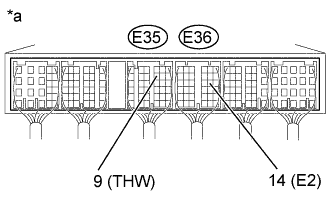
Text in Illustration *a Component with harness connected
(ECM)
Start the engine.
-
Measure the voltage of the ECM connector.
Standard Voltage Tester Connection Condition Specified Condition E35-9 (THW) - E36-14 (E2) Idling, engine coolant temperature between 60 and 120°C (140 and 248°F) 0.2 to 0.6 V
NG
INSPECT ENGINE COOLANT TEMPERATURE SENSOR Click here
OK
-
-
CHECK ECM TERMINAL VOLTAGE (PIM TERMINAL)
-
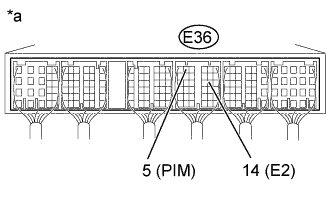
Text in Illustration *a Component with harness connected
(ECM)
Turn the ignition switch to ON.
-
Measure the voltage according to the value(s) in the table below.
Standard Voltage Tester Connection Condition Specified Condition E36-5 (PIM) - E36-14 (E2) Vacuum of 40 kPa (300 mmHg) is applied 0.1 to 0.7 V Atmospheric pressure 0.8 to 1.5 V Pressure of 70 kPa (0.7 kgf/cm2) is applied 1.6 to 2.3 V
NG
CHECK HARNESS AND CONNECTOR (MANIFOLD ABSOLUTE PRESSURE SENSOR - ECM) Click here
OK
-
-
CHECK ECM TERMINAL VOLTAGE (NE+ AND NE- TERMINALS)
-
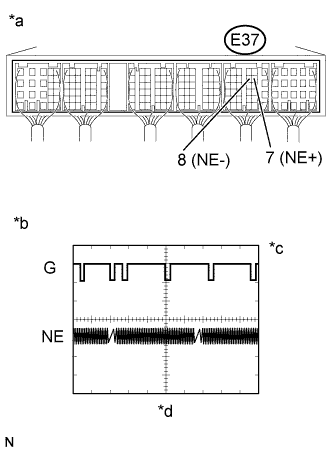
Text in Illustration *a Component with harness connected
(ECM)
*b G and NE Signal Waveform *c 5 V/DIV. *d 20 ms./DIV. While idling the engine, check the waveform between the specified terminals of the ECM connector using an oscilloscope.
Standard Tester Connection Specified Condition E37-7 (NE+) - E37-8 (NE-) Correct waveform appears as shown Tool Setting 5 V/DIV., 20 ms./DIV. Condition Idling with warm engine Tech Tips
The waveform varies depending on the engine revolution.
NG
INSPECT CRANKSHAFT POSITION SENSOR Click here
OK
-
-
CHECK ECM TERMINAL VOLTAGE (VPA AND VPA2 TERMINALS)
-
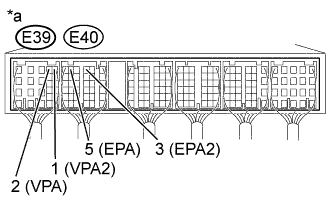
Text in Illustration *a Component with harness connected
(ECM)
Turn the ignition switch to ON.
-
Measure the voltage according to the value(s) in the table below.
Standard Voltage Tester Condition Accelerator Pedal Condition Specified Condition E39-2 (VPA) - E40-5 (EPA) Released 0.6 to 1.0 V E39-2 (VPA) - E40-5 (EPA) Depressed 2.8 to 3.6 V E39-1 (VPA2) - E40-3 (EPA2) Released 1.4 to 1.8 V E39-1 (VPA2) - E40-3 (EPA2) Depressed 3.6 to 4.4 V
NG
CHECK HARNESS AND CONNECTOR (ACCELERATOR PEDAL POSITION SENSOR - ECM) Click here
OK
-
-
CHECK ECM TERMINAL VOLTAGE (THA TERMINAL)
-
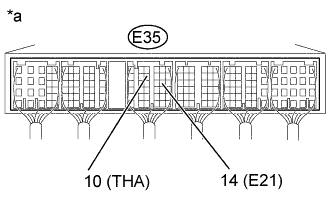
Text in Illustration *a Component with harness connected
(ECM)
Start the engine.
-
Measure the voltage according to the value(s) in the table below.
Standard Voltage Tester Connection Condition Specified Condition E35-10 (THA) - E35-14 (E21) Idling, intake air temperature at 0 to 80°C (32 to 176°F) 0.5 to 3.4 V
NG
INSPECT MASS AIR FLOW METER SUB-ASSEMBLY Click here
OK
-
-
CHECK ECM TERMINAL VOLTAGE (THIA TERMINAL)
-
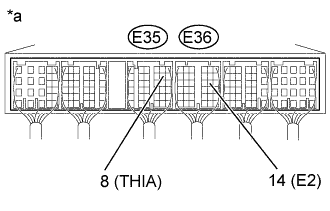
Text in Illustration *a Component with harness connected
(ECM)
Start the engine.
-
Measure the voltage according to the value(s) in the table below.
Standard Voltage Tester Connection Condition Specified Condition E35-8 (THIA) - E36-14 (E2) Idling, intake air temperature at 0 to 80°C (32 to 176°F) 1.0 to 4.4 V
NG
INSPECT INTAKE AIR TEMPERATURE SENSOR Click here
OK
-
-
CHECK ECM TERMINAL VOLTAGE (PCR1 AND PCR2 TERMINAL)
-
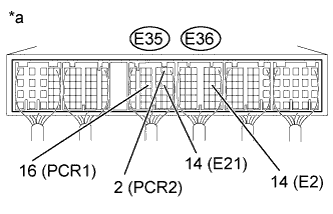
Text in Illustration *a Component with harness connected
(ECM)
Start the engine.
-
Measure the voltage according to the value(s) in the table below.
Standard Voltage Tester Connection Condition Specified Condition E35-16 (PCR1) - E36-14 (E2) Idling 1.6 to 2.0 V E35-2 (PCR2) - E35-14 (E21) Idling 1.1 to 1.5 V
NG
INSPECT COMMON RAIL ASSEMBLY (FUEL PRESSURE SENSOR) Click here
OK
REPLACE ECM Click here
-
-
INSPECT ENGINE COOLANT TEMPERATURE SENSOR
-
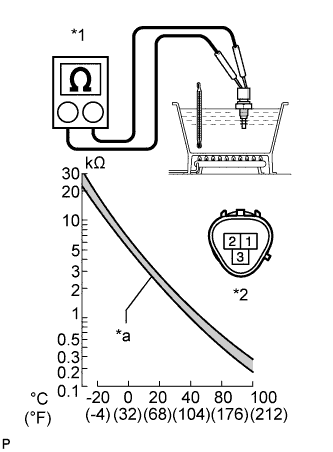
Text in Illustration *1 Ohmmeter *2 Engine Coolant Temperature Sensor *a Acceptable Remove the engine coolant temperature sensor.
-
Measure the resistance according to the value(s) in the table below.
Standard Resistance Tester Connection Condition Specified Condition 1 - 2 20°C (68°F) 2.32 to 2.59 kΩ 1 - 2 80°C (176°F) 0.31 to 0.326 kΩ Note
When checking the sensor in water, keep the terminals dry. After the check, wipe the sensor dry.
Tech Tips
Alternative procedure: Connect an ohmmeter to the installed engine coolant temperature sensor and read the resistance. Use an infrared thermometer to measure the engine temperature in the immediate vicinity of the sensor. Compare these values against the resistance/ temperature graph. Change the engine temperature (warm up or cool down) and repeat the test.
-
Reinstall the engine coolant temperature sensor.
NG
REPLACE ENGINE COOLANT TEMPERATURE SENSOR Click here
OK
REPAIR OR REPLACE HARNESS OR CONNECTOR (ENGINE COOLANT TEMPERATURE SENSOR - ECM)
-
-
CHECK HARNESS AND CONNECTOR (MANIFOLD ABSOLUTE PRESSURE SENSOR - ECM)
-
Disconnect the manifold absolute pressure sensor connector.
-
Disconnect the ECM connectors.
-
Measure the resistance according to the value(s) in the table below.
Standard Resistance (Check for Open) Tester Connection Condition Specified Condition V9-2 (PIM) - E36-5 (PIM) Always Below 1 Ω V9-3 (VC) - E36-13 (VC) Always Below 1 Ω V9-1 (E) - E36-14 (E2) Always Below 1 Ω Standard Resistance (Check for Short) Tester Connection Condition Specified Condition V9-2 (PIM) or E36-5 (PIM) - Body ground Always 10 kΩ or higher V9-3 (VC) or E36-13 (VC) - Body ground Always 10 kΩ or higher V9-1 (E) or E36-14 (E2) - Body ground Always 10 kΩ or higher -
Reconnect the manifold absolute pressure sensor connector.
-
Reconnect the ECM connectors.
NG
REPAIR OR REPLACE HARNESS OR CONNECTOR (MANIFOLD ABSOLUTE PRESSURE SENSOR - ECM)
OK
REPLACE MANIFOLD ABSOLUTE PRESSURE SENSOR
-
-
INSPECT CRANKSHAFT POSITION SENSOR
-
Inspect the crankshaft position sensor Click here.
NG
REPLACE CRANKSHAFT POSITION SENSOR Click here
OK
REPAIR OR REPLACE HARNESS OR CONNECTOR (CRANKSHAFT POSITION SENSOR - ECM)
-
-
CHECK HARNESS AND CONNECTOR (ACCELERATOR PEDAL POSITION SENSOR - ECM)
-
Disconnect the accelerator pedal position sensor connector.
-
Disconnect the ECM connector.
-
Measure the resistance according to the value(s) in the table below.
Standard Resistance (Check for Open) Tester Connection Condition Specified Condition A29-1 (VCP2) - E40-4 (VCP2) Always Below 1 Ω A29-2 (E2) - E40-3 (EPA2) Always Below 1 Ω A29-3 (VPA2) - E39-1 (VPA2) Always Below 1 Ω A29-4 (VCP1) - E40-6 (VCPA) Always Below 1 Ω A29-5 (E1) - E40-5 (EPA) Always Below 1 Ω A29-6 (VPA1) - E39-2 (VPA) Always Below 1 Ω Standard Resistance (Check for Short) Tester Connection Condition Specified Condition A29-1 (VCP2) or E40-4 (VCP2) - Body ground Always 10 kΩ or higher A29-2 (E2) or E40-3 (EPA2) - Body ground Always 10 kΩ or higher A29-3 (VPA2) or E39-1 (VPA2) - Body ground Always 10 kΩ or higher A29-4 (VCP1) or E40-6 (VCPA) - Body ground Always 10 kΩ or higher A29-5 (E1) or E40-5 (EPA) - Body ground Always 10 kΩ or higher A29-6 (VPA1) or E39-2 (VPA) - Body ground Always 10 kΩ or higher -
Reconnect the accelerator pedal position sensor.
-
Reconnect the ECM connector.
NG
REPAIR OR REPLACE HARNESS OR CONNECTOR (ACCELERATOR PEDAL POSITION SENSOR - ECM)
OK
REPLACE ACCELERATOR LINK ASSEMBLY (ACCELERATOR PEDAL POSITION SENSOR) Click here
-
-
INSPECT MASS AIR FLOW METER SUB-ASSEMBLY
-
Inspect the mass air flow meter sub-assembly Click here.
NG
REPLACE MASS AIR FLOW METER SUB-ASSEMBLY Click here
OK
REPAIR OR REPLACE HARNESS OR CONNECTOR (MASS AIR FLOW METER SUB-ASSEMBLY - ECM)
-
-
INSPECT INTAKE AIR TEMPERATURE SENSOR
-
Inspect the intake air temperature sensor Click here.
NG
REPLACE INTAKE AIR TEMPERATURE SENSOR Click here
OK
REPAIR OR REPLACE HARNESS OR CONNECTOR (INTAKE AIR TEMPERATURE SENSOR - ECM)
-
-
INSPECT COMMON RAIL ASSEMBLY (FUEL PRESSURE SENSOR)
-
Inspect the fuel pressure sensor Click here.
NG
REPLACE COMMON RAIL ASSEMBLY Click here
OK
-
-
CHECK HARNESS AND CONNECTOR (FUEL PRESSURE SENSOR - ECM)
-
Disconnect the ECM connector.
-
Disconnect the fuel pressure sensor connector.
-
Measure the resistance according to the value(s) in the table below.
Standard Resistance (Check for Open) Tester Connection Condition Specified Condition E36-13 (VC) - C12-1 (VC1) Always Below 1 Ω E35-16 (PCR1) - C12-2 (PCR1) Always Below 1 Ω E36-14 (E2) - C12-3 (E1) Always Below 1 Ω E35-13 (VC2) - C12-6 (VC2) Always Below 1 Ω E35-2 (PCR2) - C12-5 (PCR2) Always Below 1 Ω E35-14 (E21) - C12-4 (E2) Always Below 1 Ω Standard Resistance (Check for Short) Tester Connection Condition Specified Condition E36-13 (VC) or C12-1 (VC1) - Body ground Always 10 kΩ or higher E35-16 (PCR1) or C12-2 (PCR1) - Body ground Always 10 kΩ or higher E35-13 (VC2) or C12-6 (VC2) - Body ground Always 10 kΩ or higher E35-2 (PCR2) or C12-5 (PCR2) - Body ground Always 10 kΩ or higher -
Reconnect the fuel pressure sensor connector.
-
Reconnect the ECM connector.
NG
REPAIR OR REPLACE HARNESS OR CONNECTOR (FUEL PRESSURE SENSOR - ECM)
OK
-
-
REPLACE ECM
-
Replace the ECM Click here.
Note
After replacing the ECM, the new ECM needs registration Click here and initialization Click here.
-
Check the volume of black smoke in the exhaust gas.
OK Black smoke is not present.
NG
CHECK FUEL INJECTION SYSTEM Click here
OK
END
-