ECD SYSTEM Engine Knocking or Rattling
DESCRIPTION
| Malfunction Condition | Main Trouble Areas | Related Trouble Areas |
|---|---|---|
|
|
|
Tech Tips
-
Specified values in the following troubleshooting flowchart are for reference only. Variations in the Data List values may occur depending on the measuring conditions or the vehicle's age. Do not judge the vehicle to be normal even when the Data List values indicate a standard level. There are possibly some concealed factors causing the malfunction.
-
Check that the vehicle has not been modified in any way prior to the vehicle inspection.
INSPECTION PROCEDURE
Note
-
After replacing the injection or supply pump assembly, the ECM needs initialization Click here.
-
After replacing an injector assembly, the ECM needs registration Click here.
Tech Tips
-
This troubleshooting procedure checks for knocking and rattling.
-
Knocking is most likely to occur while the engine is idling.
PROCEDURE
-
CHECK SOUND AREA
-
Find source of the abnormal sound using a mechanic's stethoscope.
Result Result Proceed to Sound from injection or supply pump assembly A Sound from parts other than injection or supply pump assembly B
B 
REPAIR OR REPLACE MALFUNCTION PARTS
A 
-
-
CHECK WIRE HARNESS IN ENGINE COMPARTMENT
-
Check the wire harness connections.
OK Wire harnesses are connected securely.
NG
REPAIR OR REPLACE HARNESS OR CONNECTOR
OK
-
-
PERFORM CONFIRMATION DRIVING PATTERN
Tech Tips
Drive the vehicle according to the driving pattern below to allow the ECM to set DTCs relating to malfunctions of the fuel system, EGR system and throttle valve. If DTCs are set, problem areas can be identified.
-
Enter Check Mode Click here.
-
Fully warm up the engine.
-
Allow the engine to idle for 5 minutes or more.
-
Drive the vehicle at more than 40 km/h (25 mph) for 1 minute or more (Procedure "A").
-
Decelerate and stop the vehicle (Procedure "B").
-
Repeat procedure "A" and procedure "B" 4 times or more.
-
Stop the engine and wait for at least 10 seconds (Procedure "C").
-
Repeat procedure "A" and procedure "C" described above (to set DTCs relating to the EGR system and throttle valve).
-
Drive the vehicle at more than 70 km/h (43 mph) for at least 1 minute (to set DTCs relating to the injection or supply pump assembly).
NEXT
-
-
READ OUTPUT DTC (RELATING TO ENGINE)
-
Replace the normal DLC3 cable (12 V specification) for the intelligent tester with the 24 V DLC3 cable.
Note
Be sure to use the 24 V DLC3 cable when connecting the intelligent tester to the DLC3. Using the normal DLC3 cable (12 V specification) will cause damage to the tester.
-
Connect the intelligent tester to the DLC3.
-
Turn the ignition switch to ON.
-
Turn the tester on.
-
Enter the following menus: Powertrain / Engine and ECT / DTC.
-
Read the pending DTCs.
Result Result Proceed to DTC is not output A Engine related DTCs are output B
B
GO TO DTC CHART Click here
A
-
-
PERFORM ACTIVE TEST USING INTELLIGENT TESTER (TEST THE FUEL LEAK)
Tech Tips
By performing this Active Test, the engine speed is maintained. As a result, a fuel leak check can be conducted while retaining the high common rail pressure.
-
Replace the normal DLC3 cable (12 V specification) for the intelligent tester with the 24 V DLC3 cable.
Note
Be sure to use the 24 V DLC3 cable when connecting the intelligent tester to the DLC3. Using the normal DLC3 cable (12 V specification) will cause damage to the tester.
-
Connect the intelligent tester to the DLC3.
-
Start the engine.
-
Turn the tester on.
-
Enter the following menus: Powertrain / Engine and ECT / Active Test / Test the Fuel Leak.
-
Visually check the injection or supply pump assembly, injector assembly, and fuel line located between the injection or supply pump assembly and common rail assembly for fuel leaks and fuel pressure leaks. Also, perform the same check on the fuel line between the common rail assembly and the injector assembly.
Tech Tips
There may be fuel leaks inside the components, such as the injection or supply pump assembly.
OK No fuel leakage.
NG
REPAIR OR REPLACE FUEL LEAKAGE POINT
OK
-
-
READ VALUE USING INTELLIGENT TESTER
-
Replace the normal DLC3 cable (12 V specification) for the intelligent tester with the 24 V DLC3 cable.
Note
Be sure to use the 24 V DLC3 cable when connecting the intelligent tester to the DLC3. Using the normal DLC3 cable (12 V specification) will cause damage to the tester.
-
Connect the intelligent tester to the DLC3.
-
Start the engine, and warm it up.
-
Turn the tester on.
-
Enter the following menus: Powertrain / Engine and ECT / Data List.
-
Enter the following menus in order and read the values.
-
MAP
-
MAF
-
Fuel Press
Standard Item Engine Speed *1 Standard Range Description MAP Ignition switch ON (engine stopped) Same as atmospheric pressure Intake manifold internal pressure detected by manifold absolute pressure sensor Idling 90 to 100 kPa (675 to 750 mmHg, 26.57 to 29.53 in.Hg) or less 3000 rpm (no engine load) 110 to 140 kPa (825 to 1050 mmHg, 32.48 to 41.35 in.Hg) MAF Ignition switch ON (engine stopped) 0 gm/sec Intake air volume detected by mass air flow meter sub-assembly Idling 5 to 20 gm/sec 3000 rpm (no engine load) 70 to 90 gm/sec Fuel Press Idling 25000 to 35000 kPa Common rail assembly internal fuel pressure Result Item Result Proceed to MAP, MAF, and Fuel press Standard range A MAP and MAF Outside standard range B Only MAP Outside standard range C Only MAF Outside standard range D Only Fuel Press Outside standard range E Tech Tips
*1: The A/C switch and all accessory switches should be off with a fully-warmed engine.
-
B 
CHECK INTAKE SYSTEM Click here
C
GO TO DTC PO105, P0107 AND P0108 (RELATED TO MANIFOLD ABSOLUTE PRESSURE SENSOR) Click here
D
GO TO DTC P0100, P0102 AND P0103 (RELATED TO MASS AIR FLOW METER) Click here
E
INSPECT COMMON RAIL ASSEMBLY (FUEL PRESSURE SENSOR) Click here
A
-
-
READ VALUE USING INTELLIGENT TESTER (INJECTION FEED BACK VAL AND INJECTION VOLUME)
-
Enter the following menus in order and read the values.
-
Injection Feedback Val #1, #2, #3, and #4
-
Injection Volume
Standard Item Engine Speed* Standard Range Description Injection Feedback Val #1 Idling -7.0 to 7.0 mm3/st
Value of injector assembly fuel injection volume compensates for differences in combustion condition of cylinders
-
Positive values indicate control which corrects combustion degradation
-
Negative values indicate control which corrects excessive combustion pressure
-
If problems exist, Injection Feedback Val may deviate from -7.0 and 7.0 mm3/st range
Injection Feedback Val #2 Idling -7.0 to 7.0 mm3/st
Injection Feedback Val #3 Idling -7.0 to 7.0 mm3/st
Injection Feedback Val #4 Idling -7.0 to 7.0 mm3/st
Injection Volume Idling 5.0 to 16.0 mm3/st
Fuel injection volume controlled by ECM
-
Controls NE signal, fuel temperature, engine coolant temperature, intake air temperature, manifold absolute pressure, atmospheric pressure, and EGR volume.
-
If problems exist, Injection Volume may be outside standard range
Result Result Proceed to Standard range A Injection Feedback Val #1 to #4 and/or Injection Volume outside standard range B Tech Tips
*: The A/C switch and all accessory switches should be off, and the engine should be fully warmed up.
-
B
IDENTIFY MALFUNCTIONING CYLINDER INJECTOR ASSEMBLY Click here
A
-
-
CHECK INJECTOR COMPENSATION CODE
Tech Tips
If the injector compensation code is not correctly registered, it may cause malfunctions Click here.
OK Compensation code of the installed injector assembly is the same as the code registered in the ECM.
NG
REGISTER INJECTOR COMPENSATION CODE Click here
OK
-
RESET ECM
-
Disconnect the cable from the negative battery terminal for at least 2 minutes.
-
Reconnect the cable to the negative battery terminal.
-
Check whether the malfunction has been successfully repaired by performing a driving test using the freeze frame data recorded at the time the malfunction occurred.
OK Malfunction has been repaired successfully.
NG
CHECK INTAKE SYSTEM Click here
OK 
PROCEED TO NEXT SUSPECTED AREA SHOWN IN PROBLEM SYMPTOMS TABLE Click here
-
-
CHECK INTAKE SYSTEM
-
Check for air leaks and blockage between the air cleaner and turbocharger sub-assembly.
-
Check for air leaks and blockage between the turbocharger sub-assembly and intake manifold.
OK No air leakage or blockage.
NG
REPAIR OR REPLACE MALFUNCTION PARTS
OK
-
-
INSPECT EXHAUST RETARDER ASSEMBLY
-
Inspect the exhaust retarder assembly.
NG
REPLACE EXHAUST RETARDER ASSEMBLY
OK
-
-
CHECK EGR VALVE ASSEMBLY
-
Check the EGR valve assembly Click here.
NG
REPLACE EGR VALVE ASSEMBLY Click here
OK
-
-
INSPECT DIESEL THROTTLE BODY ASSEMBLY
-
Replace the normal DLC3 cable (12 V specification) for the intelligent tester with the 24 V DLC3 cable.
Note
Be sure to use the 24 V DLC3 cable when connecting the intelligent tester to the DLC3. Using the normal DLC3 cable (12 V specification) will cause damage to the tester.
-
Connect the intelligent tester to the DLC3.
-
Turn the ignition switch to ON.
-
Turn the tester on.
-
Enter the following menus: Powertrain / Engine and ECT / Actual Throttle Position.
-
Read the value.
Standard Ignition switch to ON 0% Idling (Warmed up engine) 81 to 95% Accelerator pedal fully depressed 0%
NG
REPLACE DIESEL THROTTLE BODY ASSEMBLY Click here
OK
-
-
CHECK COMBUSTION SOUND
-
Confirm type of sound emitted.
Result Result Proceed to Knocking A Mechanical sound other than knocking B
B
BLEED AIR FROM FUEL SYSTEM Click here
A
-
-
PERFORM ACTIVE TEST USING INTELLIGENT TESTER (INJECTOR CUT FOR IDENTIFYING MALFUNCTIONING CYLINDER)
-
Connect the intelligent tester to the DLC3.
-
Start the engine and turn the tester on.
-
Enter the following menus: Powertrain / Engine and ECT / Active Test / Control the Cylinder #1, #2, #3, and #4 Fuel Cut.
-
Check the four cylinders in sequence to identify any faulty cylinders by performing the power-balance inspection.
Tech Tips
-
If the engine idle does not change when an injector is disabled, the cylinder being tested is malfunctioning.
-
If the cylinder being tested is normal, there will be a significant change of idle speed when the fuel injection is stopped for that cylinder.
-
NEXT
-
-
CHECK CYLINDER COMPRESSION PRESSURE
-
Check the cylinder compression pressure Click here.
NG
CHECK ENGINE TO DETERMINE CAUSE OF LOW COMPRESSION
OK
-
-
CHECK MALFUNCTIONING CYLINDER'S INJECTOR ASSEMBLY FOR DEPOSITS
Tech Tips
If an injector assembly is contaminated with deposits, the fuel injection volume deviates from the standard range. This may cause malfunctions.
-
Check the injector assembly for any deposits.
Result Result Proceed to Deposits A No deposits B
B
REPLACE INJECTOR ASSEMBLY OF MALFUNCTIONING CYLINDER Click here
A
-
-
CLEAN INJECTOR ASSEMBLY
-
Wipe away deposits from the tips of the injector assemblies.
Tech Tips
-
Solvent or carbon removal agents help remove deposits easily.
-
Exercise extreme care not to damage the injector assemblies while wiping off the deposits.
-
NEXT
-
-
READ VALUE USING INTELLIGENT TESTER (INJECTION FEEDBACK VAL AND INJECTION VOLUME)
-
Reinstall the injector assembly.
-
Replace the normal DLC3 cable (12 V specification) for the intelligent tester with the 24 V DLC3 cable.
Note
Be sure to use the 24 V DLC3 cable when connecting the intelligent tester to the DLC3. Using the normal DLC3 cable (12 V specification) will cause damage to the tester.
-
Connect the intelligent tester to the DLC3.
-
Turn the ignition switch to ON.
-
Turn the tester on.
-
Start the engine and warm it up.
-
Enter the following menus: Powertrain / Engine and ECT / Data List.
-
Enter the following menus in order and read the values.
-
Injection Feedback Val #1, #2, #3, and #4
-
Injection Volume
Standard Item Engine Speed* Reference Value Injection Feedback Val #1 to #4 Idling -7.0 to 7.0 mm3/st
Injection Volume Idling 5.0 to 16.0 mm3/st
Tech Tips
-
*: The A/C switch and all accessory switches should be off, and the engine should be fully warmed up.
-
When the values are outside the standard range, deposits inside the injector assembly may be causing the problem.
OK Values are within the standard range. -
NG
REPLACE INJECTOR ASSEMBLY OF MALFUNCTIONING CYLINDER Click here
OK
END
-
-
IDENTIFY MALFUNCTIONING CYLINDER INJECTOR ASSEMBLY
-
Follow the instructions in the table below according to the check result of the intelligent tester.
Tech Tips
This operation is based on the premise that the common rail pressure is normal.
Standard Item Engine Speed* Reference Value Injection Feedback Val #1 to #4 Idling -7.0 to 7.0 mm3/st
Injection Volume Idling 5.0 to 16.0 mm3/st
Tech Tips
*: The A/C switch and all accessory switches should be off, and the engine should be fully warmed up.
Result Injection Feedback Val #1 to #4 Injection Volume Less than 5.0 mm3/st
Between 5.0 and 23.0 mm3/st (Normal)
More than 23.0 mm3/st
7.0 mm3/st or more, -7.0 mm3/st or less
A B B Between -7.0 and 7.0 mm3/st
- Normal C* Proceed to Inspection Areas Descriptions A Inspect and repair cylinder injector assembly with revised injection volume of less than -7.0 mm3/st:
-
Perform power balance inspection and identify malfunctioning cylinder
-
Replace malfunctioning cylinder injector assembly
Abnormal cylinder injector assembly injects excessively large quantity of fuel B Identify malfunctioning cylinders by conducting power balance inspection:
-
Perform power balance inspection to identify malfunctioning cylinders
-
Clean malfunctioning cylinder injector assembly, then check and repair it
-
Fuel injection volume too low due to injector assembly nozzle being blocked by deposits
-
Abnormal value cylinder injector compression decreases
-
Abnormal value cylinder injector assembly injects excessively large quantity of fuel
C Inspect and repair all cylinder injector assemblies:
Clean all cylinder injector assemblies, and then inspect and repair them
All cylinder injector assemblies inject excessively small quantity of fuel:
Fuel injection volume too low due to all cylinder injector assembly nozzles being blocked by deposits
Tech Tips
*: When the Injection Volume displayed on the intelligent tester is large despite the Fuel Press and Injection Feedback Val #1 to #4 in the Data List being normal, the injector assembly may be clogged. In this case, there may be deposits inside or outside the injector assembly.
-
Despite the injector assembly functioning normally, the indicated Injection Feedback Val #1 to #4 values may be outside the normal operating range due to compensation for other problems (such as low compression).
-
Injection Feedback Val #1 to #4 is the value used to correct the fuel injection volumes of each cylinder, in order to optimize (compensate for the unevenness between) all the cylinder combustion conditions. If any of the cylinders malfunction, the fuel injection volumes for the normal cylinders are corrected simultaneously. As a result, the Injection Feedback Val #1 to #4 may deviate from the standard range.
-
B
CHECK MALFUNCTIONING CYLINDER'S INJECTOR ASSEMBLY FOR DEPOSITS Click here
C
CHECK INJECTOR ASSEMBLY FOR DEPOSITS Click here
A
-
-
PERFORM ACTIVE TEST USING INTELLIGENT TESTER (INJECTOR CUT FOR IDENTIFYING MALFUNCTIONING CYLINDER)
-
Replace the normal DLC3 cable (12 V specification) for the intelligent tester with the 24 V DLC3 cable.
Note
Be sure to use the 24 V DLC3 cable when connecting the intelligent tester to the DLC3. Using the normal DLC3 cable (12 V specification) will cause damage to the tester.
-
Connect the intelligent tester to the DLC3.
-
Start the engine and turn the tester on.
-
Enter the following menus: Powertrain / Engine and ECT / Active Test / Control the Cylinder #1, #2, #3, and #4 Fuel Cut.
-
Check the four cylinders in sequence to identify any faulty cylinders by performing the power-balance inspection.
Tech Tips
-
If the engine idle does not change when an injector is disabled, the cylinder being tested is malfunctioning.
-
If the cylinder being tested is normal, there will be a significant change of idle speed when the fuel injection is stopped for that cylinder.
-
NEXT
REPLACE INJECTOR ASSEMBLY OF MALFUNCTIONING CYLINDER Click here
-
-
CHECK INJECTOR ASSEMBLY FOR DEPOSITS
Tech Tips
If an injector assembly is contaminated with deposits, the fuel injection volume deviates from the standard range. This may cause malfunctions.
-
Check the injector assembly for any deposits.
Result Injector Condition Proceed to Deposits A No Deposits B
B
REPLACE INJECTOR ASSEMBLY Click here
A
-
-
CLEAN INJECTOR ASSEMBLY
-
Wipe away deposits from the tips of the injector assemblies.
Tech Tips
-
Solvent or carbon removal agents help remove deposits easily.
-
Exercise extreme care not to damage the injector assemblies while wiping off the deposits.
-
NEXT
-
-
READ VALUE USING INTELLIGENT TESTER (INJECTION FEEDBACK VAL AND INJECTION VOLUME)
-
Reinstall the injector assembly.
-
Replace the normal DLC3 cable (12 V specification) for the intelligent tester with the 24 V DLC3 cable.
Note
Be sure to use the 24 V DLC3 cable when connecting the intelligent tester to the DLC3. Using the normal DLC3 cable (12 V specification) will cause damage to the tester.
-
Connect the intelligent tester to the DLC3.
-
Turn the ignition switch to ON.
-
Turn the tester on.
-
Start the engine and warm it up.
-
Enter the following menus: Powertrain / Engine and ECT / Data List.
-
Enter the following menus in order and read the values displayed on the intelligent tester respectively.
-
Injection Feedback Val #1, #2, #3, and #4
-
Injection Volume
Standard Item Engine Speed* Reference Value Injection Feedback Val #1 to #4 Idling -7.0 to 7.0 mm3/st
Injection Volume Idling 5.0 to 16.0 mm3/st
*: The A/C switch and all accessory switches should be off, and the engine should be fully warmed up.
Tech Tips
When the values are outside the standard range, deposits inside the injector assembly may be causing the problem.
OK Values are within the standard range. -
NG
REPLACE INJECTOR ASSEMBLY Click here
OK
END
-
-
BLEED AIR FROM FUEL SYSTEM
-
To bleed air from the priming pump, pump the priming pump until it becomes hard and cannot be pumped any more.
NEXT
-
-
CONFIRM WHETHER MALFUNCTION HAS BEEN SUCCESSFULLY REPAIRED
-
Check whether the knocking has been successfully repaired by performing a driving test.
OK Malfunction has been repaired successfully.
NEXT
END
-
-
INSPECT COMMON RAIL ASSEMBLY (FUEL PRESSURE SENSOR)
-
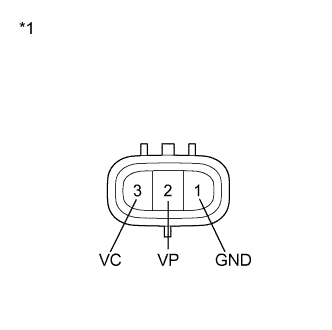
Text in Illustration *1 Component without harness connected
(Fuel Pressure Sensor)
Disconnect the fuel pressure sensor connector.
-
Measure the resistance according to the value(s) in the table below.
Standard Resistance Tester Connection Specified Condition 2 (VP) - 1 (GND) 16.4 kΩ or less 2 (VP) - 3 (VC) 3 kΩ or less -
Reconnect the fuel pressure sensor connector.
NG
REPLACE COMMON RAIL ASSEMBLY Click here
OK
-
-
INSPECT INSPECTION OR SUPPLY PUMP ASSEMBLY
-
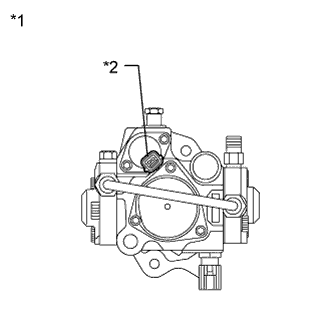
Text in Illustration *1 Component without harness connected
(Injection or Supply Pump Assembly)
*2 Suction Control Valve Disconnect the suction control valve connector.
-
Measure the resistance according to the value(s) in the table below.
Standard Resistance Tester Connection Condition Specified Condition 1 - 2 20°C (68°F) 1.9 to 2.3 Ω -
Reconnect the suction control valve connector.
NG
REPLACE INJECTION OR SUPPLY PUMP ASSEMBLY Click here
OK
-
-
READ VALUE USING INTELLIGENT TESTER (TARGET PUMP SCV CURRENT)
-
Replace the normal DLC3 cable (12 V specification) for the intelligent tester with the 24 V DLC3 cable.
Note
Be sure to use the 24 V DLC3 cable when connecting the intelligent tester to the DLC3. Using the normal DLC3 cable (12 V specification) will cause damage to the tester.
-
Connect the intelligent tester to the DLC3.
-
Start the engine.
-
Turn the tester on.
-
Enter the following menus: Powertrain / Engine and ECT / Data List / Target Pump SCV Current.
-
Read the value.
Standard Engine Speed Result Idling 800 to 1400 mA
NG
REPLACE INJECTION OR SUPPLY PUMP ASSEMBLY Click here
OK
REPAIR OR REPLACE COMMON RAIL ASSEMBLY (PRESSURE DISCHARGE VALVE)
-