ECD SYSTEM, Diagnostic DTC:P0045

| DTC Code | DTC Name |
|---|---|
| P0045 | Turbocharger / Supercharger Boost Control Solenoid Circuit / Open |
DESCRIPTION
The turbocharger system is comprised of the Variable Nozzle (VN) type turbocharger, the turbo motor driver and ECM.
The turbocharger sub-assembly has nozzle vanes which open and close to control the volume of the exhaust gas flowing into the turbine. This, in turn, controls the boost pressure. When the nozzle vanes move toward the closing direction, the pressure increases. When the vanes move toward the opening direction, the pressure decreases.
The turbocharger actuator mounted on the turbine side activates the nozzle vanes. The nozzle vane position sensor mounted on the actuator detects the opening angle of the nozzle vanes. The nozzle vane position sensor signal is sent via the turbo motor driver to the ECM. Then, based on the signal, the ECM actuates the actuator.
The ECM sends a target nozzle vane position signal to the turbo motor driver to obtain the nozzle vane position for the optimal boost pressure in accordance with the driving conditions.
| DTC No. | DTC Detection Condition | Trouble Area |
|---|---|---|
| P0045 | Send trouble signal in VN turbo controller for 0.3 seconds or more |
|
WIRING DIAGRAM
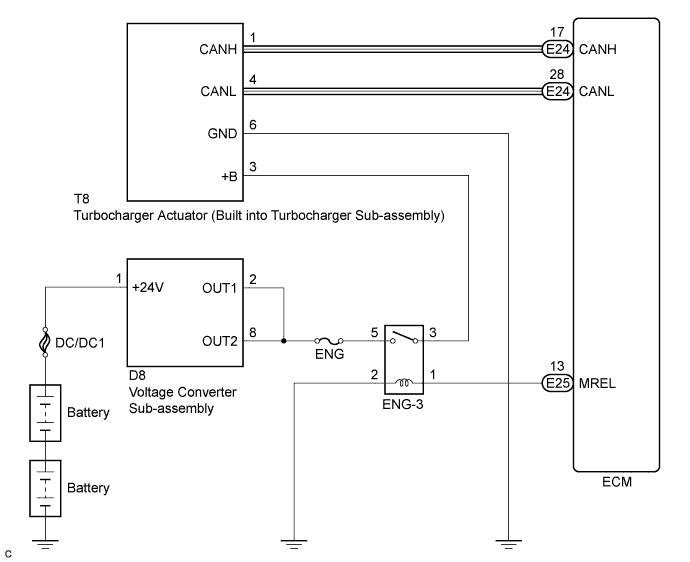
INSPECTION PROCEDURE
Note
-
After replacing the ECM, the new ECM needs registration Click here and initialization Click here.
-
Inspect the fuses for circuits related to this system before performing the following inspection procedure.
Tech Tips
Read freeze frame data using the intelligent tester. The ECM records vehicle and driving condition information as freeze frame data the moment a DTC is stored. When troubleshooting, freeze frame data can be helpful in determining whether the vehicle was moving or stationary, whether the engine was warmed up or not, as well as other data recorded at the time of a malfunction.
PROCEDURE
-
CHECK TURBOCHARGER SUB-ASSEMBLY (POWER SOURCE)
-
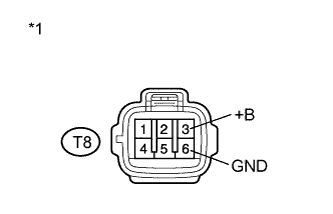
Text in Illustration *1 Front view of wire harness connector
(to Turbocharger Actuator)
Disconnect the turbocharger actuator connector.
-
Turn the ignition switch to ON.
-
Measure the voltage according to the value(s) in the table below.
Standard Voltage Tester Connection Switch Condition Specified Condition T8-3 (+B) - T8-6 (GND) Ignition switch ON 11 to 14 V
NG 
CHECK HARNESS OR CONNECTOR (TURBOCHARGER ACTUATOR - BODY GROUND) Click here
OK 
-
-
INSPECT TURBOCHARGER SUB-ASSEMBLY
-
Inspect the turbocharger sub-assembly Click here.
NG 
REPLACE TURBOCHARGER SUB-ASSEMBLY Click here
OK
-
-
REPLACE ECM
-
Replace the ECM Click here.
NEXT
-
-
CHECK WHETHER DTC OUTPUT RECURS
-
Replace the normal DLC3 cable (12 V specification) for the intelligent tester with the 24 V DLC3 cable.
Note
Be sure to use the 24 V DLC3 cable when connecting the intelligent tester to the DLC3. Using the normal DLC3 cable (12 V specification) will cause damage to the tester.
-
Connect the intelligent tester to the DLC3.
-
Turn the ignition switch to ON.
-
Turn the tester on.
-
Enter the following menus: Powertrain / Engine and ECT / DTC.
-
Read the DTCs.
Result Result Proceed to DTC is not output A DTC P0045 is output B
B
REPLACE TURBOCHARGER SUB-ASSEMBLY Click here
A 
END
-
-
CHECK HARNESS OR CONNECTOR (TURBOCHARGER ACTUATOR - BODY GROUND)
-
Disconnect the turbocharger actuator connector.
-
Measure the resistance according to the value(s) in the table below.
Standard Resistance Tester Connection Condition Specified Condition T8-6 (GND) - Body ground Always Below 1 Ω -
Reconnect the turbocharger actuator connector.
NG
REPAIR OR REPLACE HARNESS OR CONNECTOR (TURBOCHARGER ACTUATOR - BODY GROUND)
OK
REPAIR OR REPLACE HARNESS OR CONNECTOR (TURBOCHARGER ACTUATOR - ENG-3 RELAY)
-