ECD SYSTEM, Diagnostic DTC:P2002

| DTC Code | DTC Name |
|---|---|
| P2002 | Particulate Trap Efficiency Below Threshold (Bank1) |
DESCRIPTION
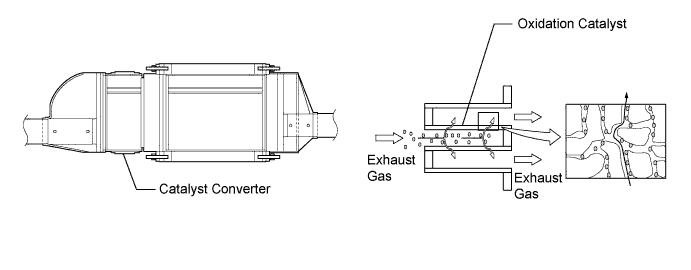
A DPF (Diesel Particulate Filter) catalyst is located in the exhaust pipe. A wall-flow type DPF catalyst, which filters all exhaust gas through ceramic walls with high heat resistance, is used to allow the exhaust gas to be organized by the catalyst when flowing through the porous ceramic structure, reducing PM (Particulate Matter) drastically.
| DTC No. | DTC Detection Condition | Trouble Area |
|---|---|---|
| P2002 |
|
|
INSPECTION PROCEDURE
Note
After replacing the ECM, the new ECM needs registration Click here and initialization Click here.
Tech Tips
-
Read freeze frame data using the intelligent tester. The ECM records vehicle and driving condition information as freeze frame data the moment a DTC is stored. When troubleshooting, freeze frame data can be helpful in determining whether the vehicle was running or stopped, whether the engine was warmed up or not, whether the air fuel ratio was lean or rich, as well as other data recorded at the time of a malfunction.
-
If the amount of accumulated PM exceeds the specified value, DTC P2002 is set and the system enters fail-safe mode, in which the system limits the engine power.
-
Check the amount of engine oil after troubleshooting is finished.
-
If the amount of engine oil is more than the specified level, replace the engine oil.
PROCEDURE
-
INSPECT DPR SWITCH
-
Use the table below to troubleshoot each problem symptom.
Result Condition Proceed to DPF switch light is not blinking A DPF switch light is blinking B
B 
READ VALUE USING INTELLIGENT TESTER (DIFFERENTIAL PRESSURE) Click here
A 
-
-
CHECK OTHER DTC OUTPUT
-
Replace the normal DLC3 cable (12 V specification) for the intelligent tester with the 24 V DLC3 cable.
Note
Be sure to use the 24 V DLC3 cable when connecting the intelligent tester to the DLC3. Using the normal DLC3 cable (12 V specification) will cause damage to the tester.
-
Connect the intelligent tester to the DLC3.
-
Turn the ignition switch to the ON position.
-
Turn the tester on.
-
Enter the following menu items: Powertrain / Engine and ECT / DTC.
-
Read the DTCs.
Result Display (DTC Output) Proceed to P2002 A P2002 and other DTCs B
B 
GO TO DTC CHART
A
-
-
READ VALUE USING FREEZE FRAME DATA (EXHAUST GAS TEMPERATURE)
-
Replace the normal DLC3 cable (12 V specification) for the intelligent tester with the 24 V DLC3 cable.
Note
Be sure to use the 24 V DLC3 cable when connecting the intelligent tester to the DLC3. Using the normal DLC3 cable (12 V specification) will cause damage to the tester.
-
Connect the intelligent tester to the DLC3.
-
Turn the ignition switch to the ON position.
-
Turn the tester on.
-
Enter the following menu items: Powertrain / Engine and ECT / DTC / P2002.
-
Read the value.
Result Item Exhaust Temperature Proceed to Initial Exhaust Temp (IN) 740°C (1,364°F) or less A Initial Exhaust Temp (OUT) 940°C (1,724°F) or less A Initial Exhaust Temp (IN) 740°C (1,364°F) or more B Initial Exhaust Temp (OUT) 940°C (1,724°F) or more C Tech Tips
When troubleshooting abnormal temperature detection by exhaust temperature sensor (upstream), check that the hose between the turbocharger and the intake manifold is connected properly.
B
GO TO ABNORMAL TEMPERATURE DETECTION BY EXHAUST TEMPERATURE SENSOR (DOWNSTREAM)
C
GO TO ABNORMAL TEMPERATURE DETECTION BY EXHAUST TEMPERATURE SENSOR (UPSTREAM)
A
-
-
READ VALUE USING FREEZE FRAME DATA (DIFFERENTIAL PRESSURE)
-
Replace the normal DLC3 cable (12 V specification) for the intelligent tester with the 24 V DLC3 cable.
Note
Be sure to use the 24 V DLC3 cable when connecting the intelligent tester to the DLC3. Using the normal DLC3 cable (12 V specification) will cause damage to the tester.
-
Connect the intelligent tester to the DLC3.
-
Turn the ignition switch to the ON position.
-
Turn the tester on.
-
Enter the following menu items: Powertrain / Engine and ECT / DTC / P2002.
-
Read the value.
Result Item Differential Pressure Proceed to DPF Differential Pressure 15 kPa or less A DPF Differential Pressure 15 kPa or more B
B
GO TO CLOGGING BY DPF CATALYTIC CONVERTER
A 
GO TO CLOGGING BY DPF CATALYTIC CONVERTER (GO TO STEP8)
-
-
READ VALUE USING INTELLIGENT TESTER (DIFFERENTIAL PRESSURE)
-
Warm up the engine.
-
Disconnect the negative battery terminal and wait for at least 1 minute.
-
Reconnect the negative battery terminal.
-
Initialize the learning value of the supply pump Click here.
Tech Tips
Perform initialization with the engine warmed up (engine coolant temperature is 60°C (140°F) or more and fuel temperature is 20°C (68°F) or more).
-
Initialize the learning value of the diesel throttle body Click here.
-
Allow the engine to idle for at least 5 minutes.
-
Replace the normal DLC3 cable (12 V specification) for the intelligent tester with the 24 V DLC3 cable.
Note
Be sure to use the 24 V DLC3 cable when connecting the intelligent tester to the DLC3. Using the normal DLC3 cable (12 V specification) will cause damage to the tester.
-
Connect the intelligent tester to the DLC3.
-
Turn the ignition switch to the ON position.
-
Turn the tester on.
-
Enter the following menu items: Powertrain / Engine and ECT / Data List / DPNR Differential Pressure.
Tech Tips
-
If the exhaust gas temperature is high, the differential pressure cannot be measured correctly.
-
If the differential pressure is outside the normal range, the monolithic converter assembly may have deteriorated or the monolithic converter assembly may be clogged with PM.
-
Fully depress the accelerator pedal and when the engine speed becomes stable, promptly read the differential pressure.
-
If DTC P2002 is stored, the engine speed cannot be raised to the high-speed range because the engine output limiting control is performed.
-
If DTC P2002 is stored, be sure to clear the DTCs.
Result Engine Speed (no engine load) Differential Pressure Proceed to 3,500 to 3,600 rpm (Exhaust gas temperature (up stream) is 200°C or less) 30 kPa or more A 3,500 to 3,600 rpm (Exhaust gas temperature (up stream) is 200°C or less) 30 kPa or less B -
B
READ VALUE USING INTELLIGENT TESTER (DIFFERENTIAL PRESSURE) Click here
A
-
-
CLEAN EXHAUST SYSTEM
-
Clean the catalytic converter and monolithic converter Click here.
NEXT
-
-
READ VALUE USING INTELLIGENT TESTER (DIFFERENTIAL PRESSURE)
-
Allow the engine to idle for at least 5 minutes.
-
Replace the normal DLC3 cable (12 V specification) for the intelligent tester with the 24 V DLC3 cable.
Note
Be sure to use the 24 V DLC3 cable when connecting the intelligent tester to the DLC3. Using the normal DLC3 cable (12 V specification) will cause damage to the tester.
-
Connect the intelligent tester to the DLC3.
-
Turn the ignition switch to the ON position.
-
Turn the tester on.
-
Enter the following menu items: Powertrain / Engine and ECT / Data List / DPNR Differential Pressure.
Tech Tips
-
If the exhaust gas temperature is high, the differential pressure cannot be measured correctly.
-
If the differential pressure is outside the normal range, the monolithic converter assembly may have deteriorated or the monolithic converter assembly may be clogged with PM.
-
Fully depress the accelerator pedal and when the engine speed becomes stable, promptly read the differential pressure.
Result Engine Speed (no engine load) Differential Pressure Proceed to 3,500 to 3,600 rpm (Exhaust gas temperature (up stream) is 200°C or less) 30 kPa or less A 3,500 to 3,600 rpm (Exhaust gas temperature (up stream) is 200°C or less) 30 kPa or more B -
B
REPLACE MONOLITHIC CONVERTER ASSEMBLY
A
-
-
READ VALUE USING INTELLIGENT TESTER (DIFFERENTIAL PRESSURE)
-
Perform the forcible regeneration function Click here.
-
After the forcible regeneration is completed, allow the engine to idle for at least 5 minutes.
-
Enter the following menu items: Powertrain / Engine and ECT / Data List / DPNR Differential Pressure.
-
Check the differential pressure when the exhaust gas temperature sensor indicates 200°C or less.
Tech Tips
-
If the exhaust gas temperature is high, the differential pressure cannot be measured correctly.
-
If the differential pressure is outside the normal range, the monolithic converter assembly may have deteriorated or the monolithic converter assembly may be clogged with PM.
-
Fully depress the accelerator pedal and when the engine speed becomes stable, promptly read the differential pressure.
Result Engine Speed (no engine load) Differential Pressure Proceed to 3,500 to 3,600 rpm (Exhaust gas temperature (up stream) is 200°C or less) 15 kPa or less A 3,500 to 3,600 rpm (Exhaust gas temperature (up stream) is 200°C or less) 15 kPa or more B -
B
REPLACE MONOLITHIC CONVERTER ASSEMBLY
A
END
-
-
READ VALUE USING INTELLIGENT TESTER (DIFFERENTIAL PRESSURE)
-
Perform the forcible regeneration function Click here.
-
After the forcible regeneration is completed, allow the engine to idle for at least 5 minutes.
-
Enter the following menu items: Powertrain / Engine and ECT / Data List / DPNR Differential Pressure.
-
Check the differential pressure when the exhaust gas temperature sensor indicates 200°C or less.
Tech Tips
-
If the exhaust gas temperature is high, the differential pressure cannot be measured correctly.
-
If the differential pressure is outside the normal range, the monolithic converter assembly may have deteriorated or the monolithic converter assembly may be clogged with PM.
-
Fully depress the accelerator pedal and when the engine speed becomes stable, promptly read the differential pressure.
Result Engine Speed (no engine load) Differential Pressure Proceed to 3,500 to 3,600 rpm (Exhaust gas temperature (up stream) is 200°C or less) 15 kPa or less A 3,500 to 3,600 rpm (Exhaust gas temperature (up stream) is 200°C or less) 15 kPa or more B -
B
REPLACE MONOLITHIC CONVERTER ASSEMBLY
A
END
-