CAN COMMUNICATION SYSTEM HOW TO PROCEED WITH TROUBLESHOOTING

-
IMPORTANT POINT CONCERNING TROUBLESHOOTING
CAUTION:
Wait at least 90 seconds after disconnecting the cable from the negative (-) battery terminal to disable the airbag system.
Note
-
Refer to the troubleshooting procedures of each system if DTCs regarding the CAN communication system are not output.
-
Before measuring the resistance, leave the vehicle for at least 1 minute and do not operate the ignition switch, any switches or any doors. If doors need to be opened in order to check connectors, open the doors and leave them open.
-
After turning the ignition switch off, waiting time may be required before disconnecting the cable from the battery terminal. Therefore, make sure to read the disconnecting the cable from the battery terminal notice before proceeding with work Click here.
-
When disconnecting the cable, some systems need to be initialized after the cable is reconnected Click here.
Tech Tips
-
Operating the ignition switch, any switches or any doors triggers related ECU and sensor communication with the CAN, which causes resistance variation.
-
*: Use the intelligent tester.
-
DTCs indicating a CAN communication malfunction are also stored due to internal or power source-related problems in ECUs or sensors of systems using CAN communication. Therefore, check whether codes indicating internal or power source-related problems in those systems are output together with the CAN communication DTCs.
-
It is possible to inspect the circuit of the DLC3 CAN branch wire or V bus main line for malfunctions by inspecting the terminals of the DLC3 using SST.
Note
It is only possible to inspect CAN branch wires to ECUs (sensors) or the V bus from the DLC3.
-
It is possible to check which ECUs (sensors) are not able to communicate via CAN communication by checking the "Bus Check" function of the intelligent tester (when the DLC3 CAN branch wire and V bus CAN main wire are normal).
Tech Tips
-
When checking "Bus Check", ECUs (sensors) whose CAN branch wire is open or that cannot communicate via CAN communication do not respond to the intelligent tester (they are not displayed on the screen).
-
When checking "Bus Check", if a DTC indicating a CAN communication malfunction is output even though all ECUs (sensors) respond (they are displayed on the screen), use the DTC combination table to determine the suspected trouble area and perform symptom simulation.
-
-
For past malfunctions of the V bus, the ECUs (sensors) which cannot communicate via CAN communication can be determined from the combination of CAN communication DTCs that are output.
-
The electric vehicle control ECU assembly detects malfunctions in the control bus circuit and stores DTCs depending on the malfunctioning areas. The ECUs (sensors) which cannot communicate via CAN communication can be determined from the combination of CAN communication DTCs that are output.
-
The ECM detects malfunctions in the sub bus circuit and stores DTCs depending on the malfunctioning areas. The ECUs (sensors) which cannot communicate via CAN communication can be determined from the combination of CAN communication DTCs that are output.
-
When an open circuit malfunction is confirmed, before disconnecting the connectors for inspection, check whether the connectors are loose by pushing in the connector case.
-
When a connector is disconnected, check if the connector terminals or case is damaged, deformed, deteriorated, etc.
-
VEHICLE BROUGHT TO WORKSHOP
NEXT 
-
INSPECT BATTERY VOLTAGE
Standard voltage 20 to 28 V If the voltage is below 20 V, recharge or replace the battery before proceeding.
NEXT
-
CHECK FOR DTC*
-
Using the intelligent tester, check for all DTCs.
Note
-
If codes indicating internal or power source-related malfunctions of ECUs or sensors are output together with codes indicating that those ECUs or sensors cannot communicate via CAN communication, it is likely that the problem is not in the CAN communication line. Therefore, perform troubleshooting for the DTCs related to the malfunctioning parts first.
-
If a connector of a system which includes a CAN communication line is disconnected when the ignition switch ON or ACC, CAN communication DTCs will be stored by that system and any related systems.
NEXT
-
-
-
CHECK INSTALLED SYSTEMS (ECUS AND SENSORS) THAT USE CAN COMMUNICATION
-
Based on the vehicle equipment and specifications, confirm the systems that use CAN communication Click here.
NEXT
-
-
CHECK FOR OPEN CIRCUIT IN DLC3 CAN BRANCH WIRE AND V BUS CIRCUIT CAN MAIN WIRE AND CHECK FOR SHORT CIRCUIT (CANH - CANL)
-
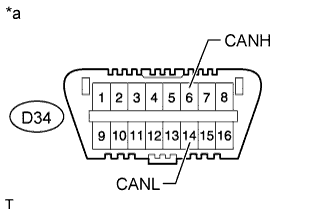
Text in Illustration *a Front view of DLC3 Disconnect the cable from the negative (-) battery terminal before measuring the resistances of the CAN main wire and CAN branch wire.
-
Measure the resistance according to the value(s) in the table below.
Standard Resistance Tester Connection Switch Condition Specified Condition Proceed to D34-6 (CANH) - D34-14 (CANL) Ignition switch off OK (54 to 69 Ω) A D34-6 (CANH) - D34-14 (CANL) Ignition switch off NG (Higher than 70 Ω) B D34-6 (CANH) - D34-14 (CANL) Ignition switch off NG (Below 53 Ω) C
B 
Go to "Open in CAN Main Wire" Click here
C
Go to "Short in CAN Bus Lines" Click here
A
-
-
CHECK FOR SHORT TO B+ IN CAN V BUS (CANH, CANL - BAT)
-
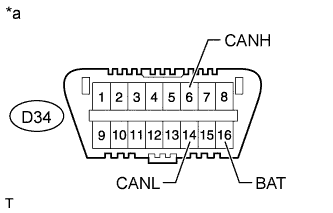
Text in Illustration *a Front view of DLC3 Measure the resistance according to the value(s) in the table below.
Standard Resistance Tester Connection Switch Condition Specified Condition D34-6 (CANH) - D34-16 (BAT) Ignition switch off 6 kΩ or higher D34-14 (CANL) - D34-16 (BAT) Ignition switch off 6 kΩ or higher
NG
Go to "Short to B+ in CAN Bus Line" Click here
OK
-
-
CHECK FOR SHORT TO GND IN CAN V BUS (CANH, CANL - CG)
-
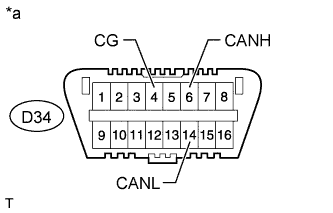
Text in Illustration *a Front view of DLC3 Measure the resistance according to the value(s) in the table below.
Standard Resistance Tester Connection Switch Condition Specified Condition D34-6 (CANH) - D34-4 (CG) Ignition switch off 200 Ω or higher D34-14 (CANL) - D34-4 (CG) Ignition switch off 200 Ω or higher
NG
Go to "Short to GND in CAN Bus Line" Click here
OK
-
-
CHECK ECUS CONNECTED TO CAN BUS*
-
Connect the cable to the negative (-) battery terminal.
Note
When disconnecting the cable, some systems need to be initialized after the cable is reconnected Click here.
-
Select "Bus Check" from "System Select" Click here.
-
Check the display of the connected ECUs and sensors for a minute.
Result Result Proceed to All ECUs and sensors connected to CAN communication system are displayed on screen (CAN bus circuit currently normal) A Except for electric vehicle control ECU assembly, no ECUs connected to control bus are displayed (control bus CAN main wire open or short malfunction) B No ECUs connected to control bus are displayed (CAN branch wire between electric vehicle control ECU assembly and control bus circuit is open) C Single ECU or sensor that should be connected to CAN communication is not displayed (ECU or sensor CAN branch wire open or communication stop) D ECU or sensor that should be connected to CAN communication is not displayed or display is intermittent during check (ECU or sensor CAN branch wire open on one side) E Note
ECUs and sensors that are not present will not be displayed. Be careful not to mistake them for communication stop malfunctions.
Tech Tips
-
If the display of an ECU is intermittent during the check, one side of an ECU or sensor CAN branch wire is open (the signal of the ECU is treated as noise, which affects the response and display of the intelligent tester).
-
The electric vehicle control ECU assembly checks for proper ECU communication for ECUs that are connected to the control bus and the results are displayed on the intelligent tester. ECUs that stop communicating with the electric vehicle control ECU assembly for 3 seconds or more will stop being displayed on the intelligent tester.
-
The electric vehicle control ECU assembly may be malfunctioning if both of the following occur: 1) all ECUs connected to the control bus are not displayed on the intelligent tester; and 2) DTC U0105/23 (Lost Communication With Fuel Injector Control Module) is not output.
B
Go to "DTC U0105/23" Click here
C
Go to "Electric Vehicle Control ECU Communication Stop Mode" Click here
D
Go to "PROBLEM SYMPTOMS TABLE" Click here
E
Go to "Open in One Side of CAN Branch Line" Click here
A
-
-
-
CHECK COMMUNICATION MALFUNCTION DTC (PAST DTC CHECK)*
-
Select "Bus Check" from "System Select" Click here.
-
Write down all of the DTCs stored in each ECU.
Tech Tips
-
If there are communication malfunction DTCs output but the intelligent tester "Bus Check - Communication Bus Check" screen displays all of the ECUs and sensors connected to the CAN system, the communication malfunction DTCs may be past malfunctions that are no longer present.
-
For V bus CAN main wire malfunctions, DTCs for related ECUs are also output. Therefore, determine the malfunctioning area based on all of the DTCs that are output.
-
For control bus malfunctions, DTCs are stored based on the detection of communication stop malfunctions and network malfunctions of ECUs that are connected by the electric vehicle control ECU assembly.
-
For sub bus malfunctions, DTCs are stored based on the detection of communication stop malfunctions and network malfunctions of ECUs that are connected by the ECM.
Result Result Proceed to ECU connected to V bus outputs communication trouble code A Electric vehicle control ECU assembly outputs network malfunction trouble code (U0105/23) (control bus CAN main wire past malfunction) B ECM outputs network malfunction trouble code (U1122, U1123) (sub bus) C Electric vehicle control ECU assembly outputs trouble code other than network malfunction trouble code (U0105/23) (past malfunction of ECU or CAN branch wire connected to control bus) D ECM outputs trouble code other than the network malfunction trouble code (past malfunction of ECU or CAN branch wire connected to sub bus) D
B
Go to "DTC U0105/23" Click here
C
Go to "Check Sub Bus Wire Harness" Click here
D
Go to "DIAGNOSTIC TROUBLE CODE CHART" Click here
A
-
-
-
CHECK DTC COMBINATION TABLE (V BUS CAN BRANCH WIRE OPEN, PAST COMMUNICATION STOP MALFUNCTION)
-
Based on the combination of output CAN communication system DTCs, determine which ECUs and sensors have a communication stop malfunction Click here.
NEXT
-
-
PERFORM MALFUNCTION SIMULATION TEST (V BUS CIRCUIT CAN MAIN WIRE PAST MALFUNCTION)*
-
Using the intelligent tester, clear all DTCs.
-
Perform a malfunction simulation test on all harnesses and connectors related to the V bus CAN main wire.
-
Check the DTCs that were output as a result of the malfunction simulation test. Then determine the malfunctioning area.
NEXT
-
-
ADJUST, REPAIR AND REPLACE
NEXT
-
CLEAR DTC*
-
Using the intelligent tester, clear all DTCs.
NEXT
-
-
CONFIRMATION TEST
NEXT
END
-