VOLTAGE CONVERTER SYSTEM PRECAUTION

-
REMOVAL AND INSTALLATION OF THE BATTERY TERMINAL
-
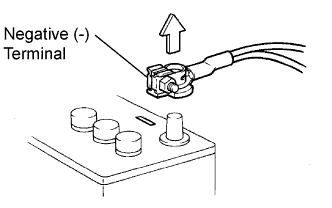
Before performing electrical work, disconnect the battery negative (-) terminal in order to prevent a short in the system.
-
When disconnecting and reconnecting the battery cable, turn the ignition switch and lighting switches off and loosen the terminal nut completely. Perform this operation without prying on the terminal.
-
-
PRECAUTION FOR VOLTAGE CONVERTER SYSTEM
-
The DC/DC CONV warning light comes on to inform the driver that the system has a malfunction.
Even if the DC/DC CONV warning light comes on, the vehicle can be operated normally, but the voltage converter system needs to be repaired.
-
When performing electrical work, do not expose the DC/DC converter connection to water, as it is not a waterproof connection.
-
The output voltage capacity is designed for the ECD system. Therefore, if another system uses the DC/DC converter, the DC/DC converter may be stopped due to lack of voltage.
-
Do not cover the DC/DC converter.
-
If the ECD system has a malfunction, check the DC/DC converter first.
-
The DC/DC converter does not have diagnostic trouble code outputs or diagnostic memory functions.
-
When the DC/DC converter operates normally, the DC/DC converter outputs voltage for 30 seconds after turning the ignition switch off. If turning the ignition switch to the ON position again within 30 seconds after turning the ignition switch off, the DC/DC CONV warning light comes on for 1 second, then goes off.
During the above condition, the DC/DC converter continues to output the voltage from terminal No. 2.
-
Do not damage the DC/DC converter in order not to break the inside of DC/DC converter.
-
Do not move the voltage converter because the DC/DC converter has a case ground.
-
Before performing electrical work, disconnect the battery negative (-) terminal.
Note
If the battery negative (-) terminal is connected while connecting the DC/DC converter terminal, it may damage the voltage converter.
-
Use new bolts when reinstalling the DC/DC converter.
-