AIRBAG SYSTEM DIAGNOSIS SYSTEM

-
SYMPTOM SIMULATION
Tech Tips
The most difficult case in troubleshooting is when no problem symptoms occur. In such a case, a thorough problem analysis must be carried out. A simulation of the same or similar conditions and environment in which the problem occurred in the customer's vehicle should be carried out. No matter how much skill or experience a technician has, troubleshooting without confirming the problem symptoms will lead to important repairs being overlooked and mistakes or delays.
-
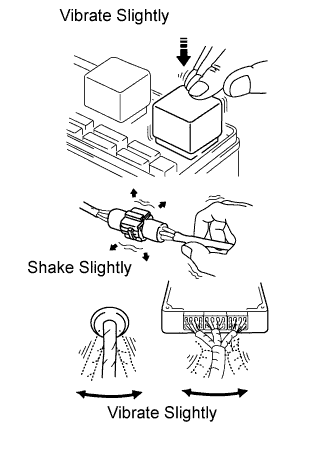
Vibration method: When vibration seems to be the major cause.
Tech Tips
Perform the simulation method only during the primary check period (for approximately 6 seconds after the ignition switch is turned to ON).
-
Slightly vibrate the part of the sensor considered to be the cause of the problem with your fingers and check whether the malfunction occurs.
Note
Shaking the relays too strongly may result in open relays.
-
Slightly shake the connector vertically and horizontally.
-
Slightly shake the wire harness vertically and horizontally.
Tech Tips
The connector joint and fulcrum of the vibration are the major areas to be checked thoroughly.
-
-
-
FUNCTION OF SRS WARNING LIGHT
-
Primary check.
-
Turn the ignition switch off. Wait at least 2 seconds, and then turn the ignition switch to ON. The SRS warning light comes on for approximately 6 seconds and diagnosis of the airbag system is performed.
Tech Tips
If trouble is detected during the primary check, the SRS warning light remains on even after the primary check period (of approximately 6 seconds) has elapsed.
-
-
Constant check.
-
After the primary check, the airbag ECU assembly constantly monitors the airbag system for trouble.
Tech Tips
If trouble is detected during the constant check, the airbag ECU assembly functions as follows:
-
The SRS warning light comes on.
-
The SRS warning light goes off, and then comes on. This pattern indicates a source voltage drop. The SRS warning light goes off 10 seconds after the source voltage returns to normal.
-
-
-
Review.
-
When the airbag system is normal:
The SRS warning light comes on only during the primary check period (for approximately 6 seconds after the ignition switch is turned to ON).
-
When the airbag system has trouble:
-
The SRS warning light remains on even after the primary check period has elapsed.
-
The SRS warning light goes off after the primary check, but comes on again during the constant check.
-
The SRS warning light does not come on when turning the ignition switch from off to ON.
-
The SRS warning light blinks after the primary check period has elapsed.
Tech Tips
The airbag ECU assembly functions to keep the SRS warning blinks on if the airbag has been deployed.
-
-
-
-
CHECK SRS WARNING LIGHT
-
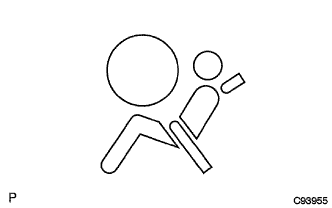
Turn the ignition switch to ON and check that the SRS warning light comes on for approximately 6 seconds (primary check).
-
Check that the SRS warning light goes off approximately 6 seconds after the ignition switch is turned to ON (constant check).
Tech Tips
When any of the following symptoms occur, refer to the "Problem Symptoms Table" Click here.
-
The SRS warning light comes on occasionally after the primary check period has elapsed.
-
The SRS warning light comes on, but a DTC is not output.
-
The ignition switch is turned from off to ON, but the SRS warning light does not come on.
-
The SRS warning light blinks after the primary check period has elapsed.
-
-
-
FUNCTION OF SRS CONNECTORS
-
SRS connectors are located as shown in the illustration.
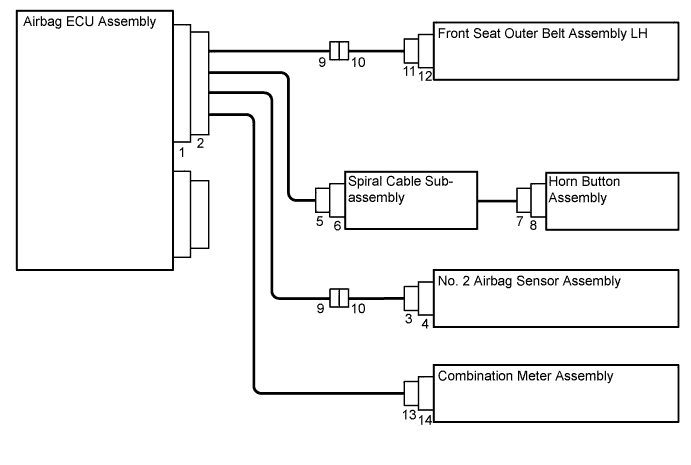
Connector Type Application Terminal Twin-Lock Mechanism Connectors 2, 4, 5, 9, 10 Half Connection Prevention Mechanism Connectors 6, 10 Connector Position Assurance Mechanism Connector 2, 3 Activation Prevention Mechanism Connectors 2, 6 Connector Lock Mechanism (1) Connectors 11 -
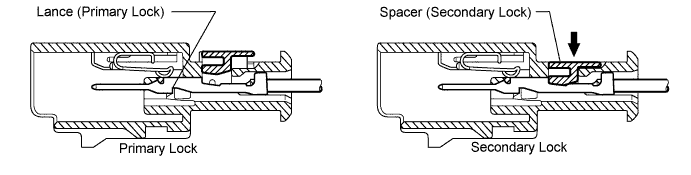
Terminal twin-lock mechanism
-
This mechanism is designed to increase the ability of the terminal to remain connected and prevents it from accidentally being disconnected.
-
The connector has a two-piece construction consisting of the housing and spacer to securely lock the terminal using both the lance (primary lock) and spacer (secondary lock).
-
-
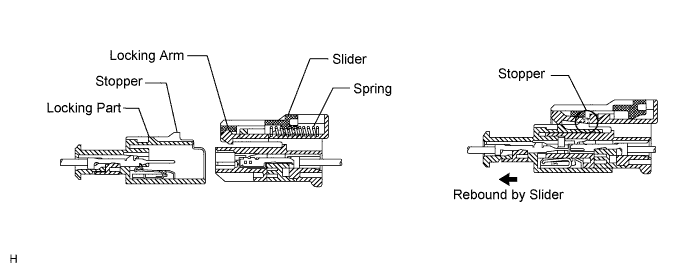
Half connection prevention mechanism
-
This mechanism is designed to prevent the connector from being connected only halfway.
-
If the connector is not completely connected, the connector is disconnected by the force of the spring so that no continuity exists.
-
-
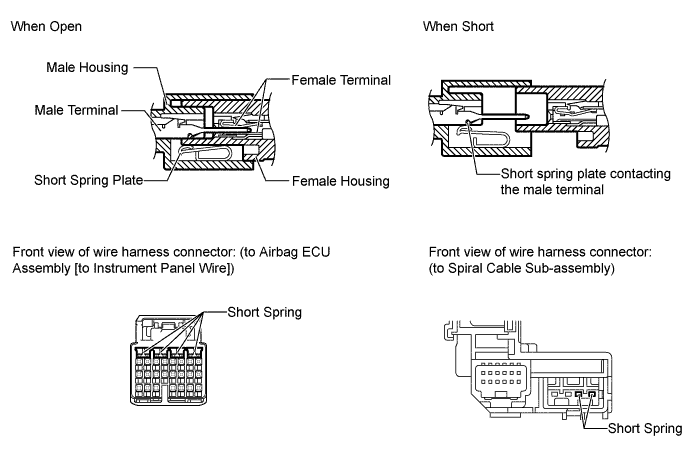
Activation prevention mechanism
-
The activation prevention mechanism is designed to create a short circuit automatically between the positive (+) and negative (-) terminals of an airbag power source connector when disconnected.
-
The short spring plate contained in the connector creates a closed circuit on the airbag side (no potential difference can occur between both terminals), preventing accidental airbag deployment when servicing.
-
-
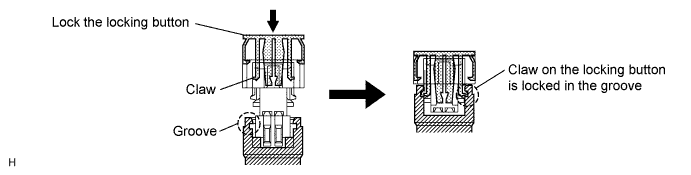
Connector lock mechanism (1)
-
This mechanism is designed to prevent the connector from accidentally being disconnected.
-
Locking the connector locking button engages the locking button claw in the groove of the other connector to connect the connector securely.
-
-
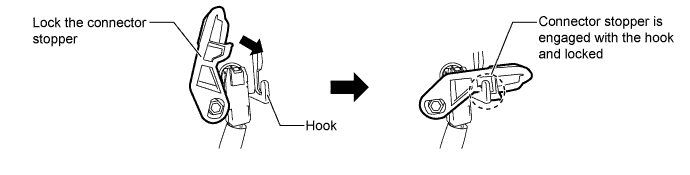
Connector lock mechanism (1) (for Standard Body)
-
This mechanism is designed to prevent the connector from accidentally being disconnected.
-
Locking the connector stopper engages the connector stopper in the groove of the hook to connect the connector securely.
-
-
-
ACTIVATION PREVENTION MECHANISM
-
Function of activation prevention mechanism
-
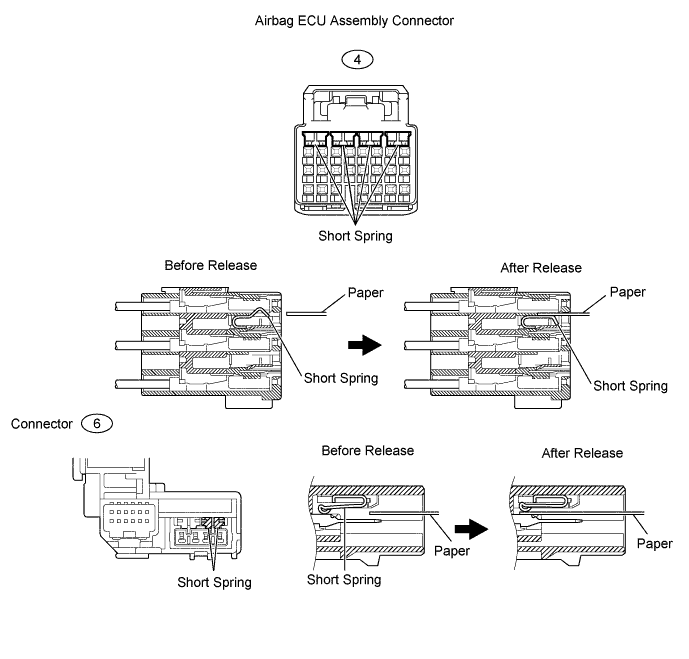
An activation prevention mechanism is built into the connector (on the airbag ECU assembly side) of the airbag system squib circuit to prevent accidental airbag activation.
-
This mechanism closes the circuit when the connector is disconnected by bringing the short spring into contact with the terminals and insulating the circuit from external power sources to prevent accidental airbag activation.
-
-
Releasing of activation prevention mechanism
-
To release the activation prevention mechanism, insert a piece of paper with the same thickness as the male terminal (approximately 0.5 mm [0.0197 in.]) between the terminals and short spring to break the connection.
-
Refer to the following illustrations concerning connectors utilizing the activation prevention mechanism and its release method.
CAUTION:
Never release the activation prevention mechanism on the squib connector even when inspecting with the squib disconnected.
Note
-
Do not release the activation prevention mechanism unless specially directed by the troubleshooting procedure.
-
To prevent the terminal and short spring from being damaged, always use a piece of paper with the same thickness as the male terminal.
-
-
-