VANE PUMP INSTALLATION

-
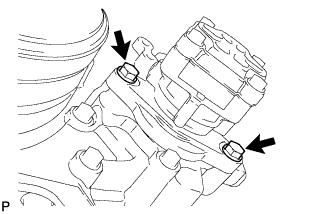
INSTALL VANE PUMP ASSEMBLY
-
Install the O-ring to the vane pump assembly.
Note
Install the O-ring securely until it touches the bottom of the groove.
-
Install the vane pump assembly with the 2 bolts.
- Torque:
- 47 N*m { 480 kgf*cm, 35 ft.*lbf }
Note
-
There should be no clearance between the vane pump assembly and engine case.
-
Be careful not to allow the O-ring to get caught between the parts.
-
-
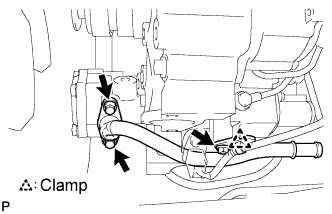
INSTALL POWER STEERING SUCTION PORT UNION
-
Coat a new O-ring with power steering fluid and install it to the power steering suction port union.
-
Install the power steering suction port union to the vane pump assembly and setting plate with the 3 bolts.
- Torque:
- 29 N*m { 290 kgf*cm, 21 ft.*lbf }
-
Install the sensor harness clamp to the power steering suction port union.
Note
Do not twist the sensor harness.
-
-
CONNECT NO. 2 OIL RESERVOIR TO PUMP HOSE
-
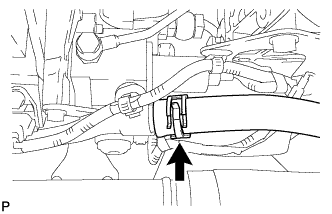
Connect the No. 2 oil reservoir to pump hose to the power steering suction port union with the clip.
-
-
INSTALL OIL PUMP TO GEAR BOX TUBE
-
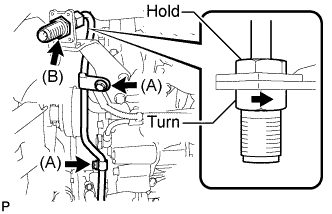
Install the oil pump to gear box tube to the timing gear case and No. 1 hose support bracket with 2 bolts (A).
- Torque:
- 18 N*m { 180 kgf*cm, 13 ft.*lbf }
-
Install the oil pump to gear box tube to the No. 1 hose support bracket with nut (B).
- Torque:
- 44 N*m { 440 kgf*cm, 32 ft.*lbf }
-
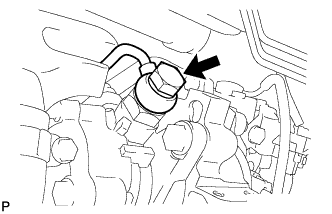
Install the oil pump to gear box tube to the vane pump with a new gasket and the union bolt.
- Torque:
- 49 N*m { 490 kgf*cm, 36 ft.*lbf }
-
-
CONNECT PRESSURE FEED HOSE
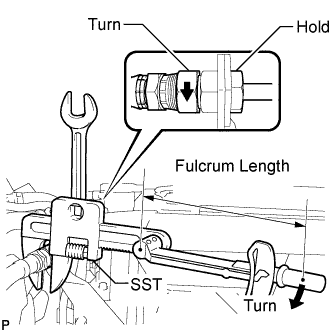
-
Using a wrench, secure the oil pump to gear box tube.
-
Using SST, connect the pressure feed hose to the oil pump to gear box tube.
- SST
- 09922-10010
- Torque:
- Without SST
- 44 N*m { 440 kgf*cm, 32 ft.*lbf }
- with SST
- 30 N*m { 300 kgf*cm, 22 ft.*lbf }
Note
-
Use a torque wrench with a fulcrum length of 300 mm (11.81 in.).
-
This torque value is effective when SST is parallel to the torque wrench.
-
-
INSTALL RADIATOR PIPE WITH RADIATOR HOSE OUTLET
-
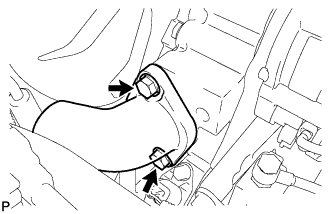
Install a new O-ring in the groove of the radiator pipe.
Note
Install the O-ring securely until it touches the bottom of the groove.
-
Install the radiator pipe with radiator hose outlet to the timing gear case with the 2 bolts.
- Torque:
- 18 N*m { 180 kgf*cm, 13 ft.*lbf }
Note
-
Make sure that the installation surface is free from dust or foreign matter.
-
Be careful not to allow the O-ring to get caught between the parts.
-
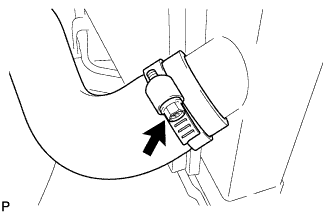
Connect the radiator outlet hose to the radiator.
-
Tighten the clamp.
- Torque:
- 3.5 N*m { 35 kgf*cm, 31 in.*lbf }
-
-
ADD POWER STEERING FLUID
-
ADD ENGINE COOLANT
-
BLEED POWER STEERING SYSTEM
-
Check the fluid level Click here.
-
Jack up the front of the vehicle and support it with stands.
-
Turn the steering wheel.
-
With the engine stopped, turn the steering wheel slowly from lock to lock several times.
-
-
Lower the vehicle.
-
Start the engine.
-
Run the engine at idle for a few minutes.
-
-
Turn the steering wheel.
-
With the engine idling, turn the steering wheel left or right to the full lock position and keep it in that position for 2 to 3 seconds, then turn the steering wheel to the opposite full lock position and keep it there for 2 to 3 seconds (*1).
-
Repeat this procedure (*1) several times.
-
-
Stop the engine.
-
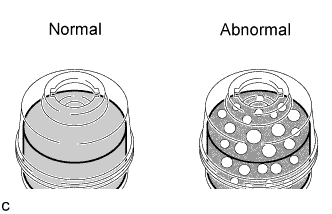
Check for foaming or emulsification.
Tech Tips
If the system has to be bled twice because of forming or emulsification, be sure to check for fluid leaks in the system.
-
Check the fluid level Click here.
-
-
INSPECT FOR COOLANT LEAK
-
INSPECT FOR POWER STEERING FLUID LEAK
-
CHECK POWER STEERING FLUID LEVEL
-
Keep the vehicle level.
-
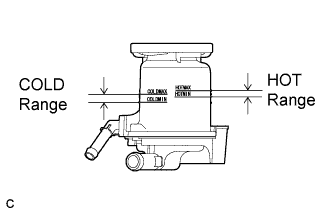
With the engine stopped, check the fluid level in the fluid reservoir.
If necessary, add fluid.
Fluid ATF DEXRON II or III, or equivalent. Tech Tips
If the fluid is hot, check that the fluid level is within the HOT range on the fluid reservoir. If the fluid is cold, check that the fluid level is within the COLD range.
-
Start the engine and run it at idle.
-
Turn the steering wheel from lock to lock several times to raise fluid temperature.
Fluid temperature 50 to 60°C (122 to 140°F) -
Check for foaming or emulsification.
If foaming or emulsification is identified, bleed the power steering system Click here.
-
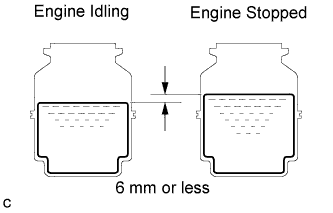
With the engine idling, measure the fluid level in the fluid reservoir.
-
Stop the engine.
-
Wait a few minutes and remeasure the fluid level in the fluid reservoir.
Maximum fluid level rise 6 mm (0.24 in.) If any problem is found, bleed the power steering system Click here.
-
Check the fluid level.
-
-
CHECK COOLANT LEVEL OF RESERVOIR