FRONT BRAKE INSPECTION

-
INSPECT BRAKE CYLINDER AND PISTON
-
Check the cylinder bore and piston for rust or scoring.
If necessary, replace the piston or the disc brake cylinder assembly.
-
-
INSPECT PAD LINING THICKNESS
-
Using a ruler, measure the pad lining thickness.
Standard thickness 13.0 mm (0.512 in.) Minimum thickness 1.0 mm (0.039 in.) If the pad lining thickness is equal to the minimum thickness or less, replace the brake pads.
-
-
INSPECT NO. 1 FRONT DISC BRAKE PAD SUPPORT PLATE
-
Make sure that the No. 1 front disc brake pad support plate has sufficient rebound, has no deformation, cracks or wear, and that all rust and dirt are cleaned off.
If necessary, replace the No. 1 front disc brake pad support plate.
-
-
INSPECT NO. 2 FRONT DISC BRAKE PAD SUPPORT PLATE
-
Make sure that the No. 2 front disc brake pad support plate has sufficient rebound, has no deformation, cracks or wear, and that all rust and dirt are cleaned off.
If necessary, replace the No. 2 front disc brake pad support plate.
-
-
INSPECT DISC THICKNESS
-
Using a micrometer, measure the disc thickness.
Standard thickness 40.0 mm (1.575 in.) Minimum thickness 38.0 mm (1.496 in.) If the disc thickness is less than the minimum, replace the front disc.
-
-
INSPECT DISC RUNOUT
-
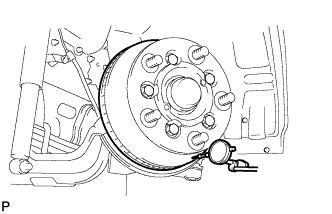
Using a dial indicator, measure the disc runout 10 mm (0.39 in.) away from the outer edge of the disc.
Maximum disc runout 0.1 mm (0.0039 in.) Tech Tips
If the runout exceeds the maximum value, change the installation positions of the disc and axle so that the runout will become minimal. If the runout exceeds the maximum even when the installation positions are changed, check the bearing play in the axial direction and the axle hub runout. If the bearing play and the axle hub runout are normal and if the disc thickness is not within the specified range, shave the disc. If the disc thickness is less than the minimum, replace the disc.
-