ANTI-LOCK BRAKE SYSTEM, Diagnostic DTC:C1271, C1272, C1401, C1402

| DTC Code | DTC Name |
|---|---|
| C1271 | Low Output Signal of Front Speed Sensor RH (Test Mode DTC) |
| C1272 | Low Output Signal of Front Speed Sensor LH (Test Mode DTC) |
| C1401 | Front Speed Sensor RH Malfunction |
| C1402 | Front Speed Sensor LH Malfunction |
DESCRIPTION
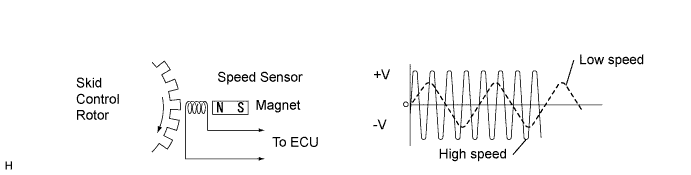
The speed sensors detect wheel speed and transmit the signals to the ECU. These signals are used for control of the ABS control system. Each of the skid control rotor has 48 serrations. When the rotors rotate, the magnetic field generated by the permanent magnet in the speed sensor induces an AC voltage.
Since the frequency of this AC voltage changes in direct proportion to the speed of the skid control rotor, the frequency is used by the ECU to detect the speed of each wheel.
| DTC No. | DTC Detection Condition | Trouble Area |
|---|---|---|
| C1401 C1402 |
When any of following conditions detected:
|
|
| C1271 C1272 |
Detected only during Test Mode. |
|
Tech Tips
-
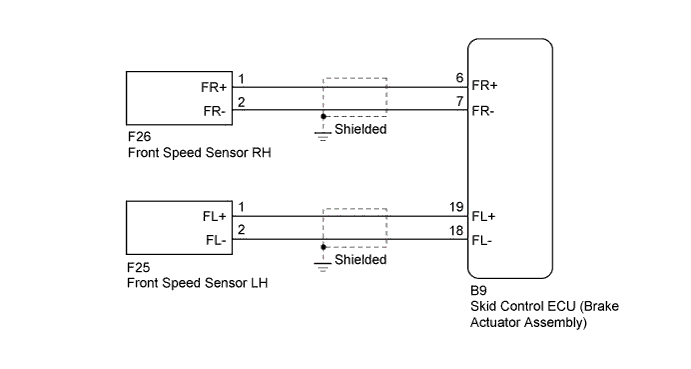
DTC C1401 and C1271 are for the front speed sensor RH.
-
DTC C1402 and C1272 are for the front speed sensor LH.
WIRING DIAGRAM
INSPECTION PROCEDURE
Note
Check the speed sensor signal after cleaning or replacement Click here.
PROCEDURE
-
READ VALUE USING INTELLIGENT TESTER (FRONT SPEED SENSOR)
-
Warm up the engine.
-
Turn the ignition switch off.
-
Replace the normal DLC3 cable (12 V specification) for the intelligent tester with the 24 V DLC3 cable.
Note
Be sure to use the 24 V DLC3 cable when connecting the intelligent tester to the DLC3. Using the normal DLC3 cable (12 V specification) will cause damage to the tester.
-
Connect the intelligent tester to the DLC3.
-
Turn the ignition switch to ON.
-
Turn the intelligent tester on.
-
Enter the following menus: Chassis / ABS/VSC/TRC / Data List.
-
According to the display on the intelligent tester, read the Data List.
ABS/VSC/TRC Tester Display Measurement Item/Range Normal Condition Diagnostic Note FR Wheel Speed FR wheel speed sensor reading / Min.: 0 km/h (0 mph), Max.: 326 km/h (202 mph) Vehicle stopped:
0 km/h
When driving at constant speed: No large fluctuations FL Wheel Speed FL wheel speed sensor reading /Min.: 0 km/h (0 mph), Max.: 326 km/h (202 mph) Vehicle stopped:
0 km/h
When driving at constant speed: No large fluctuations -
Check that there is no difference between the speed value output from the speed sensor displayed on the intelligent tester and the speed value displayed on the speedometer when driving the vehicle.
Tech Tips
Factors that affect the indicated vehicle speed include tire size, tire inflation, and tire wear. The speed indicated on the speedometer has an allowable margin of error. This can be tested using a speedometer tester (calibrated chassis dynamometer). For details about testing and the margin of error, see the reference chart.
OK The speed value output from the speed sensor displayed on the intelligent tester is the same as the actual vehicle speed measured using a speedometer tester (calibrated chassis dynamometer).
NG 
CHECK FRONT SPEED SENSOR INSTALLATION Click here
OK 
-
-
PERFORM TEST MODE INSPECTION (SIGNAL CHECK)
-
Perform the sensor check in the Test Mode procedure Click here.
OK All Test Mode DTCs are cleared.
NG
CHECK FRONT SPEED SENSOR INSTALLATION Click here
OK
-
-
CHECK SPEED SENSOR AND SKID CONTROL ROTOR SERRATIONS
-
Turn the ignition switch off.
-
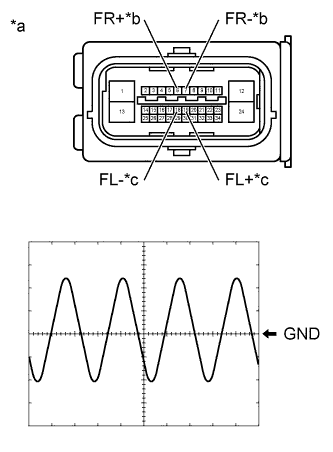
Text in Illustration *a Front view of wire harness connector
(to Skid Control ECU (Brake Actuator Assembly))
*b RH *c LH Disconnect the B9 skid control ECU (brake actuator assembly) connector.
-
Check that a waveform is output by each sensor circuit when the tires are rotated.
OK The same waveform is output from all the 4 wheels and there is no noise or interference in the waveform. Tech Tips
-
As the vehicle speed (wheel revolution speed) increases, a cycle of the waveform narrows and the output voltage becomes greater.
-
When noise is identified in the waveform on the oscilloscope, the erratic signals are generated due to speed sensor rotor's scratches, looseness or foreign matter attached to it.
Front Speed Sensor RH wheel speed signal (reference) Terminal Names B9-6 (FR+) - B9-7 (FR-) Tester Ranges 1 V/DIV, 2 ms/DIV Conditions wheel speed approximately 30 km/h Front Speed Sensor LH wheel speed signal (reference) Terminal Names B9-19 (FL+) - B9-18 (FL-) Tester Ranges 1 V/DIV, 2 ms/DIV Conditions wheel speed approximately 30 km/h -
-
Reconnect the D30 skid control ECU (brake actuator assembly) connector.
NG
INSPECT FRONT SPEED SENSOR TIP Click here
OK 
USE SIMULATION METHOD TO CHECK Click here
-
-
CHECK FRONT SPEED SENSOR INSTALLATION
-
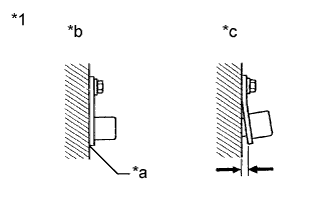
Text in Illustration *1 Front Speed Sensor *a No clearance *b OK *c NG Check the front speed sensor installation.
OK There is no clearance between the front speed sensor and the front steering knuckle.
NG 
INSTALL FRONT SPEED SENSOR CORRECTLY Click here
OK
-
-
INSPECT FRONT SPEED SENSOR
-
Remove the front speed sensor.
-
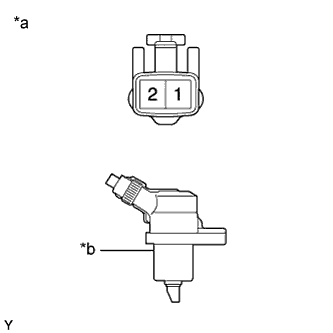
Text in Illustration *a Component without harness connected
(Front Speed Sensor)
*b Sensor Housing Measure the resistance according to the value(s) in the table below.
Standard resistance Tester Connection Condition Specified Condition 1 - 2 20°C (68°F) 0.9 to 1.3 kΩ 1 - Sensor housing Always 10 MΩ or higher 2 - Sensor housing Always 10 MΩ or higher -
Reinstall the front speed sensor.
NG
REPLACE FRONT SPEED SENSOR Click here
OK
-
-
CHECK HARNESS AND CONNECTOR (BRAKE ACTUATOR ASSEMBLY - FRONT SPEED SENSOR)
-
Turn the ignition switch off.
-
Disconnect the B9 skid control ECU (brake actuator assembly) connector.
-
Disconnect the F26 and/or F25 front speed sensor connector.
-
Measure the resistance according to the value(s) in the table below.
Standard Resistance RH Tester Connection Condition Specified Condition B9-6 (FR+) - F26-1 (FR+) Always Below 1 Ω B9-7 (FR-) - F26-2 (FR-) Always Below 1 Ω B9-6 (FR+) or F26-1 (FR+) - Body ground Always 10 kΩ or higher B9-7 (FR-) or F26-2 (FR-) - Body ground Always 10 kΩ or higher LH Tester Connection Condition Specified Condition B9-19 (FL+) - F25-1 (FL+) Always Below 1 Ω B9-18 (FL-) - F25-2 (FL-) Always Below 1 Ω B9-19 (FL+) or F25-1 (FL+) - Body ground Always 10 kΩ or higher B9-18 (FL-) or F25-2 (FL-) - Body ground Always 10 kΩ or higher -
Reconnect the B9 skid control ECU (brake actuator assembly) connector.
-
Reconnect the F26 and/or F25 front speed sensor connector.
NG
REPAIR OR REPLACE HARNESS OR CONNECTOR
OK
-
-
CHECK SPEED SENSOR AND SKID CONTROL ROTOR SERRATIONS
-
Turn the ignition switch off.
-
Text in Illustration *a Front view of wire harness connector
(to Skid Control ECU (Brake Actuator Assembly))
*b RH *c LH Disconnect the B9 skid control ECU (brake actuator assembly) connector.
-
Check that a waveform is output by each sensor circuit when the tires are rotated.
OK The same waveform is output from all the 4 wheels and there is no noise or interference in the waveform. Tech Tips
-
As the vehicle speed (wheel revolution speed) increases, a cycle of the waveform narrows and the output voltage becomes greater.
-
When noise is identified in the waveform on the oscilloscope, the erratic signals are generated due to speed sensor rotor's scratches, looseness or foreign matter attached to it.
Front Speed Sensor RH wheel speed signal (reference) Terminal Names B9-6 (FR+) - B9-7 (FR-) Tester Ranges 1 V/DIV, 2 ms/DIV Conditions wheel speed approximately 30 km/h Front Speed Sensor LH wheel speed signal (reference) Terminal Names B9-19 (FL+) - B9-18 (FL-) Tester Ranges 1 V/DIV, 2 ms/DIV Conditions wheel speed approximately 30 km/h -
-
Reconnect the B9 skid control ECU (brake actuator assembly) connector.
NG
INSPECT FRONT SPEED SENSOR TIP Click here
OK
-
-
READ VALUE USING INTELLIGENT TESTER (FRONT SPEED SENSOR)
-
Warm up the engine.
-
Turn the ignition switch off.
-
Replace the normal DLC3 cable (12 V specification) for the intelligent tester with the 24 V DLC3 cable.
Note
Be sure to use the 24 V DLC3 cable when connecting the intelligent tester to the DLC3. Using the normal DLC3 cable (12 V specification) will cause damage to the tester.
-
Connect the intelligent tester to the DLC3.
-
Turn the ignition switch to ON.
-
Turn the intelligent tester on.
-
Enter the following menus: Chassis / ABS/VSC/TRC / Data List.
-
According to the display on the intelligent tester, read the Data List.
ABS/VSC/TRC Tester Display Measurement Item/Range Normal Condition Diagnostic Note FR Wheel Speed FR wheel speed sensor reading / Min.: 0 km/h (0 mph), Max.: 326 km/h (202 mph) Vehicle stopped:
0 km/h
When driving at constant speed: No large fluctuations FL Wheel Speed FL wheel speed sensor reading /Min.: 0 km/h (0 mph), Max.: 326 km/h (202 mph) Vehicle stopped:
0 km/h
When driving at constant speed: No large fluctuations -
Check that there is no difference between the speed value output from the speed sensor displayed on the intelligent tester and the speed value displayed on the speedometer when driving the vehicle.
Tech Tips
Factors that affect the indicated vehicle speed include tire size, tire inflation, and tire wear. The speed indicated on the speedometer has an allowable margin of error. This can be tested using a speedometer tester (calibrated chassis dynamometer). For details about testing and the margin of error, see the reference chart.
OK The speed value output from the speed sensor displayed on the intelligent tester is the same as the actual vehicle speed measured using a speedometer tester (calibrated chassis dynamometer).
NG
REPLACE BRAKE ACTUATOR ASSEMBLY Click here
OK
USE SIMULATION METHOD TO CHECK Click here
-
-
INSPECT FRONT SPEED SENSOR TIP
-
Remove the front speed sensor Click here.
-
Check the front speed sensor tip.
OK No scratches, oil, or foreign matter on the front speed sensor tip. Note
If no damage to the front speed sensor tip is found during this inspection, do not replace the front speed sensor.
-
Reinstall the front speed sensor.
NG
CLEAN OR REPLACE FRONT SPEED SENSOR Click here
OK
-
-
INSPECT FRONT SKID CONTROL ROTOR
-
Remove the front skid control rotor.
-
Check the speed sensor rotor.
OK No scratches, oil, or foreign matter on the rotors. -
Reinstall the front skid control rotor.
NG
CLEAN OR REPLACE FRONT SKID CONTROL ROTOR
OK
-
-
REPLACE FRONT SPEED SENSOR
-
Replace the front speed sensor Click here.
NEXT
-
-
RECONFIRM DTC
-
Clear the DTC Click here.
-
Start the engine.
-
Drive the vehicle at a speed of 40 km/h (25 mph) or more for at least 60 seconds.
-
Check if the same DTC is recorded Click here.
Result Result Proceed to DTC is not output A DTC is output B
B
REPLACE FRONT SKID CONTROL ROTOR Click here
A
END
-
-
REPLACE FRONT SKID CONTROL ROTOR
-
Replace the front skid control rotor.
NEXT
-
-
RECONFIRM DTC
-
Clear the DTC Click here.
-
Start the engine.
-
Drive the vehicle at a speed of 40 km/h (25 mph) or more for at least 60 seconds.
-
Check if the same DTC is recorded Click here.
Result Result Proceed to DTC is not output A DTC is output B
B
REPLACE BRAKE ACTUATOR ASSEMBLY Click here
A
END
-