CONTINUOUSLY VARIABLE TRANSAXLE SYSTEM, Diagnostic DTC:P0715, P0717
| DTC Code | DTC Name |
|---|---|
| P0715 | Input/Turbine Speed Sensor "A" Circuit |
| P0717 | Input/Turbine Speed Sensor "A" Circuit No Signal |
DESCRIPTION
The ECM receives a signal from the turbine speed sensor (transmission revolution sensor NT) installed in the continuously variable transaxle to control the lock-up engagement pressure and forward and reverse clutch pressure.
The transmission revolution sensor NT detects the continuously variable transaxle input shaft (primary pulley) speed and sends it to the ECM.
| DTC No. | DTC Detection Condition
|
Trouble Area |
|---|---|---|
| P0715 |
|
|
| P0717 |
|
|
MONITOR DESCRIPTION
The turbine speed sensor detects the transaxle input shaft speed. The ECM determines the necessary gear ratio based on a comparison of the turbine speed sensor (input shaft speed) with the output speed sensor (output shaft speed).
When the output shaft speed is higher than the expected value and the input shaft speed is less than 300 rpm while driving with the shift lever in D, the ECM will conclude that there is a malfunction in the transmission revolution sensor NT. The ECM will illuminate the MIL and store the DTC.
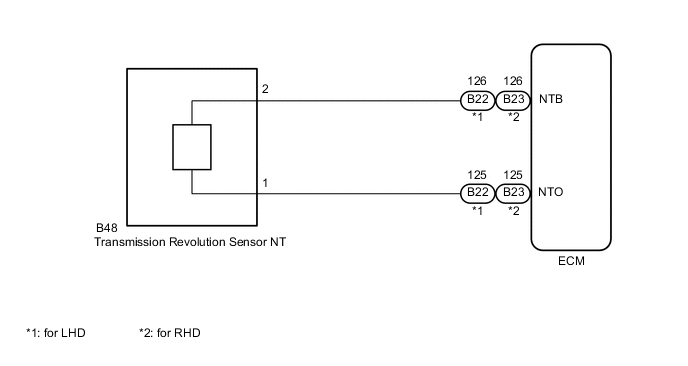
WIRING DIAGRAM
PROCEDURE
-
READ VALUE USING INTELLIGENT TESTER (SPD (NT) AND NT SENSOR VOLTAGE)
-
Connect the intelligent tester to the DLC3.
-
Turn the ignition switch to ON.
-
Turn the tester on.
-
Enter the following menus: Powertrain / Engine and ECT / Data List.
-
In accordance with the display on the tester, read the Data List.
Engine and ECT Tester Display Measurement Item/Range Normal Condition Diagnostic Note SPD (NT) Input turbine speed/
min.: 0 rpm
max.: 12750 rpm
-
Input turbine speed NT equal to engine speed: Lock-up on (After warming up engine)
-
Input turbine speed NT nearly equal to engine speed: Lock-up off (Idling with shift lever in P or N)
-
0 rpm: Vehicle stopped with shift lever in R
Data is displayed in increments of 50 rpm. NT Sensor Voltage Input turbine speed NT sensor output voltage/
min.: 0 V
max.: 5 V
Constantly changes between 0.8 to 1.6 V and 2.4 to 3.2 V: Engine idling (Vehicle stopped with shift lever in P or N) - Result Result Proceed to Data display is not within Normal Condition range A Data display is within Normal Condition range B -
B 
REPLACE ECM Click here
A 
-
-
INSPECT TRANSMISSION REVOLUTION SENSOR NT
-
Remove the transmission revolution sensor NT Click here.
-
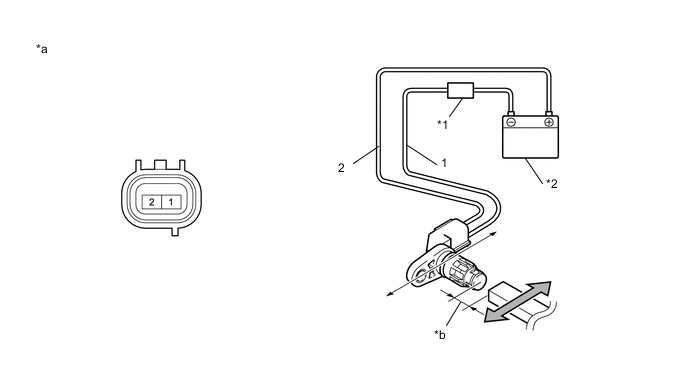
Connect the battery to the sensor as shown in the illustration.
-
Wave a magnetic object left and right in front of the transmission revolution sensor NT tip (5 mm (0.197 in.) gap or closer) to change the high/low signals while measuring the current.
Note
Make sure to wave the magnetic object during the inspection. The current will not change without waving the magnetic object as indicated by the arrow in the illustration.
-
Measure the current according to the value(s) in the table below.
Standard Current Tester Connection Condition Specified Condition 1 - 2 Low signal 4 to 8 mA 1 - 2 High signal 12 to 16 mA Text in Illustration *1 Ammeter *2 Battery *a Component without harness connected
(Transmission Revolution Sensor NT)
*b 5 mm (0.197 in.) Gap or Closer
NG 
REPLACE TRANSMISSION REVOLUTION SENSOR (NT) Click here
OK
-
-
CHECK HARNESS AND CONNECTOR (TRANSMISSION REVOLUTION SENSOR NT - ECM)
-
Disconnect the ECM connector.
-
Measure the resistance according to the value(s) in the table below.
Standard Resistance (for LHD) Tester Connection Condition Specified Condition B48-1 - B22-125 (NTO) Always Below 1 Ω B48-2 - B22-126 (NTB) Always Below 1 Ω B48-1 or B22-125 (NTO) - Body ground Always 10 kΩ or higher B48-2 or B22-126 (NTB) - Body ground Always 10 kΩ or higher Standard Resistance (for RHD) Tester Connection Condition Specified Condition B48-1 - B23-125 (NTO) Always Below 1 Ω B48-2 - B23-126 (NTB) Always Below 1 Ω B48-1 or B23-125 (NTO) - Body ground Always 10 kΩ or higher B48-2 or B23-126 (NTB) - Body ground Always 10 kΩ or higher
NG
REPAIR OR REPLACE HARNESS OR CONNECTOR
OK
-
-
REPLACE ECM
-
Replace the ECM Click here.
NEXT
-
-
PERFORM INITIALIZATION
-
Perform the initialization Click here.
-
Check for DTCs again Click here.
NEXT
END
-