MULTI-MODE MANUAL TRANSAXLE SYSTEM, Diagnostic DTC:P0915, P0916, P0917
| DTC Code | DTC Name |
|---|---|
| P0915 | Gear Shift Position Circuit Range / Performance |
| P0916 | Gear Shift Position Circuit Low |
| P0917 | Gear Shift Position Circuit High |
DESCRIPTION
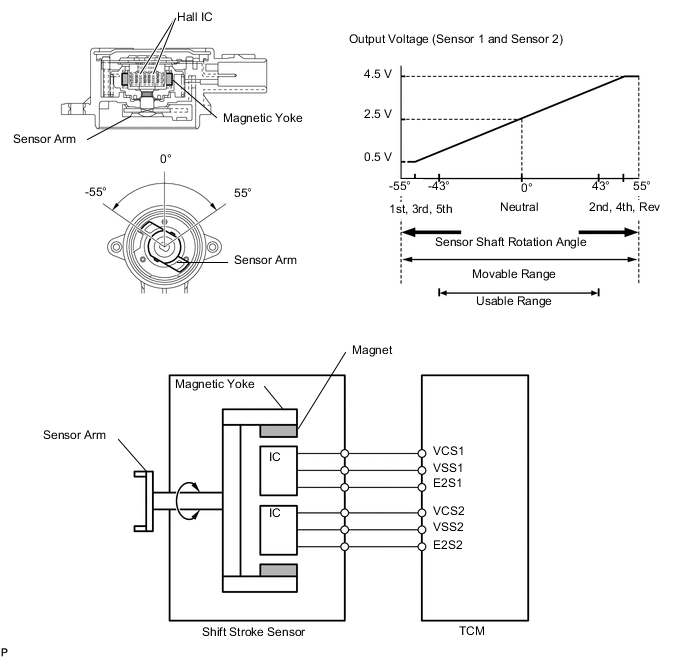
The shift stroke sensor is mounted on the shift and select actuator, and detects the shift position of the shift and select lever shaft. The sensor consists of a sensor arm, magnetic yoke and 2 Hall ICs. This sensor is a non-contact type, and uses Hall-effect elements (Hall ICs: main and sub), in order to yield accurate signals.
When the shift and select actuator is operating in the shift direction, the magnetic yoke that is coaxially positioned on the sensor arm is rotated and the magnet position changes. The Hall ICs convert the magnet position change into the voltage signal and send it to the TCM. The TCM judges the shift motor operating condition (whether the gear is shifted to Reverse, 1st, 3rd and 5th or 2nd, 4th and 6th) based on the signal from the shift stroke sensor.
The main and sub circuits in the shift stroke sensor have the same output characteristics.
The sensor construction and operation of the shift stroke sensor are basically the same as those of the clutch stroke sensor.
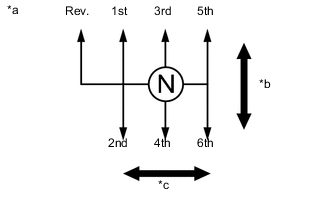
| *a | Shift and Select Actuator Operation |
| *b | Shift Direction |
| *c | Select Direction |
| DTC No. | DTC Detection Condition | Trouble Area |
|---|---|---|
| P0915 | Deviation between sensor signal 1 (main) and sensor signal 2 (sub) is 2.0 mm (0.078 in.) or more for 1.0 second or more (1-trip detection logic) |
|
| P0916 | Shift stroke sensor (main) signal voltage is 0.2 V or less for 0.5 seconds or more (1-trip detection logic) |
|
| Shift stroke sensor (sub) signal voltage is 0.2 V or less for 0.5 seconds or more (1-trip detection logic) |
||
| P0917 | Shift stroke sensor (main) signal voltage is 4.8 V or more for 0.5 seconds or more (1-trip detection logic) |
|
| Shift stroke sensor (sub) signal voltage is 4.8 V or more for 0.5 seconds or more (1-trip detection logic) |
WIRING DIAGRAM
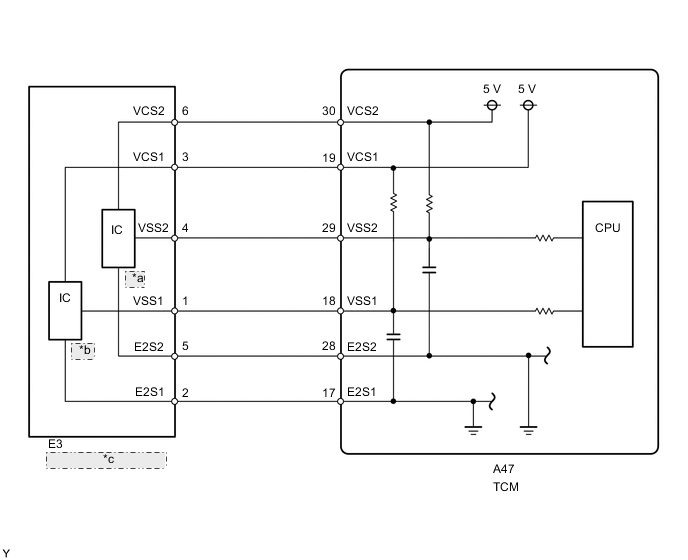
| *a | Sub |
| *b | Main |
| *c | Shift Stroke Sensor |
CAUTION / NOTICE / HINT
Note
In shift stroke sensor replacement, perform [Initialization and Learning] (See page ) and [Synchronization Position Calibration] Click here after installing the sensor.
If the sensor is installed without performing [Initialization and Learning] and [Synchronization Position Calibration], it may cause driving performance degradation or system component breakage.
PROCEDURE
-
INSPECT TCM (VCS1 AND VCS2 VOLTAGE)
-
Disconnect the shift stroke sensor connector.
-
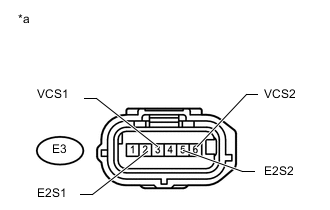
Text In Illustration *a Front view of wire harness connector
(to Shift Stroke Sensor)
Turn the ignition switch to ON.
-
Measure the voltage according to the value(s) in the table below.
Standard Voltage Tester Connection Switch Condition Specified Condition E3-2 (E2S1) - E3-3 (VCS1) Ignition switch ON 4.7 to 5.3 V E3-5 (E2S2) - E3-6 (VCS2) Ignition switch ON 4.7 to 5.3 V
NG 
CHECK HARNESS AND CONNECTOR (SHIFT STROKE SENSOR - TCM) Click here
OK 
-
-
INSPECT SHIFT STROKE SENSOR
-
Remove the shift stroke sensor.
-
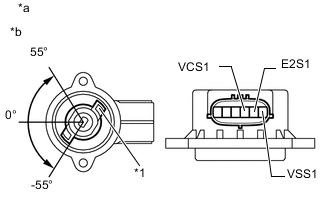
Text In Illustration *1 Sensor Arm *a Component without harness connected
(Shift Stroke Sensor)
*b Main Measure the voltage between the terminals of the shift stroke sensor connector (main).
-
Prepare 3 dry cell batteries (1.5 V) and 2 leads for connecting the batteries and the sensor.
-
Connect the batteries in series.
-
Connect the positive battery terminal to sensor terminal 3 (VCS1), and the negative battery terminal to sensor terminal 2 (E2S1).
-
Measure the voltage according to the value(s) in the table below.
Standard Voltage (combined dry cell battery voltage of 4.5 V) Tester Connection Condition
(Sensor Angle)
Specified Condition 1 (VSS1) - 2 (E2S1) 55° Approximately 4.05 V 0° Approximately 2.25 V -55° Approximately 0.45 V Reference Voltage (combined dry cell battery voltage of 5.0 +/- 0.3 V) Tester Connection Condition
(Sensor Angle)
Specified Condition 1 (VSS1) - 2 (E2S1) 55° Approximately 4.5 V 0° Approximately 2.5 V -55° Approximately 0.5 V
-
-
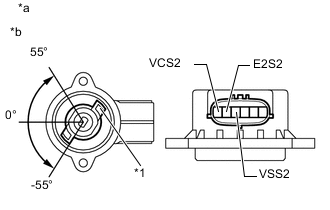
Text In Illustration *1 Sensor Arm *a Component without harness connected
(Shift Stroke Sensor)
*b Sub Measure the voltage between the terminals of the shift stroke sensor connector (Sub).
-
Connect the positive battery terminal to sensor terminal 6 (VCS2), and the negative battery terminal to sensor terminal 5 (E2S2).
-
Measure the voltage according to the value(s) in the table below.
Standard Voltage (combined dry cell battery voltage of 4.5 V) Tester Connection Condition
(Sensor Angle)
Specified Condition 4 (VSS2) - 5 (E2S2) 55° Approximately 4.05 V 0° Approximately 2.25 V -55° Approximately 0.45 V Reference Voltage (combined dry cell battery voltage of 5.0 +/- 0.3 V) Tester Connection Condition
(Sensor Angle)
Specified Condition 4 (VSS2) - 5 (E2S2) 55° Approximately 4.5 V 0° Approximately 2.5 V -55° Approximately 0.5 V Note
-
Do not apply more than 6 V
-
Do not use a sensor which has been dropped.
-
-
NG
REPLACE SHIFT STROKE SENSOR Click here
OK
-
-
CHECK HARNESS AND CONNECTOR (SHIFT STROKE SENSOR - TCM)
-
Disconnect the TCM connector.
-
Measure the resistance according to the value(s) in the table below.
Standard Resistance Tester Connection Condition Specified Condition E3-1 (VSS1) - A47-18 (VSS1) Always Below 1 Ω E3-4 (VSS2) - A47-29 (VSS2) Always Below 1 Ω A47-18 (VSS1) - Body ground Always 10 kΩ or higher A47-29 (VSS2) - Body ground Always 10 kΩ or higher
NG 
REPAIR OR REPLACE HARNESS OR CONNECTOR
OK
-
-
REPLACE TCM
-
Replace the TCM Click here.
NEXT
-
-
PERFORM INITIALIZATION
-
Perform the initialization and learning for multi-mode manual transaxle system Click here.
NEXT
END
-
-
CHECK HARNESS AND CONNECTOR (SHIFT STROKE SENSOR - TCM)
-
Disconnect the TCM connector.
-
Measure the resistance according to the value(s) in the table below.
Standard Resistance Tester Connection Condition Specified Condition E3-2 (E2S1) - A47-17 (E2S1) Always Below 1 Ω E3-3 (VCS1) - A47-19 (VCS1) Always Below 1 Ω E3-5 (E2S2) - A47-28 (E2S2) Always Below 1 Ω E3-6 (VCS2) - A47-30 (VCS2) Always Below 1 Ω A47-17 (E2S1) - Body ground Always 10 kΩ or higher A47-19 (VCS1) - Body ground Always 10 kΩ or higher A47-28 (E2S2) - Body ground Always 10 kΩ or higher A47-30 (VCS2) - Body ground Always 10 kΩ or higher
NG
REPAIR OR REPLACE HARNESS OR CONNECTOR
OK
-
-
REPLACE TCM
-
Replace the TCM Click here.
NEXT
-
-
PERFORM INITIALIZATION
-
Perform the initialization and learning for multi-mode manual transaxle system Click here.
NEXT
END
-
-
REPLACE SHIFT STROKE SENSOR
-
Replace the shift stroke sensor Click here.
NEXT
-
-
PERFORM INITIALIZATION
-
Perform the initialization and learning for multi-mode manual transaxle system Click here.
NEXT
END
-