STOP AND START SYSTEM, Diagnostic DTC:P2531
| DTC Code | DTC Name |
|---|---|
| P2531 | Ignition Switch Run Position Circuit Low |
DESCRIPTION
When the engine stop and start ECU receives the OFF signal from the ignition or starter switch assembly when communication with the ECM is normal, the engine stop and start ECU stores DTC P2531.
| DTC No. | DTC Detection Condition | Trouble Area |
|---|---|---|
| P2531 | Both of the following conditions continue for 10 seconds or more (1 trip detection logic):
|
|
CONFIRMATION DRIVING PATTERN
Tech Tips
DTCs for the stop and start system are not cleared even if the malfunction has been repaired. After repairing the malfunction, be sure to clear the DTCs Click here.
-
After troubleshooting, perform the following steps to recheck for DTCs.
Tech Tips
-
If the cable is disconnected from the negative (-) battery terminal, stop and start control is prohibited until refresh charge is completed. After connecting the cable, drive the vehicle until refresh charge is completed and stop and start control is permitted (approximately 15 to 40 minutes).
-
Allow the engine to idle for 3 minutes after it is warmed up and check that the engine idle speed is within 50 rpm of the target idle speed.
-
for Manual transaxle
-
Connect the GTS to the DLC3.
-
Turn the ignition switch to ON and turn the GTS on.
-
Clear the DTCs Click here.
-
Start the engine and warm it up.
-
Drive the vehicle at 7 km/h (4.3 mph) or more.
CAUTION:
When performing the confirmation driving pattern, obey all speed limits and traffic laws.
-
Stop the vehicle, move the shift lever to neutral and release the clutch pedal.
-
Keep the engine stopped by stop and start control for 1 second or more.
-
Depress the clutch pedal and start the engine.
Tech Tips
If the engine cranks slowly when the engine is restarted, it can be determined that battery voltage is low.
-
Check that DTCs are not output Click here.
-
-
for CVT
-
Connect the GTS to the DLC3.
-
Turn the ignition switch to ON and turn the GTS on.
-
Clear the DTCs Click here.
-
Start the engine and warm it up.
-
Drive the vehicle at 7 km/h (4.3 mph) or more.
CAUTION:
When performing the confirmation driving pattern, obey all speed limits and traffic laws.
-
Depress the brake pedal and stop the vehicle.
-
Keep the engine stopped by stop and start control for 1 second or more (Keep the shift lever in D).
-
Release the brake pedal with the shift lever in D to start the engine.
Tech Tips
If the engine cranks slowly when the engine is restarted, it can be determined that battery voltage is low.
-
Check that DTCs are not output Click here.
-
-
-
Check if the stop and start system operates normally.
Tech Tips
If the cable is disconnected from the negative (-) battery terminal, stop and start control is prohibited until refresh charge is completed. After connecting the cable, drive the vehicle until refresh charge is completed and stop and start control is permitted (approximately 15 to 40 minutes).
-
for Manual transaxle
-
Start the engine and warm it up.
-
Turn the air conditioning system off.
-
Drive the vehicle at 7 km/h (4.3 mph) or more.
CAUTION:
When performing the confirmation driving pattern, obey all speed limits and traffic laws.
-
Stop the vehicle, move the shift lever to neutral and release the clutch pedal.
-
Allow the engine to stop by stop and start control.
-
Depress the clutch pedal and start the engine.
-
-
for CVT
-
Start the engine and warm it up.
-
Turn the air conditioning system off.
-
Drive the vehicle at 7 km/h (4.3 mph) or more.
CAUTION:
When performing the confirmation driving pattern, obey all speed limits and traffic laws.
-
Depress the brake pedal and stop the vehicle.
-
Keep the engine stopped by stop and start control for 1 second or more (Keep the shift lever in D).
-
Release the brake pedal with the shift lever in D to start the engine.
-
-
WIRING DIAGRAM
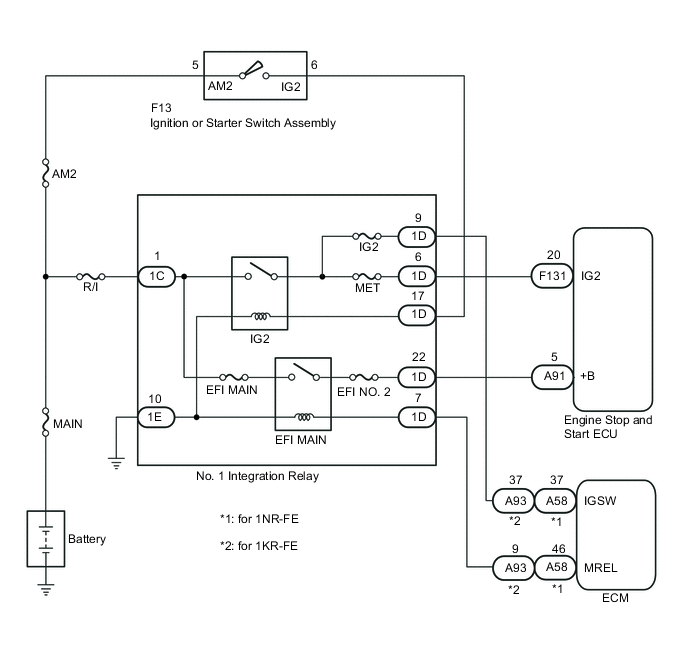
CAUTION / NOTICE / HINT
Note
-
Before replacing the engine stop and start ECU, read the number of starter operations and write it into a new engine stop and start ECU Click here.
-
After replacing the engine stop and start ECU or air conditioning amplifier assembly, reset and perform learning of the air conditioning information in the engine stop and start ECU Click here.
-
After replacing the engine stop and start ECU or airbag sensor assembly, clear and calibrate the deceleration sensor zero point in the engine stop and start ECU Click here.
-
Inspect the fuses for circuits related to this system before performing the following inspection procedure.
Tech Tips
Using the GTS, read the freeze frame data before troubleshooting. System condition information is recorded as freeze frame data the moment a DTC is stored. This information can be useful when troubleshooting Click here.
PROCEDURE
-
READ VALUE USING GTS (IG SWITCH)
-
Connect the GTS to the DLC3.
-
Turn the ignition switch to ON.
-
Turn the GTS on.
-
Enter the following menus: Powertrain / Stop and Start / Data List / IG Switch.
-
Read the value displayed on the GTS.
Result Result Proceed to ON A OFF B
A 
USE SIMULATION METHOD TO CHECK Click here
B 
-
-
CHECK HARNESS AND CONNECTOR (ENGINE STOP AND START ECU - NO. 1 INTEGRATION RELAY)
-
Disconnect the F131 engine stop and start ECU connector.
-
Remove the No. 1 integration relay connector.
-
Measure the resistance according to the value(s) in the table below.
Standard Resistance Tester Connection Condition Specified Condition F131-20 (IG2) - 1D-6 (IG2 Relay) Always Below 1 Ω F131-20 (IG2) or 1D-6 (IG2 Relay) - Body ground Always 10 kΩ or higher
NG
REPAIR OR REPLACE HARNESS OR CONNECTOR
OK
-
-
INSPECT INTEGRATION NO. 1 RELAY (IG2 RELAY)
-
Inspect the No. 1 integration relay (IG2 relay) (for 1NR-FE) Click here.
-
Inspect the No. 1 integration relay (IG2 relay) (for 1KR-FE) Click here.
Result Result Proceed to OK A NG (for 1NR-FE) B NG (for 1KR-FE) C
B
REPLACE NO. 1 INTEGRATION RELAY Click here
C
REPLACE NO. 1 INTEGRATION RELAY Click here
A
-
-
CHECK HARNESS AND CONNECTOR (NO. 1 INTEGRATION RELAY - BODY GROUND)
-
Remove the No. 1 integration relay connector.
-
Measure the resistance according to the value(s) in the table below.
Standard Resistance Tester Connection Condition Specified Condition 1E-10 - Body ground Always Below 1 Ω
NG
REPAIR OR REPLACE HARNESS OR CONNECTOR
OK
-
-
CHECK HARNESS AND CONNECTOR (NO. 1 INTEGRATION RELAY - IGNITION OR STARTER SWITCH ASSEMBLY)
-
Remove the No. 1 integration relay connector.
-
Disconnect the F13 ignition or starter switch assembly connector.
-
Measure the resistance according to the value(s) in the table below.
Standard Resistance Tester Connection Condition Specified Condition 1D-17 - F13-6 (IG2) Always Below 1 Ω 1D-17 or F13-6 (IG2) - Body ground Always 10 kΩ or higher
NG
REPAIR OR REPLACE HARNESS OR CONNECTOR
OK
-
-
CHECK HARNESS AND CONNECTOR (ENGINE STOP AND START ECU - NO. 1 INTEGRATION RELAY)
-
Remove the No. 1 integration relay connector.
-
Disconnect the A91 engine stop and start ECU connector.
-
Measure the resistance according to the value(s) in the table below.
Standard Resistance Tester Connection Condition Specified Condition A91-5 (+B) - 1D-22 (EFI RELAY) Always Below 1 Ω A91-5 (+B) or 1D-22 (EFI RELAY) - Body ground Always 10 kΩ or higher
NG
REPAIR OR REPLACE HARNESS OR CONNECTOR
OK
-
-
INSPECT ECM (IGSW VOLTAGE)
-
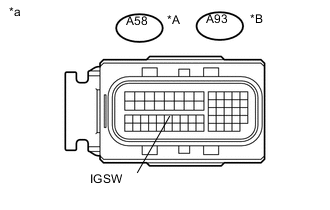
Text in Illustration *A for 1NR-FE *B for 1KR-FE *a Front view of wire harness connector:
(to ECM)
Disconnect the A58 ECM connector. (for 1NR-FE)
-
Disconnect the A93 ECM connector. (for 1KR-FE)
-
Turn the ignition switch to ON.
-
Measure the voltage according to the value(s) in the table below.
Standard Voltage for 1NR-FE Tester Connection Switch Condition Specified Condition A58-37 (IGSW) - Body ground Ignition switch ON 9.5 to 14 V for 1KR-FE Tester Connection Switch Condition Specified Condition A93-37 (IGSW) - Body ground Ignition switch ON 9.5 to 14 V Result Result Proceed to OK A NG (for 1NR-FE) B NG (for 1KR-FE) C
B
INSPECT ECM POWER SOURCE CIRCUIT Click here
C
INSPECT ECM POWER SOURCE CIRCUIT Click here
A
-
-
INSPECT NO. 1 INTEGRATION RELAY (EFI MAIN RELAY)
-
Inspect the No. 1 integration relay (EFI MAIN relay) (for 1NR-FE) Click here.
-
Inspect the No. 1 integration relay (EFI MAIN relay) (for 1KR-FE) Click here.
Result Result Proceed to OK A NG (for 1NR-FE) B NG (for 1KR-FE) C
B
REPLACE NO. 1 INTEGRATION RELAY Click here
C
REPLACE NO. 1 INTEGRATION RELAY Click here
A
-
-
CHECK HARNESS AND CONNECTOR (NO. 1 INTEGRATION RELAY - ECM)
Tech Tips
If the data in the ECM can be read using the GTS even when 30 seconds or more have elapsed after the ignition switch is turned off, there may be a malfunction in the EFI relay circuit.
-
Remove the No. 1 integration relay connector.
-
Disconnect the A58 ECM connector. (for 1NR-FE)
-
Disconnect the A93 ECM connector. (for 1KR-FE)
-
Measure the resistance according to the value(s) in the table below.
Standard Resistance for 1NR-FE Tester Connection Condition Specified Condition 1D-7 - A58-46 (MREL) Always Below 1 Ω 1D-7 or A58-46 (MREL) - Body ground Always 10 kΩ or higher for 1KR-FE Tester Connection Condition Specified Condition 1D-7 - A93-9 (MREL) Always Below 1 Ω 1D-7 or A93-9 (MREL) - Body ground Always 10 kΩ or higher
NG
REPAIR OR REPLACE HARNESS OR CONNECTOR
OK
-
-
INSPECT IGNITION OR STARTER SWITCH ASSEMBLY
-
Inspect the ignition or starter switch assembly (for 1NR-FE) Click here.
-
Inspect the ignition or starter switch assembly (for 1KR-FE) Click here.
Result Result Proceed to OK A NG (for 1NR-FE) B NG (for 1KR-FE) C
A
REPLACE ENGINE STOP AND START ECU Click here
B
REPLACE IGNITION OR STARTER SWITCH ASSEMBLY Click here
C
REPLACE IGNITION OR STARTER SWITCH ASSEMBLY Click here
-