STARTER(w/o Stop and Start System for Cold Area Specification Vehicles) INSPECTION
PROCEDURE
-
INSPECT STARTER ASSEMBLY
CAUTION:
As a large electric current passes through the cable during this inspection, a thick cable must be used.
If not, the cable may become hot and cause injury.
Note
Perform each of the following tests within 3 to 5 seconds to prevent the coil from burning out.
-
Perform a pull-in test.
-
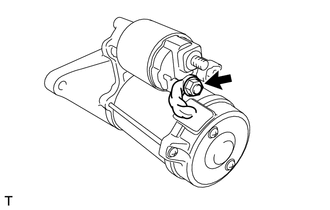
Remove the nut to disconnect the lead wire from terminal C.
-
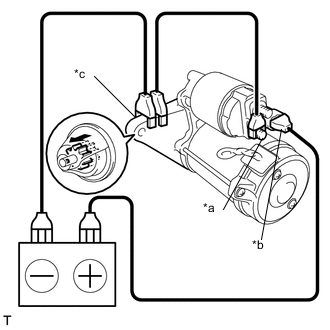
Text in Illustration *a Terminal C *b Terminal 50 *c Starter Body Connect the battery to the magnet starter switch as shown in the illustration. Check that the clutch pinion gear moves outward.
If the clutch pinion gear does not move, replace the magnet starter switch assembly.
-
-
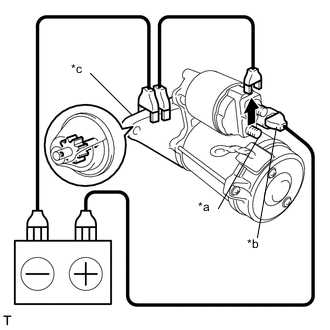
Text in Illustration *a Terminal C *b Terminal 50 *c Starter Body Perform a holding test.
-
Disconnect the lead from terminal C. Check that the clutch pinion gear does not move inward.
If the clutch pinion gear returns inward, replace the magnet starter switch assembly.
-
-
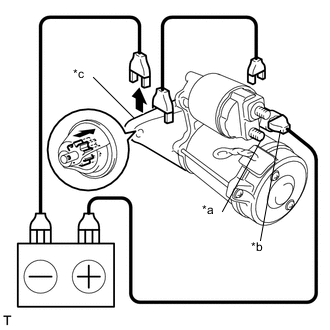
Text in Illustration *a Terminal C *b Terminal 50 *c Starter Body Check return operation.
-
Disconnect the negative (-) lead from the switch body. Check that the clutch pinion gear moves inward.
If the clutch pinion gear does not move inward, replace the magnet starter switch assembly.
-
-
Perform a no-load performance test.
-
Connect the lead wire to terminal C with the nut. Make sure that the lead wire is not grounded.
- Torque:
- 10 N*m { 102 kgf*cm, 7.4 ft.*lbf }
-
Clamp the starter assembly in a vise between aluminum plates.
Note
Ensure that the starter is secured in the vise to prevent it from falling out.
-
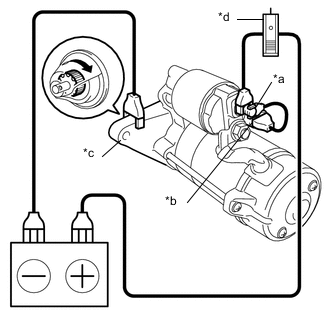
Text in Illustration *a Terminal 30 *b Terminal 50 *c Starter Body *d Probe Connect the battery and an ammeter to the starter as shown in the illustration.
Note
Do not allow any lead to get caught as the pinion gear operates.
-
Check that the starter rotates smoothly and steadily with the clutch pinion gear moved outward.
Measure the current according to the value(s) in the table below.
Standard Current Tester Connection Condition Specified Condition Battery positive terminal - Terminal 30 - Terminal 50 11.5 V Below 150 A If the result is not as specified, replace the starter assembly.
-
-
-
INSPECT MAGNET STARTER SWITCH ASSEMBLY
-
Check the plunger.
-
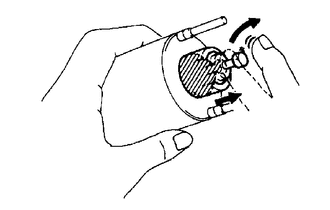
Push in the plunger and check that it returns quickly to its original position.
If the plunger does not return, replace the magnet starter switch assembly.
-
-
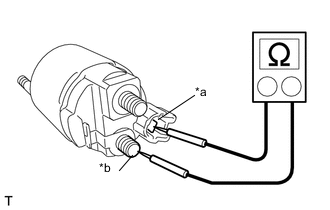
Text in Illustration *a Terminal 50 *b Terminal C Check the pull-in coil for an open circuit.
-
Measure the resistance according to the value(s) in the table below.
Standard Resistance Tester Connection Condition Specified Condition Terminal 50 - Terminal C Always Below 1 Ω If the result is not as specified, replace the magnet starter switch assembly.
-
-
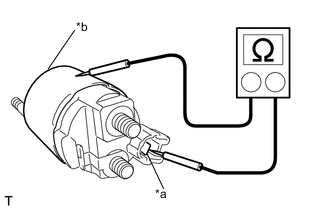
Text in Illustration *a Terminal 50 *b Magnet Starter Switch Assembly Body Check the holding coil for an open circuit.
-
Measure the resistance according to the value(s) in the table below.
Standard Resistance Tester Connection Condition Specified Condition Terminal 50 - Magnet starter switch assembly body Always Below 2 Ω If the result is not as specified, replace the magnet starter switch assembly.
-
-
-
INSPECT STARTER ARMATURE ASSEMBLY
-
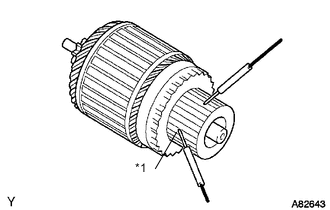
Text in Illustration *a Segment Check the commutator for an open circuit.
-
Measure the resistance according to the value(s) in the table below.
Standard Resistance Tester Connection Condition Specified Condition Segment - Segment Always Below 1 Ω If the result is not as specified, replace the starter armature assembly.
-
-
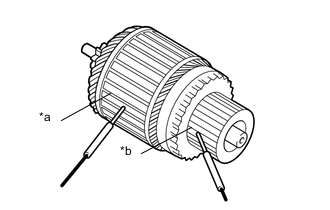
Text in Illustration *a Coil Core *b Commutator Check the commutator for a short circuit.
-
Measure the resistance according to the value(s) in the table below.
Standard Resistance Tester Connection Condition Specified Condition Commutator -Ccoil core Always 10 kΩ or higher If the result is not as specified, replace the starter armature assembly.
-
-
Check the commutator appearance.
If the surface is dirty or burnt, restore it with sandpaper (No. 400) or a lathe.
-
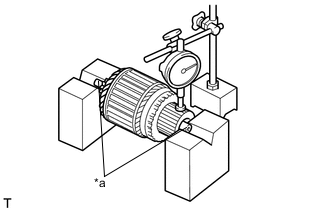
Text in Illustration *a Starter Armature Assembly shaft Check the commutator for runout.
-
Place the armature shaft on V-blocks.
-
Using a dial indicator, measure the runout.
Maximum runout 0.05 mm (0.00197 in.) If the runout is greater than the maximum, replace the starter armature assembly.
-
-
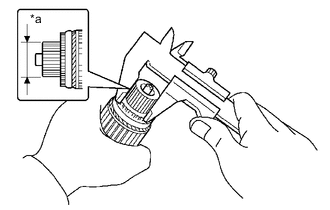
Text in Illustration *a Diameter Using a vernier caliper, measure the commutator diameter.
Standard diameter 29 mm (1.14 in.) (at convex part) Minimum diameter 28 mm (1.10 in.) (at convex part) If the diameter is less than the minimum, replace the starter armature assembly.
-
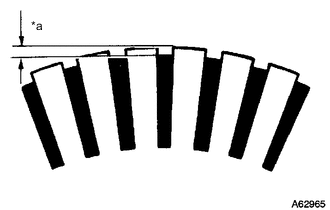
Text in Illustration *a Undercut Depth Check that the undercut portion between the segments is free of foreign matter and measure its depth.
Standard undercut depth 0.4 mm (0.0157 in.) (at convex part) Minimum undercut depth 0.2 mm (0.00787 in.) (at convex part) If the undercut depth is less than the minimum, adjust it with a hacksaw blade.
-
-
INSPECT STARTER BRUSH HOLDER ASSEMBLY
-
Check the brush length.
-
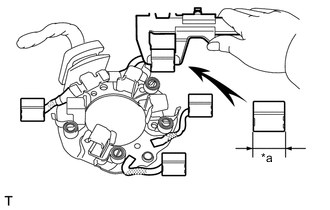
Text in Illustration *a Length Using a vernier caliper, measure the brush length.
Standard length 14.4 mm (0.567 in.) Minimum length 9.0 mm (0.354 in.) (at convex part) If the brush length is less than the minimum, replace the starter brush holder assembly.
-
-
Check the starter brush holder assembly resistance.
-
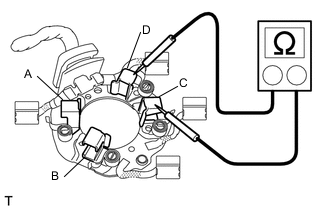
Measure the resistance according to the value(s) in the table below.
Standard Resistance Tester Connection Condition Specified Condition A - B Always 10 kΩ or higher A - C A - D Below 1 Ω B - C B - D 10 kΩ or higher C - D If the result is not as specified, replace the starter brush holder assembly.
-
-
Inspect the load of the brush spring.
-
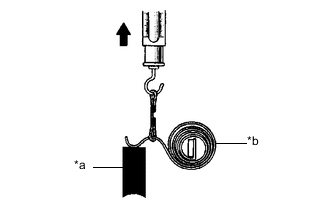
Text in Illustration *a Brush *b Brush Spring Take the pull scale reading immediately after the brush spring separates from the brush.
Standard spring installed load 22 to 27 N (2 to 3 kgf, 5.0 to 6.1 lbf) Minimum spring installed load 14 N (1 kgf, 3.1 lbf) If the installed load is less than the minimum, replace the starter brush holder assembly.
-
-
-
INSPECT STARTER CENTER BEARING CLUTCH SUB-ASSEMBLY
-
Inspect the gear teeth of the planetary gears and internal gear of the starter center bearing clutch sub-assembly for wear and damage.
If worn or damaged, replace the planetary gears or starter center bearing clutch sub-assembly. Also check the planetary gears for wear and damage.
-
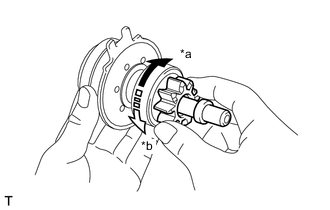
Text in Illustration *a Free *b Lock Check the movement of the clutch pinion gear.
-
While holding the starter center bearing clutch sub-assembly, rotate the clutch pinion gear clockwise and check that it turns freely.
-
Try to rotate the clutch pinion gear counterclockwise and check that it locks.
If the clutch pinion gear cannot be turned clockwise smoothly, or does not lock in the counterclockwise direction, replace the starter center bearing clutch sub-assembly.
-
-