LUBRICATION SYSTEM(w/ DPF) ON-VEHICLE INSPECTION
PROCEDURE
-
CHECK ENGINE OIL LEVEL
-
Warm up and stop the engine, wait for 5 minutes, and check that the oil level is between the Low and Full marks on the dipstick.
Tech Tips
If the oil level is low, check for leaks and add oil to the Full mark.
Note
Do not add oil above the Full mark.
Tech Tips
A certain amount of engine oil will be consumed while driving. In the following situations, oil consumption may increase, and engine oil may need to be refilled in between oil maintenance intervals.
-
When the engine is new, for example directly after purchasing the vehicle or after replacing the engine.
-
If low quality oil or oil of an inappropriate viscosity is used.
-
When driving at high engine speed or with a heavy load, (when towing, or), when driving while accelerating or decelerating frequently.
-
When leaving the idling for a long time, or when driving frequently through heavy traffic.
When judging the amount of oil consumption, keep in mind that the oil may have become diluted, making it difficult to judge the true level accurately.
-
-
Warm up the engine until the coolant temperature is 75°C to 86°C (167°F to 187°F), and confirm whether or not the oil maintenance indicator illuminates after driving the vehicle for 2 trips at a vehicle speed of 15 km/h (9 mph) or more for 40 seconds and at an engine speed of 1800 to 3000 rpm.
Tech Tips
-
If the oil maintenance warning indicator illuminates during confirmation driving after an oil change, check for an open or close in the engine oil level sensor (See page ). If there is a malfunction, replace the engine oil level sensor Click here.
-
If the oil maintenance warning indicator illuminates, the engine oil level is correct, and the sensor is functioning normally, then check the wire harness and connectors between the engine oil level sensor and ECM Click here.
-
-
-
CHECK ENGINE OIL QUALITY
-
Check the engine oil for deterioration, water intrusion, discoloration and thinning.
If the oil quality is visibly poor, replace the oil.
-
-
INSPECT OIL PRESSURE
-
Check the condition of the oil pressure warning light and oil level warning light.
Note
If the ignition switch is turned off, the warning lights do not illuminate the next time the engine is started. Therefore, checking the vehicle after it has been brought in for service will not be of any use for troubleshooting. It is essential to ask the customer whether the warning lights were illuminated or not when the malfunction occurred.
Condition 1 Condition 2 Condition 3 Condition 4 Condition 5 Condition 6 Oil Pressure Warning Light Illuminated Not illuminated Not illuminated Illuminated Not illuminated Illuminated Oil Level Warning Light Illuminated Not illuminated Illuminated Not illuminated Illuminated Illuminated DTC Output None P0524 None None P0524 P0524 MIL Not illuminated Illuminated Not illuminated Not illuminated Illuminated Illuminated Possible Cause
-
Intake of air into an oil line due to a decrease in the amount of engine oil.
-
Clogging in an oil line (the oil strainer, etc.), or a problem with the oil pump
-
Oil level is low.
-
Intake of air into an oil line due to a decrease in the amount of engine oil
-
Clogging in an oil line (the oil strainer, etc.), or a problem with the oil pump
-
Oil pressure stuck at a low value (a DTC is stored as the oil pressure does not increase when the system switches to high oil pressure control mode)
Oil level is low.
-
Intake of air into an oil line due to a decrease in the amount of engine oil.
-
Clogging in an oil line (the oil strainer, etc.), or a problem with the oil pump
-
Intake of air into an oil line due to a decrease in the amount of engine oil
-
Clogging in an oil line (the oil strainer, etc.), or a problem with the oil pump
-
Oil pressure stuck at a low value (a DTC is stored as the oil pressure does not increase when the system switches to high oil pressure control mode)
-
Oil level is low.
-
Intake of air into an oil line due to a decrease in the amount of engine oil
-
Clogging in an oil line (the oil strainer, etc.), or a problem with the oil pump
-
Oil pressure stuck at a low value (a DTC is stored as the oil pressure does not increase when the system switches to high oil pressure control mode)
-
Oil level is low.
Solution to Problem
-
Add engine oil so that the oil level is within the specified range and perform an oil pressure control system check. If the results of the check are normal, it is likely that the illumination of the warning light was caused by oil consumption (if the amount of oil consumption is large, perform an inspection of the oil consumption). If the results of the check are abnormal, it is likely that the problem was caused by the oil pressure control system being stuck in low pressure oil control mode Click here.
-
Perform an oil pressure inspection. If the results are abnormal, repair the engine.
-
Perform the inspection procedure for DTC P0524 Click here.
-
Perform an oil pressure inspection. If the results are abnormal, repair the engine.
Add engine oil so that the oil level is within the specified range and perform an oil pressure control system check. If the results of the check are normal, it is likely that the illumination of the warning light was caused by oil consumption (if the amount of oil consumption is large, perform an inspection of the oil consumption). If the results of the check are abnormal, it is likely that the problem was caused by the oil pressure control system being stuck in low pressure oil control mode Click here.
Perform an oil pressure inspection. If the results are abnormal, repair the engine.
-
Perform the inspection procedure for DTC P0524 Click here.
-
Add engine oil so that the oil level is within the specified range and perform an oil pressure control system check. If the results of the check are normal, it is likely that the illumination of the warning light was caused by oil consumption (if the amount of oil consumption is large, perform an inspection of the oil consumption). If the results of the check are abnormal, it is likely that the problem was caused by the oil pressure control system being stuck in low pressure oil control mode Click here.
-
Perform an oil pressure inspection. If the results are abnormal, repair the engine.
-
Perform the inspection procedure for DTC P0524 Click here.
-
Add engine oil so that the oil level is within the specified range and perform an oil pressure control system check. If the results of the check are normal, it is likely that the illumination of the warning light was caused by oil consumption (if the amount of oil consumption is large, perform an inspection of the oil consumption). If the results of the check are abnormal, it is likely that the problem was caused by the oil pressure control system being stuck in low pressure oil control mode Click here.
-
Perform an oil pressure inspection. If the results are abnormal, repair the engine.
Tech Tips
-
Under normal conditions, the oil pressure warning light and oil level warning light are not illuminated.
-
When performing a check of the oil pressure control system, if the system does not switch from high oil pressure control mode, one of the following may be the cause of the problem.
-
The sleeve valve is locked in the position for high oil pressure.
-
The oil pressure switching valve is stuck off.
-
If a DTC is stored but the cause of the problem cannot be found, one of the following may be the cause of the problem.
-
Engine oil was added by the customer due to a lack of engine oil.
-
The system was temporarily stuck in low oil pressure control mode (foreign matter was stuck in the system, etc.)
-
Check the oil pressure control system using the following procedure.
-
-
Check the oil pressure control system (when using the intelligent tester).
Reference Purpose of Check When to Perform Check This check is used to check whether the oil pressure control system is operating properly when the oil pressure switching valve is forcibly operated. Perform this check when DTC P0524 is output.
-
Connect the intelligent tester to the DLC3.
-
Start the engine and warm it up.
Tech Tips
Confirm that the engine coolant temperature is 70°C to 93°C (158°F to 199°F), as the oil pressure changes according to the engine coolant temperature.
-
Enter the following menus: Powertrain / Engine and ECT / Utility / Engine Oil Pressure Control Check.
-
Check the following table and perform the oil pressure control system check.
Tech Tips
-
Even when the engine is warmed up, there are some instances where the oil pressure control system check cannot be performed.
-
The engine speed will increase during the oil pressure control system check.
Item Condition Content of Check System Operation Oil Pressure Control System Check
-
Immediately after engine start
-
Vehicle is stopped
-
Shift lever is in neutral
-
Engine coolant temperature is in specified range
-
Valve turns off (high oil pressure control mode)
-
Valve turns on (low oil pressure control mode)
-
Valve turns off (high oil pressure control mode)
The average oil pressure over 1 second when the valve is operated is displayed. Details:
The oil pressure is measured for 1 second when the valve is operated, and the value measured every 0.1 seconds is displayed for each valve state [(1) to (3)].
-
-
Read the "valve off" (high pressure control mode) and "valve on" (low pressure control mode) oil pressure values.
Reference Oil Pressure Item Specified Condition Valve Off (High Pressure Control Mode) 120 to 430 kPa (1.2 to 4.4 kgf/cm2, 17 to 62 psi)
Valve On (Low Pressure Control Mode) 80 to 180 kPa (0.8 to 1.8 kgf/cm2, 12 to 26 psi)
-
Compare the "valve off" (high pressure control mode) and "valve on" (low pressure control mode) oil pressure values and check the difference.
Standard 24.5 kPa (0.25 kgf/cm2, 3.6 psi) or higher 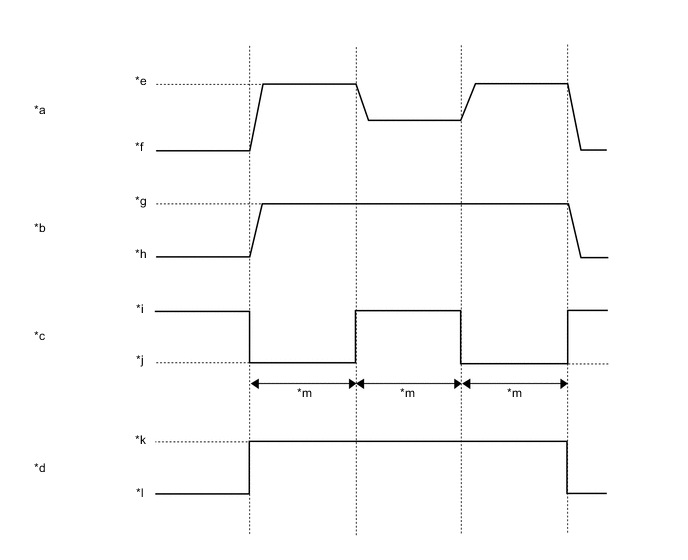
Text in Illustration *a Oil Pressure Sensor Output *b Engine Speed *c Oil Pressure Control Mode (State of Oil Pressure Switching Valve) *d Active Test Activation Request *e High Oil Pressure *f Low Oil Pressure *g 2200 rpm *h Idle Speed *i On (Low Oil Pressure Control Mode) *j Off (High Oil Pressure Control Mode) *k On *l Off *m Approximately 5 seconds - -
-
-
Check the oil pressure control system (when not using the intelligent tester).
Tech Tips
When not using the intelligent tester, it is not possible to determine whether the system is stuck in high oil pressure control mode.
-
Inspect the oil pressure using the same procedure for "4. Inspect Engine Oil Pressure".
Standard Oil Pressure Condition Specified Condition Idling 24.5 kPa (0.25 kgf/cm2, 3.6 psi) or higher
Engine running at 3200 rpm 150 kPa (1.5 kgf/cm2, 22 psi) or higher
Tech Tips
The possible cause can be determined by the following table depending on the results of the oil pressure inspection.
Measurement Results Condition 1 Condition 2 Idling Higher than specified condition Lower than specified condition 3200 rpm Lower than specified condition Lower than specified condition Possible Cause Oil pressure control stuck in low oil pressure control mode Clogging in an oil line (the oil strainer, etc.), or a problem with the oil pump
-
-
-
INSPECT ENGINE OIL PRESSURE
-
Remove the oil pressure sender gauge assembly Click here.
-
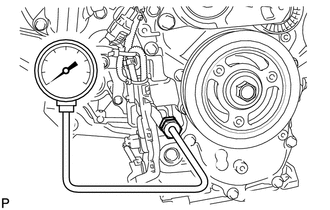
Install the oil pressure gauge.
-
Warm up the engine.
-
Check the oil pressure.
Standard Oil Pressure Condition Specified Condition Idling 24.5 kPa (0.25 kgf/cm2, 3.6 psi) or higher
Engine running at 3200 rpm 150 kPa (1.5 kgf/cm2, 22 psi) or higher
-
Remove the oil pressure gauge.
-
Install the oil pressure sender gauge assembly Click here.
-
Inspect for oil leak.
-