CANISTER ON-VEHICLE INSPECTION

PROCEDURE
-
INSPECT CANISTER (CHARCOAL CANISTER SUB-ASSEMBLY) (for Fuel Tank Cap Method)
-
Inspect evaporative emission control system.
-
Check for clogs in the air filter (when not using GTS).
-
Start the engine.
-
Warm up the engine.
-
Allow the engine to idle after the engine has warmed up.
-
After 15 minutes, open the fuel tank cap assembly to discharge the pressure in the fuel tank assembly.
-
Close the fuel tank cap assembly and allow the engine to idle for 30 seconds.
-
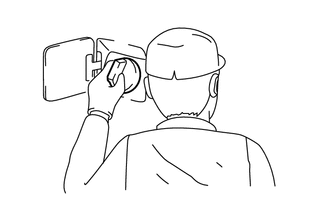
Open the fuel tank cap assembly again and check for inhalation sounds.
OK No whooshing sounds (inhalation sound) are heard. Tech Tips
If there is a smell of gasoline and a whooshing sound (exhalation sound) is heard, positive pressure in the fuel tank assembly is being discharged. This does not indicate a malfunction.
-
-
Check for clogs in the air filter (when using the GTS).
-
Connect the GTS to the DLC3.
-
Start the engine.
-
Turn the GTS on.
-
Enter the following menus: Powertrain / Engine and ECT / Active Test / Activate the VSV for Evap Control.
-
Open the fuel tank cap assembly to discharge the pressure in the fuel tank assembly.
-
Perform the "Activate the VSV for Evap Control" Active Test while the engine is idling.
-
Close the fuel tank cap assembly and allow the engine to idle for 30 seconds.
-
Open the fuel tank cap assembly again and check for inhalation sounds.
OK No whooshing sounds (inhalation sound) are heard. Tech Tips
If there is a smell of gasoline and a whooshing sound (exhalation sound) is heard, positive pressure in the fuel tank assembly is being discharged. This does not indicate a malfunction.
-
-
-
INSPECT CANISTER (CHARCOAL CANISTER SUB-ASSEMBLY) (for Vacuum Measurement Method)
-
Visually check the canister (charcoal canister sub-assembly) for airtightness.
-
Visually check the canister (charcoal canister sub-assembly) for cracks or damage, and check that there is no gasoline smell.
-
-
Inspect the ventilation of the canister (charcoal canister sub-assembly).
-
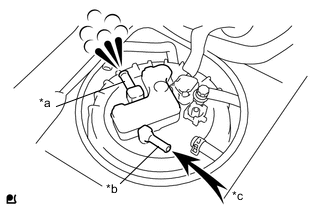
*a Port A *b Port B *c Air Open the fuel tank cap assembly, apply compressed air to port B and check that the air flows out from port A.
OK The air flows out from the port A.
-
-
Inspect the check valve.
-
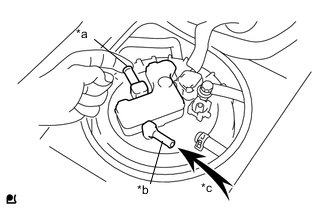
*a Port A *b Port B *c Air Open the fuel tank cap assembly, close the port A, and apply the compressed air from the port B.
OK Air does not flow at first. By gradually increasing the pressure, air flows when the pressure in the port reaches the specified level. -
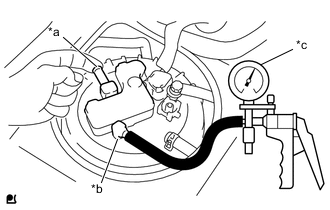
*a Port A *b Port B *c Vacuum Pump Open the fuel tank cap assembly, close the port A, and apply a vacuum from the port B, using a vacuum pump.
OK The vacuum is maintained at first. By gradually increasing the vacuum, air flows and the vacuum decreases after the vacuum reaches the specified level.
-
-
Inspect evaporative emission control system.
-
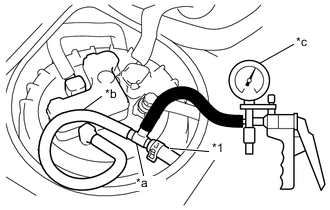
*1 No. 2 Fuel Emission Tube *a 3-way Connector *b Hose *c Vacuum Pump Check for clogs in the air filter (when not using GTS).
-
As shown in the illustration, connect the No. 2 fuel emission tube to the canister (charcoal canister sub-assembly) via the 3-way connector, hose and vacuum pump.
-
Start the engine.
-
Warm up the engine.
-
Allow the engine to idle after the engine has warmed up.
-
After 15 minutes, check the indicator needle on the vacuum pump.
OK Indicator needle of vacuum pump does not rise from its initial position. Tech Tips
The indicator needle may shake due to engine vibration, etc., but if it immediately returns to its initial position, there is no problem.
-
-
*1 No. 2 Fuel Emission Tube *a 3-way Connector *b Hose *c Vacuum Pump Check for clogs in the air filter (when using the GTS).
-
As shown in the illustration, connect the No. 2 fuel emission tube to the canister (charcoal canister sub-assembly) via the 3-way connector, hose and vacuum pump.
-
Connect the GTS to the DLC3.
-
Start the engine.
-
Turn the GTS on.
-
Enter the following menus: Powertrain / Engine and ECT / Active Test / Activate the VSV for Evap Control.
-
Perform the "Activate the VSV for Evap Control" Active Test while the engine is idling.
-
Check the indicator needle on the vacuum pump.
OK Indicator needle of vacuum pump does not rise from its initial position. Tech Tips
The indicator needle may shake due to engine vibration, etc., but if it immediately returns to its initial position, there is no problem.
-
-