EMISSION CONTROL SYSTEM ON-VEHICLE INSPECTION
PROCEDURE
-
INSPECT AIR FUEL RATIO COMPENSATION SYSTEM
-
Connect the intelligent tester to the DLC3.
-
Turn the ignition switch to ON.
-
Turn the tester on.
-
Enter the following menus: Powertrain / Engine and ECT / Data List / "AFS Voltage B1 S1" and "Short FT #1".
-
Warm up the air fuel ratio sensor with an engine speed of 2500 rpm for approximately 2 minutes.
-
Rev the engine several times and confirm that the value of "Short FT #1" changes in response to the value of "AFS Voltage B1 S1".
OK The "Short FT #1" changes in response to the "AFS Voltage B1 S1". -
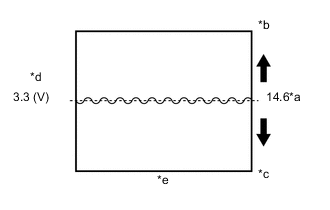
Text in Illustration *a Air-fuel Ratio *b Lean *c Rich *d Air-fuel Ratio Sensor Output *e Time Maintain the engine speed at 2500 rpm and confirm that the displays of "AFS Voltage B1S1" are as shown in the illustration.
Tech Tips
-
The illustration may differ slightly from the display on the intelligent tester.
-
Only the intelligent tester displays the waveform of the air fuel ratio sensor.
Note
-
Perform the check immediately after warming up the engine.
-
If the voltage variation cannot be verified, warm up the air fuel ratio sensor again. If it cannot be verified even after warming up the sensor again, check for DTC Click here.
-
-
-
INSPECT FUEL CUT OFF/RESTART RPM
-
Start and warm up the engine.
-
Open the throttle valve and keep the engine speed at 3000 rpm.
-
Use a sound scope to check for injector operating sounds.
-
Check that when the accelerator pedal is released, the injector operating noise stops momentarily and then resumes.
If the result is as not specified, check the injectors, wiring and ECM.
-
-
VISUALLY INSPECT HOSES, CONNECTIONS AND GASKETS
-
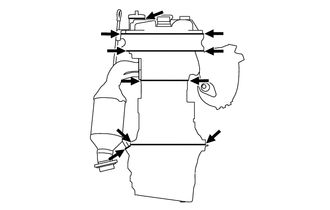
Check for cracks, leaks or damage.
-
Check the engine assembly.
Tech Tips
Detachment or other problems with the engine oil dipstick, filler cap and other components may cause the engine to run improperly.
If any defects are found, replace the parts as necessary.
-
-
-
INSPECT EVAPORATIVE EMISSION CONTROL SYSTEM
-
Start the engine.
-
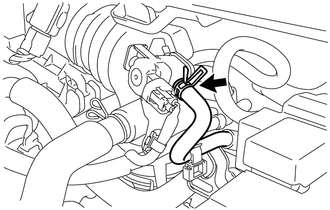
Disconnect the No. 1 fuel vapor feed hose as shown in the illustration.
-
Connect the intelligent tester to the DLC3.
-
Turn the tester on.
-
Enter the following menus: Powertrain / Engine and ECT / Active Test / Activate the VSV for Evap Control.
-
Check that a vacuum occurs at the VSV port.
-
If vacuum does not occur, check the following items.
Tech Tips
-
VSV (for canister purge)
-
Clogging in the fuel vapor feed hose connecting the intake air surge tank and VSV
-
Voltage from the ECM PRG terminal
-
-
Exit the Active Test mode and reconnect the vacuum hose.
-
Enter the following menus: Powertrain / Engine and ECT / Data List / EVAP Purge VSV.
-
Warm up the engine and drive the vehicle.
-
Confirm that the purge VSV opens.
If the result is not as specified, replace the purge valve, wire harness or ECM.
-
-
INSPECT CHARCOAL CANISTER
-
Check for clogs in the air filter (when not using the intelligent tester).
-
Start the engine.
-
Warm up the engine.
-
Allow the engine to idle after the engine has warmed up.
-
After 15 minutes, open the fuel tank cap to discharge the pressure in the fuel tank.
-
Close the fuel tank cap and allow the engine to idle for 30 seconds.
-
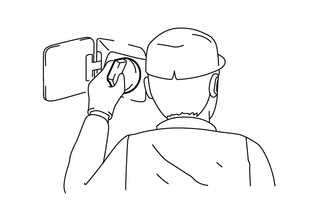
Open the fuel tank cap again and check for inhalation sounds.
OK No whooshing sounds (inhalation sound) are heard. Tech Tips
If the smell of gasoline and a whooshing sound (exhalation sound) are heard, positive pressure in the fuel tank is being discharged. This does not indicate a malfunction.
-
-
Check for clogs in the air filter (when using the intelligent tester).
-
Connect the intelligent tester to the DLC3.
-
Start the engine.
-
Turn the intelligent tester on.
-
Enter the following menus: Powertrain / Engine / Active Test / Activate the VSV for Evap Control.
-
Open the fuel tank cap to discharge the pressure in the fuel tank.
-
Perform the "Activate the VSV for Evap Control" Active Test while the engine is idling.
-
Close the fuel tank cap and allow the engine to idle for 30 seconds.
-
Open the fuel tank cap again and check for inhalation sounds.
Standard No whooshing sounds (inhalation sound) are heard. Tech Tips
If the smell of gasoline and a whooshing sound (exhalation sound) are heard, positive pressure in the fuel tank is being discharged. This does not indicate a malfunction.
-
-