SFI SYSTEM Fuel Pump Control Circuit
DESCRIPTION
The fuel pump circuit consists of the ECM, fuel pump and fuel pump control ECU (which operates the fuel pump). Based on the engine output, the ECM determines the fuel pump speed. The speed is then converted to a duty signal and sent to the fuel pump control ECU. Based on the signal sent from the ECM, the fuel pump control ECU adjust the fuel pump operation speed.
WIRING DIAGRAM
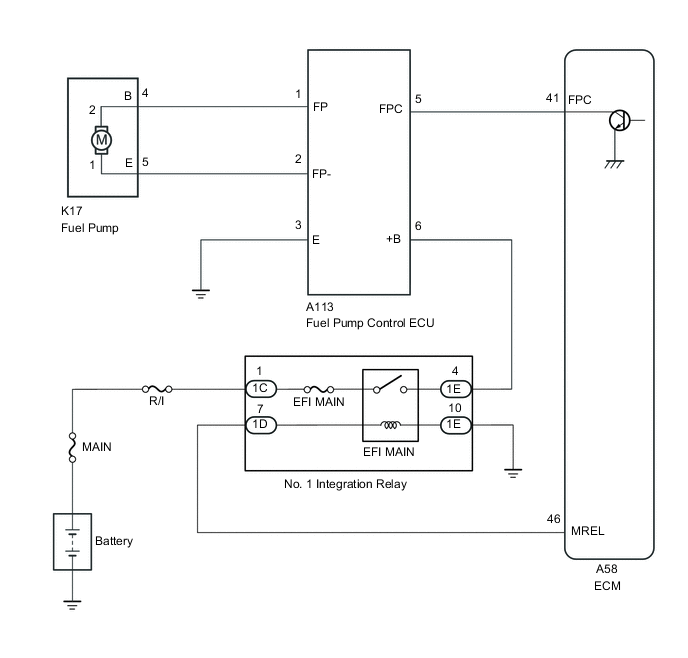
CAUTION / NOTICE / HINT
Note
Inspect the fuses for circuits related to this system before performing the following procedure.
PROCEDURE
-
PERFORM ACTIVE TEST USING GTS (CONTROL THE FUEL PUMP / SPEED)
-
Connect the GTS to the DLC3.
-
Turn the ignition switch to ON.
-
Turn the GTS on.
-
Enter the following menus: Powertrain / Engine and ECT / Active Test / Control the Fuel Pump / Speed.
-
Check whether the fuel pump operating sounds occurs when performing the Active Test on the GTS.
OK Operating sounds can be heard from the fuel pump. Result Proceed to OK NG
NG 
CHECK TERMINAL VOLTAGE (POWER SOURCE OF FUEL PUMP CONTROL ECU ASSEMBLY) Click here
OK 
-
-
PERFORM ACTIVE TEST USING GTS (CONTROL THE FUEL PUMP DUTY)
-
Remove the fuel suction tube with pump and gauge assembly.
-
Clean the fuel suction with pump and gauge tube assembly to completely remove any remaining fuel.
-
Remove the fuel pump.
-
Connect the fuel pump and fuel suction with pump and gauge tube assembly connectors.
Note
Confirm that no fuel remains inside or on the outside of the fuel pump.
-
Connect the GTS to the DLC3.
-
Turn the ignition switch to ON.
-
Turn the GTS on.
-
Enter the following menus: Powertrain / Engine and ECT / Active Test / Control the Fuel Pump Duty.
-
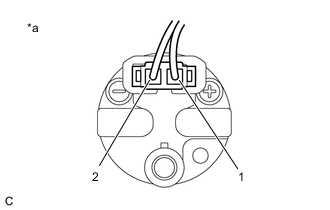
*a Component with harness connected
(Fuel Pump)
Operate the fuel pump using the Active Test measure the voltage according to the value(s) in the table below.
Standard Voltage Tester Connection GTS Operation Specified Condition 1 - 2 Fuel pump control duty: 25% 3.4 to 4.1 V Fuel pump control duty: 80% 10.0 to 12.5 V -
Enter the following menus: Powertrain / Engine and ECT / Active Test / Control the Fuel Pump / Speed.
-
Operate the fuel pump using the active test function and measure the voltage according to the value(s) in the table below.
Standard Voltage Tester Connection GTS Operation Specified Condition 1 - 2 ON (Fuel pump control duty :90%) 10.2 to 14.0 V Tech Tips
-
Be sure to measure the voltage with all connectors connected.
-
Before performing this inspection, check that the battery voltage is between 11 and 14 V (not depleted).
Result Proceed to OK NG -
NG
GO TO STEP 7 Click here
OK
-
-
INSPECT FUEL PUMP
-
Inspect the fuel pump.
Result Proceed to OK NG
OK 
END
NG
-
-
REPLACE FUEL PUMP
-
Replace the fuel pump.
Result Proceed to NEXT
NEXT
-
-
CONFIRM WHETHER MALFUNCTION HAS BEEN SUCCESSFULLY REPAIRED
-
Check the fuel pump operation.
OK Malfunction has been repaired successfully. Result Proceed to OK NG
OK
END
NG
PROCEED TO NEXT SUSPECTED AREA SHOWN IN PROBLEM SYMPTOMS TABLE Click here
-
-
CHECK TERMINAL VOLTAGE (POWER SOURCE OF FUEL PUMP CONTROL ECU ASSEMBLY)
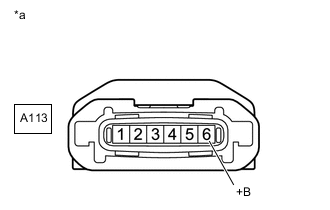
*a Front view of wire harness connector
(to Fuel Pump Control ECU)
-
Disconnect the fuel pump control ECU connector.
-
Turn the ignition switch to ON.
-
Measure the voltage according to the value(s) in the table below.
Standard Voltage Tester Connection Switch Condition Specified Condition A113-6 (+B) - Body ground Ignition switch ON 11 to 14 V Result Proceed to OK NG
NG
CHECK HARNESS AND CONNECTOR (FUEL PUMP CONTROL ECU - BODY GROUND) Click here
OK
-
-
INSPECT FUEL PUMP
-
Inspect the fuel pump.
Result Proceed to OK NG
NG
REPLACE FUEL PUMP Click here
OK
-
-
CHECK HARNESS AND CONNECTOR (FUEL PUMP - FUEL PUMP CONTROL ECU)
-
Disconnect the A113 fuel pump control ECU connector.
-
Disconnect the K17 fuel pump connector.
-
Measure the resistance according to the value(s) in the table below.
Standard Resistance Tester Connection Condition Specified Condition K17-4 (B) - A113-1 (FP) Always Below 1 Ω K17-5 (E) - A113-2 (FP-) Always Below 1 Ω K17-4 (B) or A113-1 (FP) - Body ground and other terminals Always 10 kΩ or higher K17-5 (E) or A113-2 (FP-) - Body ground and other terminals Always 10 kΩ or higher Result Proceed to OK NG
NG
REPAIR OR REPLACE HARNESS OR CONNECTOR
OK
-
-
CHECK HARNESS AND CONNECTOR (FUEL PUMP CONTROL ECU - ECM)
-
Disconnect the fuel pump control ECU connector.
-
Disconnect the ECM connector.
-
Measure the resistance according to the value(s) in the table below.
Standard Resistance Tester Connection Condition Specified Condition A113-5 (FPC) - A58-41 (FPC) Always Below 1 Ω A113-5 (FPC) or A58-41 (FPC) - Body ground and other terminals Always 10 kΩ or higher Result Proceed to OK NG
NG
REPAIR OR REPLACE HARNESS OR CONNECTOR
OK
-
-
PERFORM ACTIVE TEST USING GTS (CONTROL THE FUEL PUMP / SPEED (INSPECT ECM))
-
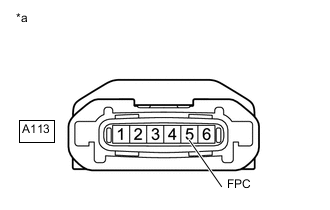
*a Front view of wire harness connector
(to Fuel Pump Control ECU)
Disconnect the fuel pump control ECU connector.
-
Connect the GTS to the DLC3.
-
Turn the ignition switch to ON.
-
Turn the GTS on.
-
Enter the following menus: Powertrain / Engine and ECT / Active Test / Control the Fuel Pump / Speed.
-
Operate the fuel pump control ECU assembly using the Active Test function and measure the resistance according to the value(s) in the table below.
Standard Resistance Tester Connection GTS Operation Specified Condition A113-5 (FPC) - Body ground Before Active Test → During Active Test Before Active Test: Resistance is stable → During Active Test: Resistance fluctuates* Tech Tips
*: Using the Active Test, duty control of the transistors in the ECM will be performed. Due to the duty control, resistance of the FPC terminal will be unstable during the Active Test. If the resistance is stable before the Active Test and fluctuates while performing the Active Test, it can be determined that the transistor is operating. If the transistor does not operate during the Active Test, the ECM may be malfunctioning.
Result Proceed to OK NG
OK
REPLACE FUEL PUMP CONTROL ECU ASSEMBLY
NG
REPLACE ECM Click here
-
-
CHECK HARNESS AND CONNECTOR (FUEL PUMP CONTROL ECU - BODY GROUND)
-
Disconnect the fuel pump control ECU connector.
-
Measure the resistance according to the value(s) in the table below.
Standard Resistance Tester Connection Condition Specified Condition A113-3 (E) - Body ground Always Below 1 Ω Result Proceed to OK NG
NG
REPAIR OR REPLACE HARNESS OR CONNECTOR
OK
-
-
CHECK HARNESS AND CONNECTOR (NO. 1 INTEGRATION RELAY - FUEL PUMP CONTROL ECU)
-
Remove the No. 1 integration relay connector.
-
Disconnect the A113 fuel pump control ECU connector.
-
Measure the resistance according to the value(s) in the table below.
Standard Resistance Tester Connection Condition Specified Condition 1E-4 - A113-6 (+B) Always Below 1 Ω 1E-4 or A113-6 (+B) - Body ground and other terminals Always 10 kΩ or higher Result Proceed to OK NG
NG
REPAIR OR REPLACE HARNESS OR CONNECTOR
OK
-
-
INSPECT NO. 1 INTEGRATION RELAY
-
Inspect the No. 1 integration relay.
Result Proceed to OK NG
OK
GO TO ECM POWER SOURCE CIRCUIT Click here
NG
REPLACE NO. 1 INTEGRATION RELAY
-