ECD SYSTEM(w/ DPF), Diagnostic DTC:P2453
| DTC Code | DTC Name |
|---|---|
| P2453 | Diesel Particulate Filter Pressure Sensor "A" Circuit Range/Performance |
DESCRIPTION
Refer to DTC P2454 Click here.
Tech Tips
If the exhaust pipe air hoses of the differential pressure sensor are incorrectly connected (crossed), the ECM interprets this as abnormal pressure difference, DTC P2453 will be stored and the MIL will be illuminated.
| DTC Detection Drive Pattern | DTC Detection Condition | Trouble Area |
|---|---|---|
| Start the engine and drive the vehicle with a engine speed of 3000 rpm or more (shift position: 3rd) for 10 minutes or more. Then turn the ignition switch off and wait for 30 seconds or more. |
All of the following conditions are met:
(1 trip detection logic) |
|
| DTC No. | Data List |
|---|---|
| P2453 | DPF Differential Pressure |
Tech Tips
DTC P2454 (Differential pressure sensor circuit low) and/or DTC P2455 (Differential pressure sensor high) will be present if there is an open or short in the differential pressure sensor circuit.
CAUTION / NOTICE / HINT
Note
When replacing the ECM and/or DPF catalyst, the ECM needs Registration and Initialization Click here.
Tech Tips
-
When the ECM must be replaced, before replacing the ECM, perform the "Learning Values Save" function using the intelligent tester. Then after installing the new ECM, perform all of the initialization/registrations for the "Learning Values Write" function by following the instructions shown on the tester display.
-
Read freeze frame data using the intelligent tester. Freeze frame data records the engine condition when malfunctions are detected. When troubleshooting, freeze frame data can help determine if the vehicle was moving or stationary, if the engine was warmed up or not, and other data from the time the malfunction occurred.
-
Check the DPF Differential Pressure using the intelligent tester by entering the following menus: Powertrain / Engine and ECT / Data List / DPF Differential Pressure. For reference, the results of a real-vehicle check are shown in the table below:
DPF Differential Pressure (Result of Real-Vehicle Check) Condition DPF Differential Pressure Idling (warm up the engine) 0.296 kPa Running without load (2500 rpm) 1.496 kPa Running without load (4000 rpm) 2.496 kPa Driving with the accelerator fully open at 2000 rpm 2.199 kPa Driving with the accelerator fully open at 3000 rpm 4.097 kPa Driving with the accelerator fully open at 4500 rpm 4.898 kPa
PROCEDURE
-
CHECK ANY OTHER DTCS OUTPUT (IN ADDITION TO DTC P2453)
-
Connect the intelligent tester to the DLC3.
-
Turn the ignition switch to ON and turn the tester on.
-
Enter the following menus: Powertrain / Engine and ECT / DTC.
-
Read the DTCs.
Result Result Proceed to DTC P2453 and "P2454 or P2455" A Except above B Tech Tips
If the DTC P2453 and "P2454 or P2455" are output, perform troubleshooting for DTC P2454 and P2455 first.
A 
GO TO DTC CHART Click here
B 
-
-
CHECK CONNECTION OF EXHAUST PIPE AIR HOSE (DIFFERENTIAL PRESSURE SENSOR - TRANSMITTING PIPE)
-
Check if exhaust pipe air hose routing between the differential pressure sensor and the vacuum transmitting pipe is correct.
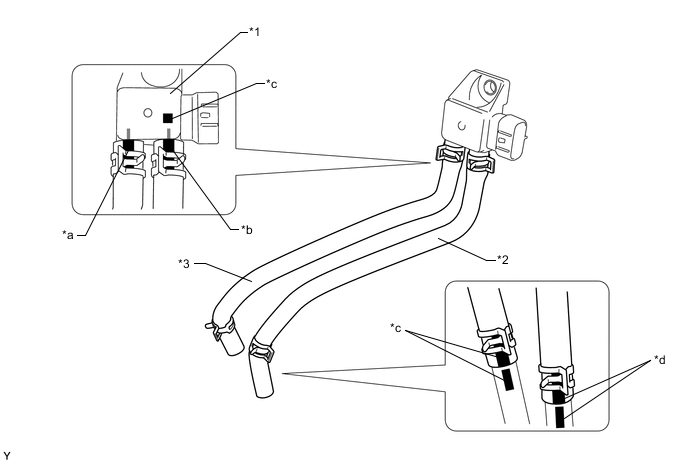
Text in Illustration *1 Differential Pressure Sensor *2 No. 1 Vacuum Transmitting Hose (for upstream) *3 No. 1 Vacuum Transmitting Hose (for downstream) - - *a Marked: Yellow *b Marked: Pink *c Marked: Red *d Marked: Orange -
Check that there is no exhaust gas leak between the differential pressure sensor and the vacuum transmitting pipe.
NG 
CORRECT TO NORMAL CONNECTION Click here
OK
-
-
CHECK BLOCKAGE OF EXHAUST PIPE AIR HOSE AND TRANSMITTING PIPE
CAUTION:
Be careful of being burned by exhaust gases during the following inspection.
-
Disconnect the exhaust pipe air hose (both upstream and downstream) on the differential pressure sensor.
-
Start the engine.
-
Check if there are exhaust gas pulsations from both exhaust pipe air hoses during idling.
OK There is no blockage.
NG
REPLACE CLOGGED PARTS Click here
OK
-
-
INSPECT DIFFERENTIAL PRESSURE SENSOR
-
Inspect the differential pressure sensor Click here.
OK Approximately the same pressure as the applied pressure is indicated. Tech Tips
The DPF Differential Pressure display is a value that does not reflect the zero point adjustment. Therefore the displayed value may vary about +/-0.3 kPa even if the applied differential pressure is 0 kPa.
NG
REPLACE DIFFERENTIAL PRESSURE SENSOR Click here
OK
-
-
PERFORM DIFFERENTIAL PRESSURE SENSOR LEARNING
-
Start the engine and wait until the engine coolant temperature reaches 75°C (167°F) or more (A).
-
Turn the ignition switch off and wait for 30 seconds or more (B).
-
Repeat the above procedures (A) and (B) 3 times.
Tech Tips
Procedures (A) and (B) must be repeated 3 times to complete the differential pressure sensor learning process.
NEXT
CONFIRM WHETHER MALFUNCTION HAS BEEN SUCCESSFULLY REPAIRED Click here
-
-
CORRECT TO NORMAL CONNECTION
NEXT
CONFIRM WHETHER MALFUNCTION HAS BEEN SUCCESSFULLY REPAIRED Click here
-
REPLACE CLOGGED PARTS
NEXT
CONFIRM WHETHER MALFUNCTION HAS BEEN SUCCESSFULLY REPAIRED Click here
-
REPLACE DIFFERENTIAL PRESSURE SENSOR
-
Replace the differential pressure sensor Click here.
-
Start the engine and wait until the engine coolant temperature reaches 75°C (167°F) or more (A).
-
Turn the ignition switch off and wait for 30 seconds or more (B).
-
Repeat the above procedures (A) and (B) 3 times.
Tech Tips
Procedures (A) and (B) must be repeated 3 times to complete the differential pressure sensor learning process.
NEXT
-
-
INSPECT DIFFERENTIAL PRESSURE SENSOR
-
Inspect the differential pressure sensor Click here.
OK Approximately the same pressure as the applied pressure is indicated. Tech Tips
The DPF Differential Pressure display is a value that does not reflect the zero point adjustment. Therefore the displayed value may vary about +/-0.3 kPa even if the applied differential pressure is 0 kPa.
OK
CONFIRM WHETHER MALFUNCTION HAS BEEN SUCCESSFULLY REPAIRED Click here
NG
-
-
REPLACE ECM
-
Replace the ECM Click here.
NEXT
-
-
CONFIRM WHETHER MALFUNCTION HAS BEEN SUCCESSFULLY REPAIRED
-
Connect the intelligent tester to the DLC3.
-
Turn the ignition switch to ON and turn the tester on.
-
Clear the DTCs Click here.
-
Turn the ignition switch off and wait for 30 seconds.
-
Start the engine and drive the vehicle with an engine speed of 3000 rpm or more (shift position: 3rd) for 10 minutes or more.
CAUTION:
When performing the confirmation driving pattern, obey all speed limits and traffic laws.
-
Turn the ignition switch off and wait for 30 seconds or more.
-
Turn the ignition switch to ON and turn the tester on.
-
Enter the following menus: Powertrain / Engine and ECT / DTC.
-
Confirm that the DTC is not output again.
NEXT
END
-