ECD SYSTEM(w/ DPF) PRECAUTION
-
INITIALIZATION AND REGISTRATION
Note
-
When the ECM and/or the other component(s) mentioned below are replaced, perform the following utility items, referring to the corresponding Initialization and Registration procedure.
-
If the ECM is replaced, register the ECU communication ID for Engine Immobiliser System (Refer to the Service Bulletin for Registration).
Tech Tips
When the ECM and other component(s) are replaced at the same time, perform the following utility items by following the instructions shown on the tester display, starting with the ECM.
Replacement Part Utility Item See page ECM
-
Learning Values Save
-
Learning Values Write
Injector Assembly
-
Injector Compensation
-
Pilot Quantity Learning Values Reset
DPF Catalyst DPF Deterioration Record Clear Air Fuel Ratio Sensor A/F Sensor Compensation Reset Engine Assembly
-
Injector Compensation
-
Pilot Quantity Learning Values Reset
-
DPF Deterioration Record means the ash accumulation volume in the DPF catalytic converter calculated by the ECM. If the ash accumulation volume in the DPF catalytic converter increases, the difference in pressure in front of and behind the DPF catalytic converter will increase. The difference in pressure in front of and behind the DPF catalytic converter is offset depending on the volume of accumulated ash.
Tech Tips
-
When the ECM must be replaced, before replacing the ECM, perform the "Learning Values Save" function using the intelligent tester. Then after installing the new ECM, perform all of the initialization/registrations for the "Learning Values Write" function by following the instructions shown on the tester display.
-
After replacing injector assembly, perform both the "Injector Compensation" and the "Pilot Quantity Learning Values Reset" functions using the intelligent tester.
-
After replacing the engine assembly, perform both the "Injector Compensation" and the "Pilot Quantity Learning Values Reset" functions using the intelligent tester.
-
-
INJECTOR COMPENSATION CODE
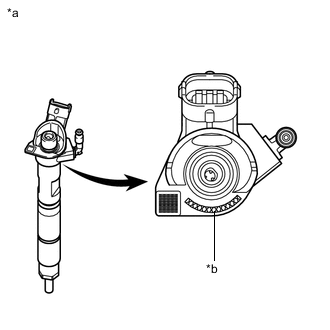
Text in Illustration *a Example *b Injector Compensation Code Tech Tips
Each injector assembly has different fuel injection characteristics. In order to optimize the fuel injections, the ECM uses the compensation codes to balance the different fuel injections between each injector assembly. Injector compensation codes are 12-digit, alphanumeric values printed on the head of each injector assembly.
Note
If an incorrect injector compensation code is input into the ECM, the engine assembly may rattle or engine idling may become rough. In addition, engine failure may occur and the life of the engine may be shortened.
-
OIL MAINTENANCE LIGHT AND MIL
Tech Tips
The troubleshooting procedure will be different depending on the combination of the output DTCs and indicator light status (oil maintenance light and MIL) in the combination meter. Thus, perform troubleshooting referring to the table below.
-
Connect the intelligent tester to the DLC3.
-
Turn the ignition switch to ON and turn the tester on.
-
Enter the following menus: Powertrain / Engine and ECT / DTC.
-
Read the output DTCs combination of P252F and P2463.
No. Oil Maintenance Light Status MIL Status Note Proceed to 0 OFF OFF Normal condition - 1 Blinks OFF
-
(a) Travel distance oil change request
-
(b) Cumulative soot oil change request
-
(c) Oil high malfunction detected in 2 consecutive trip
-
Replace engine oil and filter
-
Reset oil maintenance light
-
Drive vehicle to reset oil high level malfunction
2 ON OFF Oil maintenance light ON when vehicle driven without replacing engine oil after either of the above conditions 1-(a) or 1-(b) is detected 3 Blinks OFF
DTC P252F detected
DTC P252F is detected when oil high level malfunction detected in 2 consecutive trips P252F
4 ON OFF
DTC P252F detected
Oil maintenance light ON when 400 km (249 miles) traveled after DTC P252F is detected P252F
5 ON ON
DTC P252F and P2463 detected
-
Oil maintenance light ON when 400 km (249 miles) traveled after DTC P252F is detected
-
DTC P2463 is detected when 1000 km* (621 miles) traveled after the oil maintenance light is turned to ON
P252F
Tech Tips
*: DTC P2463 detection distance varies depending on the operation conditions.
-
-
-
DPF WARNING LIGHT
-
If the DPF warning light does not turn off 3 seconds after the ignition switch is turned on, or if the DPF warning light turns on at any other time, perform the following procedures.
Note
If DTC P252F is stored, troubleshoot the DTC first Click here.
-
Drive the vehicle for 20 to 30 minutes at 65 km/h (40 mph) or more until the DPF warning light turns off.
CAUTION:
When performing the confirmation driving pattern, obey all speed limits and traffic laws.
-
When the DPF warning light does not turned off for 40 minutes or more even if driving, perform following procedures.
-
Connect the intelligent tester to the DLC3. [A]
-
Start the engine and turn the tester on. [B]
-
Clear the DTCs Click here. [C]
-
Enter the following menus: Powertrain / Engine and ECT / Active Test / Activate the DPF Rejuvenate (PM) / Data List / Exhaust Temperature B1S1, Exhaust Temperature B1S2 and DPNR/DPF Status Reju(PM). [D]
Tech Tips
After clearing DTCs, immediately enter the Active Test / Activate the DPF Rejuvenate (PM), and then drive the vehicle.
-
Perform the Active Test and then drive the vehicle at a constant engine speed of 2000 rpm or more (shift position: 3rd) and a vehicle speed within 65 to 100 km/h (40 to 62 mph). [E]
Note
When performing the confirmation driving pattern, obey all speed limits and traffic laws.
Tech Tips
While the Active Test / Activate the DPF Rejuvenate (PM) is performing, the accelerator pedal opening angle should be kept as constant as possible.
-
Confirm that both Exhaust Temperature B1S1 and Exhaust Temperature B1S2 reach 250°C (482°F) or more and the DPNR/DPF Status Reju(PM) turns from "Ready" to "Operate". [F]
Tech Tips
-
If the exhaust gas temperature does not reach the specified value, drive the vehicle again with a constant engine speed of 2000 rpm or more (shift position: 3rd) and a vehicle speed within 65 to 100 km/h (40 to 62 mph).
-
Perform Active Test / Activate the DPF Rejuvenate(PM) until the DPNR/DPF Status Reju(PM) displays "Compl".
-
-
Confirm the DPF warning light is turn off.
Tech Tips
-
If the DPF warning light does not turn off, repeat the procedure from [step A to F].
-
If the DPF warning light still does not turn off even after repeating the procedure, replace the No. 2 exhaust manifold converter sub-assembly (DPF catalytic converter).
-
-
-
-
FOR USING INTELLIGENT TESTER
CAUTION:
-
Read the instruction manuals before using the tester.
-
Prevent the tester cable from being caught on the pedals, shift lever and steering wheel when driving with the tester connected to the vehicle.
-
When driving the vehicle for testing purposes and using the tester, two persons are required. One for driving the vehicle, and the other for operating the tester.
-
-
IGNITION SWITCH EXPRESSIONS
-
The type of ignition switch used on this model differs according to the specifications of the vehicle. The expressions listed in the table below are used in this section.
Expression Ignition Switch (Position) Engine Switch (Condition) Ignition switch off LOCK Off Ignition switch ACC ACC On (ACC) Ignition switch ON ON On (IG) Engine start START Start
-