SFI SYSTEM(w/ Canister Pump Module), Diagnostic DTC:P042000, P043000
| DTC Code | DTC Name |
|---|---|
| P042000 | Catalyst System Efficiency Below Threshold Bank 1 |
| P043000 | Catalyst System Efficiency Below Threshold Bank 2 |
MONITOR DESCRIPTION
The ECM uses sensors mounted in front of and behind the Three-Way Catalytic Converter (TWC) to monitor its efficiency.
The first sensor, the air fuel ratio sensor (sensor 1), sends pre-catalyst information to the ECM. The second sensor, the air fuel ratio sensor (sensor 2), sends post-catalyst information to the ECM.
In order to detect any deterioration in the three-way catalytic converter, the ECM calculates the oxygen storage capacity of the three-way catalytic converter. This calculation is based on the output current of the air fuel ratio sensor (sensor 2) while performing active air fuel ratio control.
The oxygen storage capacity value is an indication of the oxygen storage capacity of the three-way catalytic converter. When the vehicle is being driven with a warm engine, active air fuel ratio control is performed for approximately 30 seconds. When it is performed, the ECM deliberately sets the air fuel ratio to lean or rich levels. If the cycle of the waveform for the air fuel ratio sensor (sensor 2) is long, the oxygen storage capacity is great. There is a direct correlation between the air fuel ratio sensor (sensor 2) and the oxygen storage capacity of the three-way catalytic converter.
The ECM uses the oxygen storage capacity value to determine the state of the three-way catalytic converter. If any deterioration has occurred, the ECM will illuminate the MIL and store a DTC.
This system determines the deterioration of the entire catalyst system (including the front and rear catalysts), by using the oxygen storage capacity value of the front catalyst, that is more sensitive than the rear catalyst, as the representative value. Therefore, be sure to replace the front and rear catalysts together when catalyst replacement is necessary.
| DTC No. | Detection Item | DTC Detection Condition | Trouble Area | MIL | Memory | Note |
|---|---|---|---|---|---|---|
| P042000 | Catalyst System Efficiency Below Threshold Bank 1 | The oxygen storage capacity value is less than the standard value under active air fuel ratio control (1 trip detection logic). |
|
Comes on | DTC stored | SAE: P0420 |
| P043000 | Catalyst System Efficiency Below Threshold Bank 2 | The oxygen storage capacity value is less than the standard value under active air fuel ratio control (1 trip detection logic). |
|
Comes on | DTC stored | SAE: P0430 |
CATALYST LOCATION
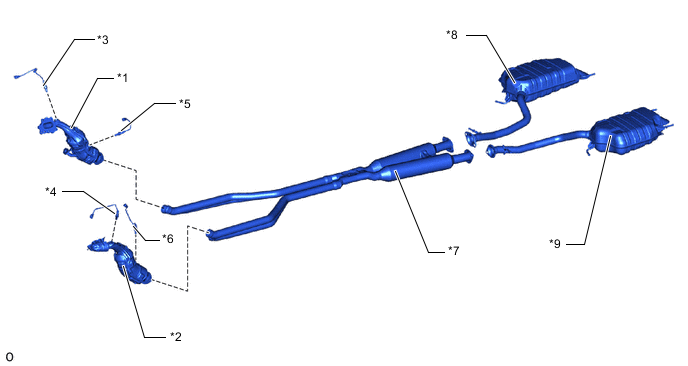
| *1 | Exhaust Manifold Sub-assembly RH (TWC: Front Catalyst and Rear Catalyst) | *2 | Exhaust Manifold Sub-assembly LH (TWC: Front Catalyst and Rear Catalyst) |
| *3 | Air Fuel Ratio Sensor (Bank 1 Sensor 1) | *4 | Air Fuel Ratio Sensor (Bank 2 Sensor 1) |
| *5 | Air Fuel Ratio Sensor (Bank 1 Sensor 2) | *6 | Air Fuel Ratio Sensor (Bank 2 Sensor 2) |
| *7 | Front Exhaust Pipe Assembly | *8 | Tailpipe Assembly RH |
| *9 | Tailpipe Assembly LH | - | - |
MONITOR STRATEGY
| Required Sensors/Components (Main) | Air fuel ratio sensor (sensor 1) Air fuel ratio sensor (sensor 2) |
| Required Sensors/Components (Related) | Intake air temperature sensor Mass air flow meter sub-assembly Crankshaft position sensor Engine coolant temperature sensor |
| Frequency of Operation | Once per driving cycle |
TYPICAL ENABLING CONDITIONS
| Response rate during fuel cut from rich condition | Completed |
| Auxiliary battery voltage | 11 V or higher |
| Intake air temperature | -10°C (14°F) or higher |
| Engine coolant temperature | 75°C (167°F) or higher |
| Atmospheric pressure | 76 kPa(abs) [11.02 psi(abs)] or higher |
| Idling | Off |
| Engine speed | Less than 4000 rpm |
| Air fuel ratio sensor status | Activated |
| Fuel system status | Closed loop |
| Engine load | 10% or higher, and less than 90% |
| All of the following conditions are met | 1, 2 and 3 |
| 1. Mass air flow | 3 gm/sec or more, and less than 90 gm/sec |
| 2. Front catalyst temperature (estimated) | 500°C (932°F) or higher, and less than 800°C (1472°F) |
| 3. Rear catalyst temperature (estimated) | 475°C (887°F) or higher, and less than 700°C (1292°F) |
TYPICAL MALFUNCTION THRESHOLDS
| Oxygen Storage Capacity (OSC) of catalyst (Normalized) | Less than 1 |
CONFIRMATION DRIVING PATTERN
Tech Tips
-
It is necessary for the response of the air fuel ratio sensor (sensor 2) to be normal in order to confirm DTC P042000 and P043000. Therefore, perform the confirmation driving pattern for the air fuel ratio sensor (sensor 2) monitor before performing the confirmation driving pattern for the catalyst efficiency monitor.
-
Performing this confirmation driving pattern will activate the catalyst efficiency monitor. This is very useful for verifying the completion of a repair.
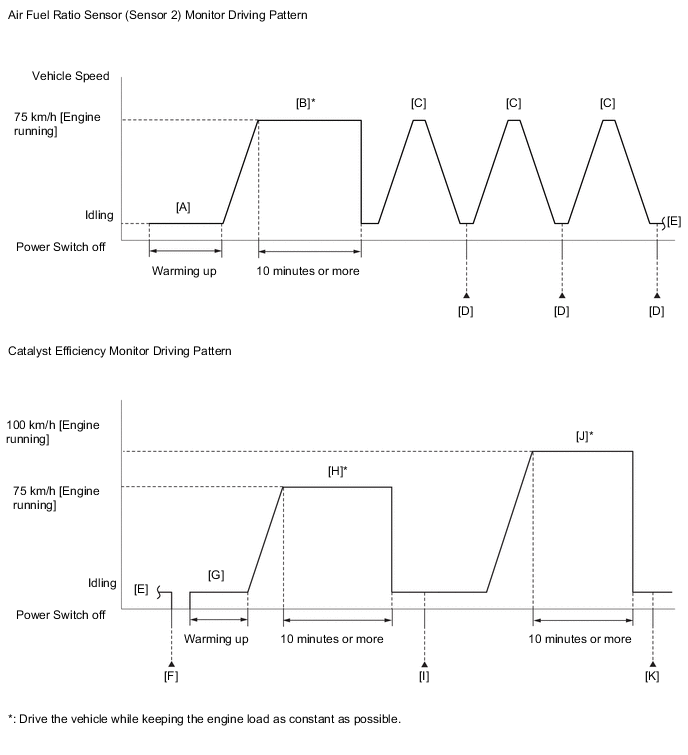
-
Connect the GTS to the DLC3.
-
Turn the power switch on (IG).
-
Turn the GTS on.
-
Clear the DTCs (even if no DTCs are stored, perform the clear DTC procedure).
-
Turn the power switch off and wait for at least 30 seconds.
-
Turn the power switch on (IG).
-
Turn the GTS on.
-
Put the engine in Inspection Mode (2WD for measuring Exhaust Gas).
-
Start the engine and warm it up until the engine coolant temperature is 75°C (167°F) or higher with park (P) selected [A].
Tech Tips
In order to keep the idle stable, turn the A/C and all other electric loads off and do not perform any shift operations.
-
With the engine running, drive the vehicle at approximately 75 km/h (47 mph) for 10 minutes or more [B].
CAUTION:
When performing the confirmation driving pattern, obey all speed limits and traffic laws.
Tech Tips
-
Drive the vehicle while keeping the engine load as constant as possible.
-
If the engine stops, further depress the accelerator pedal to restart the engine.
-
-
With shift state M selected and the engine running, drive the vehicle at 75 km/h (47 mph), and then decelerate the vehicle by releasing the accelerator pedal for 5 seconds or more to perform the fuel-cut [C].
CAUTION:
When performing the confirmation driving pattern, obey all speed limits and traffic laws.
Tech Tips
If the engine stops, further depress the accelerator pedal to restart the engine.
-
Enter the following menus: Powertrain / Engine / Utility / All Readiness [D].
-
Input the DTC: P013A7C or P013C7C.
-
Check the DTC judgment result.
GTS Display Description NORMAL
-
DTC judgment completed
-
System normal
ABNORMAL
-
DTC judgment completed
-
System abnormal
INCOMPLETE
-
DTC judgment not completed
-
Perform driving pattern after confirming DTC enabling conditions
Tech Tips
-
If the judgment result shows NORMAL, perform the following procedure.
-
If the judgment result shows INCOMPLETE, perform step [C] again.
-
-
Turn the power switch off and wait for at least 30 seconds [E].
-
Turn the power switch on (IG).
-
Turn the GTS on.
-
Put the engine in Inspection Mode (2WD for measuring Exhaust Gas).
-
Start the engine and warm it up until the engine coolant temperature is 75°C (167°F) or higher [F].
-
With the engine running, drive the vehicle at approximately 75 km/h (47 mph) for 10 minutes or more [G].
CAUTION:
When performing the confirmation driving pattern, obey all speed limits and traffic laws.
Tech Tips
-
Drive the vehicle while keeping the engine load as constant as possible.
-
The monitor item will change to Complete as the Catalyst Efficiency monitor operates.
-
If the engine stops, further depress the accelerator pedal to restart the engine.
-
-
Enter the following menus: Powertrain / Engine / Trouble Codes [H].
-
Check if any DTCs are stored.
Tech Tips
If the monitor item does not change to Complete, and no DTCs are stored, perform the following procedure.
-
With the engine running, drive the vehicle at approximately 100 km/h (62 mph) for 10 minutes or more [I].
CAUTION:
When performing the confirmation driving pattern, obey all speed limits and traffic laws.
Tech Tips
-
Drive the vehicle while keeping the engine load as constant as possible.
-
The monitor item will change to Complete as the Catalyst Efficiency monitor operates.
-
If the engine stops, further depress the accelerator pedal to restart the engine.
-
-
Enter the following menus: Powertrain / Engine / Trouble Codes [J].
-
Check if any DTCs are stored.
Tech Tips
If the monitor item does not change to Complete, and no DTCs are stored, extend the driving time.
-
Enter the following menus: Powertrain / Engine / Utility / All Readiness.
-
Input the DTC: P042000 or P043000.
-
Check the DTC judgment result.
GTS Display Description NORMAL
-
DTC judgment completed
-
System normal
ABNORMAL
-
DTC judgment completed
-
System abnormal
INCOMPLETE
-
DTC judgment not completed
-
Perform driving pattern after confirming DTC enabling conditions
Tech Tips
-
If the judgment result shows NORMAL, the system is normal.
-
If the judgment result shows ABNORMAL, the system has a malfunction.
-
CAUTION / NOTICE / HINT
Note
-
Vehicle Control History may be stored in the hybrid vehicle control ECU if the engine is malfunctioning. Certain vehicle condition information is recorded when Vehicle Control History is stored. Reading the vehicle conditions recorded in both the freeze frame data and Vehicle Control History can be useful for troubleshooting.
(Select Powertrain in Health Check and then check the time stamp data.)
-
If any "Engine Malfunction" Vehicle Control History item has been stored in the hybrid vehicle control ECU, make sure to clear it. However, as all Vehicle Control History items are cleared simultaneously, if any Vehicle Control History items other than "Engine Malfunction" are stored, make sure to perform any troubleshooting for them before clearing Vehicle Control History.
Tech Tips
-
If a malfunction cannot be found when troubleshooting DTC P042000 or P043000, a lean or rich abnormality may be the cause. Perform troubleshooting by following the inspection procedure for P017100 and P017400 (System Too Lean) and P017200 and P017500 (System Too Rich).
-
Bank 1 refers to the bank that includes the No. 1 cylinder*.
*: The No. 1 cylinder is the cylinder which is farthest from the transmission.
-
Bank 2 refers to the bank that does not include the No. 1 cylinder.
-
Sensor 1 refers to the sensor closest to the engine assembly.
-
Sensor 2 refers to the sensor farthest away from the engine assembly.
-
Read freeze frame data using the GTS. The ECM records vehicle and driving condition information as freeze frame data the moment a DTC is stored. When troubleshooting, freeze frame data can help determine if the vehicle was moving or stationary, if the engine was warmed up or not, if the air fuel ratio was lean or rich, and other data from the time the malfunction occurred.
PROCEDURE
-
CHECK ANY OTHER DTCS OUTPUT (IN ADDITION TO DTC P042000 AND/OR P043000)
-
Connect the GTS to the DLC3.
-
Turn the power switch on (IG).
-
Turn the GTS on.
-
Enter the following menus: Powertrain / Engine / Trouble Codes.
-
Read the DTCs.
Powertrain > Engine > Trouble CodesResult Result Proceed to DTC P042000 and/or P043000 is output A DTC P042000 and/or P043000 and other DTCs are output B Tech Tips
If any DTCs other than P042000 and/or P043000 are output, troubleshoot those DTCs first.
B 
GO TO DTC CHART Click here
A 
-
-
CHECK PCV HOSE CONNECTIONS
-
Check the PCV hose connections.
OK PCV valve and hose are connected correctly and are not damaged. Result Proceed to OK NG
OK 
GO TO STEP 4 Click here
NG
-
-
REPAIR OR REPLACE PCV HOSE
-
Repair or replace the PCV hose.
Result Proceed to NEXT
NEXT
-
-
PERFORM ACTIVE TEST USING GTS (CONTROL THE INJECTION VOLUME FOR A/F SENSOR)
-
Connect the GTS to the DLC3.
-
Turn the power switch on (IG).
-
Turn the GTS on.
-
Put the engine in Inspection Mode (2WD for measuring Exhaust Gas).
Powertrain > Hybrid Control > UtilityTester Display Inspection Mode -
Start the engine and warm it up until the engine coolant temperature is 75°C (167°F) or higher.
-
Idle the engine for 5 minutes or more with park (P) selected.
-
Enter the following menus: Powertrain / Engine / Active Test / Control the Injection Volume for A/F Sensor / Data List / A/F (O2) Sensor Current B1S1 and A/F (O2) Sensor Current B1S2 or A/F (O2) Sensor Current B2S1 and A/F (O2) Sensor Current B2S2.
Powertrain > Engine > Active TestActive Test Display Control the Injection Volume for A/F Sensor Data List Display A/F (O2) Sensor Current B1S1 A/F (O2) Sensor Current B2S1 A/F (O2) Sensor Current B1S2 A/F (O2) Sensor Current B2S2 -
Change the fuel injection volume using the GTS, and monitor the output voltage of the air fuel ratio sensor (sensor 1) [A/F (O2) Sensor Current B1S1 or A/F (O2) Sensor Current B2S1] and air fuel ratio sensor (sensor 2) [A/F (O2) Sensor Current B1S2 or A/F (O2) Sensor Current B2S2] displayed on the GTS.
Tech Tips
-
The Active Test "Control the Injection Volume for A/F Sensor" can be used to lower the fuel injection volume by 12.5% or increase the injection volume by 12.5%.
-
The air fuel ratio sensor (sensor 1) has an output delay of a few seconds and the air fuel ratio sensor (sensor 2) has a maximum output delay of approximately 20 seconds.
-
If the sensor output value does not change (almost no reaction) while performing the Active Test, the sensor may be malfunctioning.
Standard GTS Display
(Sensor)
Injection Volume Status Value A/F (O2) Sensor Current B1S1
A/F (O2) Sensor Current B2S1
(Air fuel ratio (sensor 1))
12.5% Rich Below -0.075 mA -12.5% Lean Higher than 0.037 mA A/F (O2) Sensor Current B1S2
A/F (O2) Sensor Current B2S2
(Air fuel ratio (sensor 2))
12.5% Rich Below -0.86 mA -12.5% Lean Higher than 0.33 mA Result Status of A/F (O2) Sensor Current B1S1 or A/F (O2) Sensor Current B2S1 Status of A/F (O2) Sensor Current B1S2 or A/F (O2) Sensor Current B2S2 Actual air fuel ratio, air fuel ratio sensor (sensor 1) and air fuel ratio sensor (sensor 2) condition Main Suspected Trouble Area Proceed to Lean/Rich Lean/Rich Normal
-
Three-way catalytic converter
-
Gas leak from exhaust system
-
EGR valve assembly
A Lean Lean/Rich Air fuel ratio sensor (sensor 1) malfunction
-
Air fuel ratio sensor (sensor 1)
B Rich Lean/Rich Air fuel ratio sensor (sensor 1) malfunction
-
Air fuel ratio sensor (sensor 1)
Lean/Rich Lean Air fuel ratio sensor (sensor 2) malfunction
-
Air fuel ratio sensor (sensor 2)
-
Gas leak from exhaust system
C Lean/Rich Rich Air fuel ratio sensor (sensor 2) malfunction
-
Air fuel ratio sensor (sensor 2)
-
Gas leak from exhaust system
Lean Lean Actual air fuel ratio lean
-
Extremely lean actual air fuel ratio
-
Gas leak from exhaust system
-
EGR valve assembly
D Rich Rich Actual air fuel ratio rich
-
Extremely rich actual air fuel ratio
-
Gas leak from exhaust system
-
EGR valve assembly
-
Lean: During the Control the Injection Volume for A/F Sensor Active Test, the air fuel ratio sensor (sensor 1) output current (A/F (O2) Sensor Current B1S1 or A/F (O2) Sensor Current B2S1) is consistently higher than 0.037 mA, and the air fuel ratio sensor (sensor 2) output currents (A/F (O2) Sensor Current B1S2 or A/F (O2) Sensor Current B2S2) is consistently higher than 0.33 mA.
-
Rich: During the Control the Injection Volume for A/F Sensor Active Test, the A/F (O2) Sensor Current B1S1 or A/F (O2) Sensor Current B2S1 is consistently below -0.075 mA, and the A/F (O2) Sensor Current B1S2 or A/F (O2) Sensor Current B2S2 is consistently below -0.86 mA.
-
Lean/Rich: During the Control the Injection Volume for A/F Sensor Active Test, the output value of the air fuel ratio sensor (sensor 1) or air fuel ratio sensor (sensor 2) alternate correctly.
-
B
REPLACE AIR FUEL RATIO SENSOR (SENSOR 1) Click here
C
CHECK FOR EXHAUST GAS LEAK Click here
D
CHECK FOR EXHAUST GAS LEAK Click here
A
-
-
CHECK FOR EXHAUST GAS LEAK
-
Check for exhaust gas leaks.
OK No gas leaks in exhaust system. Result Proceed to OK NG
NG
GO TO STEP 15 Click here
OK
-
-
PERFORM ACTIVE TEST USING GTS (CONTROL THE EGR STEP POSITION)
-
Connect the GTS to the DLC3.
-
Turn the power switch on (IG).
-
Turn the GTS on.
-
Put the engine in Inspection Mode (2WD for measuring Exhaust Gas).
Powertrain > Hybrid Control > UtilityTester Display Inspection Mode -
Start the engine and warm it up until the engine coolant temperature is 75°C (167°F) or higher.
Tech Tips
The A/C switch and all accessories should be off.
-
Enter the following menus: Powertrain / Engine / Active Test / Control the EGR Step Position / Data List / Intake Manifold Absolute Pressure and Engine Independent.
Powertrain > Engine > Active TestActive Test Display Control the EGR Step Position Data List Display Intake Manifold Absolute Pressure Engine Independent -
Confirm that the value of Data List item Engine Independent is "Operate" then check the value of Intake Manifold Absolute Pressure while performing the Active Test.
Note
-
Make sure that the value of Data List item Engine Independent is "Operate" while performing the Active Test.
-
Do not leave the EGR valve open for 10 seconds or more during the Active Test.
-
Be sure to return the EGR valve to step 0 when the Active Test is completed.
-
Do not open the EGR valve 30 steps or more during the Active Test.
OK The value of Intake Manifold Absolute Pressure changes in response to the EGR step position when the value of Engine Independent is "Operate". Standard - Control the EGR Step Position (Active Test) 0 Steps 0 to 30 Steps Intake Manifold Absolute Pressure
(Data List)
(EGR valve is fully closed) Intake Manifold Absolute Pressure value is at least +10 kPa (1.45 psi) higher than when EGR valve is fully closed Tech Tips
-
If the value of Data List item Engine Independent is "Not Opr" when the engine is idling, charge control is being performed. Perform the Active Test after charge control is complete ("Operate" is displayed).
-
While performing the Active Test, if the increase in the value of Intake Manifold Absolute Pressure is small, the EGR valve assembly may be malfunctioning.
-
Even if the EGR valve assembly is malfunctioning, rough idling or an increase in the value of Intake Manifold Absolute Pressure may occur while performing the Active Test. However, the amount that the value of Intake Manifold Absolute Pressure increases will be smaller than normal.
Result Proceed to OK NG -
OK
GO TO STEP 18 Click here
NG
-
-
INSPECT EGR VALVE ASSEMBLY
-
Remove the EGR valve assembly.
-
Check if the EGR valve is stuck open.
OK EGR valve is tightly closed. Result Proceed to OK NG
OK
GO TO STEP 18 Click here
NG
REPLACE EGR VALVE ASSEMBLY Click here
-
-
REPLACE AIR FUEL RATIO SENSOR (SENSOR 1)
-
Replace the air fuel ratio sensor (sensor 1).
Tech Tips
Perform "Inspection After Repair" after replacing the air fuel ratio sensor (sensor 1).
Result Proceed to NEXT
NEXT
GO TO STEP 16 Click here
-
-
CHECK FOR EXHAUST GAS LEAK
-
Check for exhaust gas leaks.
OK No gas leaks in exhaust system. Result Proceed to OK NG
NG
GO TO STEP 15 Click here
OK
-
-
REPLACE AIR FUEL RATIO SENSOR (SENSOR 2)
-
Replace the air fuel ratio sensor (sensor 2).
Tech Tips
Perform "Inspection After Repair" after replacing the air fuel ratio sensor (sensor 2).
Result Proceed to NEXT
NEXT
GO TO STEP 16 Click here
-
-
CHECK FOR EXHAUST GAS LEAK
-
Check for exhaust gas leaks.
OK No gas leaks in exhaust system. Result Proceed to OK NG
NG
REPAIR OR REPLACE EXHAUST SYSTEM Click here
OK
-
-
PERFORM ACTIVE TEST USING GTS (CONTROL THE EGR STEP POSITION)
-
Connect the GTS to the DLC3.
-
Turn the power switch on (IG).
-
Turn the GTS on.
-
Put the engine in Inspection Mode (2WD for measuring Exhaust Gas).
Powertrain > Hybrid Control > UtilityTester Display Inspection Mode -
Start the engine and warm it up until the engine coolant temperature is 75°C (167°F) or higher.
Tech Tips
The A/C switch and all accessories should be off.
-
Enter the following menus: Powertrain / Engine / Active Test / Control the EGR Step Position / Data List / Intake Manifold Absolute Pressure and Engine Independent.
Powertrain > Engine > Active TestActive Test Display Control the EGR Step Position Data List Display Intake Manifold Absolute Pressure Engine Independent -
Confirm that the value of Data List item Engine Independent is "Operate" then check the value of Intake Manifold Absolute Pressure while performing the Active Test.
Note
-
Make sure that the value of Data List item Engine Independent is "Operate" while performing the Active Test.
-
Do not leave the EGR valve open for 10 seconds or more during the Active Test.
-
Be sure to return the EGR valve to step 0 when the Active Test is completed.
-
Do not open the EGR valve 30 steps or more during the Active Test.
OK The value of Intake Manifold Absolute Pressure changes in response to the EGR step position when the value of Engine Independent is "Operate". Standard - Control the EGR Step Position (Active Test) 0 Steps 0 to 30 Steps Intake Manifold Absolute Pressure
(Data List)
(EGR valve is fully closed) Intake Manifold Absolute Pressure value is at least +10 kPa (1.45 psi) higher than when EGR valve is fully closed Tech Tips
-
If the value of Data List item Engine Independent is "Not Opr" when the engine is idling, charge control is being performed. Perform the Active Test after charge control is complete ("Operate" is displayed).
-
While performing the Active Test, if the increase in the value of Intake Manifold Absolute Pressure is small, the EGR valve assembly may be malfunctioning.
-
Even if the EGR valve assembly is malfunctioning, rough idling or an increase in the value of Intake Manifold Absolute Pressure may occur while performing the Active Test. However, the amount that the value of Intake Manifold Absolute Pressure increases will be smaller than normal.
Result Proceed to OK NG -
OK
GO TO STEP 14 Click here
NG
-
-
INSPECT EGR VALVE ASSEMBLY
-
Remove the EGR valve assembly.
-
Check if the EGR valve is stuck open.
OK EGR valve is tightly closed. Result Proceed to OK NG
NG
REPLACE EGR VALVE ASSEMBLY Click here
OK
-
-
CHECK CAUSE OF EXTREMELY RICH OR LEAN ACTUAL AIR FUEL RATIO
-
Check the cause of extremely rich or lean actual air fuel ratio, referring to the DTC P017100, P017200, P017400 and P017500 Inspection Procedure.
Result Proceed to NEXT
NEXT
GO TO STEP 16 Click here
-
-
REPAIR OR REPLACE EXHAUST SYSTEM
-
Repair or replace exhaust system.
Tech Tips
Perform "Inspection After Repair" after repairing or replacing the exhaust system.
Result Proceed to NEXT
NEXT
-
-
CLEAR DTC
-
Connect the GTS to the DLC3.
-
Turn the power switch on (IG).
-
Turn the GTS on.
-
Clear the DTCs.
Powertrain > Engine > Clear DTCs -
Turn the power switch off and wait for at least 30 seconds.
Result Proceed to NEXT
NEXT
-
-
CONFIRM WHETHER MALFUNCTION HAS BEEN SUCCESSFULLY REPAIRED
-
Drive the vehicle in accordance with the driving pattern described in Confirmation Driving Pattern.
-
Enter the following menus: Powertrain / Engine / Trouble Codes.
-
Read the DTCs.
Powertrain > Engine > Trouble CodesResult Result Proceed to DTCs are not output A DTC P042000 and/or P043000 is output B
A
END
B
-
-
CHECK DTC OUTPUT (DTC P042000 AND/OR P043000)
Tech Tips
Confirm the replacement parts, referring to the illustration in Catalyst Location.
-
Connect the GTS to the DLC3.
-
Turn the power switch on (IG).
-
Turn the GTS on.
-
Enter the following menus: Powertrain / Engine / Trouble Codes.
-
Read the DTCs.
Powertrain > Engine > Trouble CodesResult Result Proceed to DTC P042000 is output A DTC P043000 is output B DTC P042000 and P043000 are output C
A
REPLACE EXHAUST MANIFOLD ASSEMBLY RH (TWC: FRONT CATALYST AND REAR CATALYST) Click here
B
REPLACE EXHAUST MANIFOLD ASSEMBLY LH (TWC: FRONT CATALYST AND REAR CATALYST) Click here
C
REPLACE EXHAUST MANIFOLD ASSEMBLY RH AND LH (TWC: FRONT CATALYST AND REAR CATALYST) Click here
-