SFI SYSTEM(w/ Canister Pump Module), Diagnostic DTC:P012800
| DTC Code | DTC Name |
|---|---|
| P012800 | Coolant Thermostat (Coolant Temperature Below Thermostat Regulating Temperature) |
DESCRIPTION
This DTC is stored when the engine coolant temperature does not reach 75°C (167°F) despite sufficient engine warm-up time having elapsed.
| DTC No. | Detection Item | DTC Detection Condition | Trouble Area | MIL | Memory | Note |
|---|---|---|---|---|---|---|
| P012800 | Coolant Thermostat (Coolant Temperature Below Thermostat Regulating Temperature) | All of the following conditions are met for 5 seconds or more (2 trip detection logic):
|
|
Comes on | DTC stored | SAE: P0128 |
MONITOR DESCRIPTION
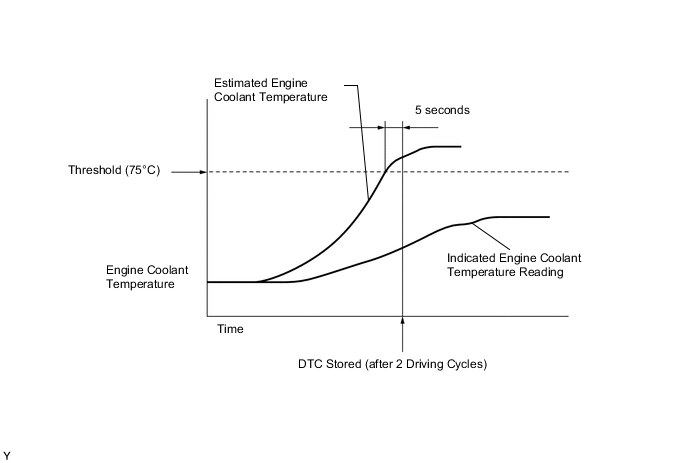
The ECM estimates the engine coolant temperature based on the starting temperature, engine load, and engine speed. The ECM then compares the estimated temperature with the actual engine coolant temperature. When the estimated engine coolant temperature reaches 75°C (167°F), the ECM checks the actual engine coolant temperature. If the actual engine coolant temperature is less than 75°C (167°F), the ECM interprets this as a malfunction of the thermostat or in the engine cooling system, illuminate the MIL and stores this DTC.
MONITOR STRATEGY
| Frequency of Operation | Once per driving cycle |
CONFIRMATION DRIVING PATTERN
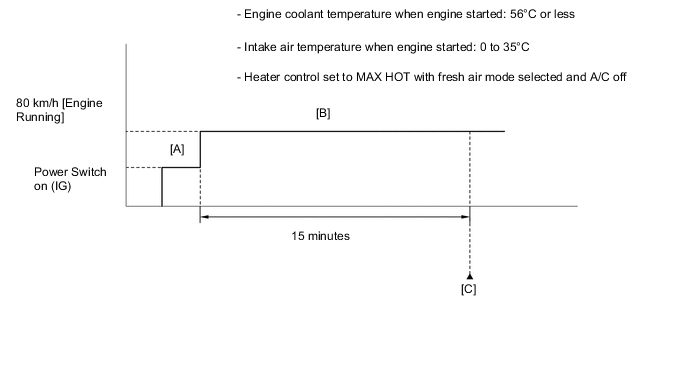
-
Turn the power switch off and leave the vehicle for several hours.
-
Connect the GTS to the DLC3.
-
Turn the power switch on (IG) [A].
-
Turn the GTS on.
-
Enter the following menus: Powertrain / Engine / Data List / Coolant Temperature and Intake Air Temperature.
-
Check that the value of the Data List item Coolant Temperature is 56°C (133°F) or less and the value of the Data List item Intake Air Temperature is between 0 and 35°C (32 and 95°F).
-
Put the engine in Inspection Mode (2WD for measuring Exhaust Gas).
-
Set the heater control to MAX HOT with fresh air mode selected and turn the A/C off.
-
Start the engine.
-
With the engine running, drive the vehicle at 80 km/h (50 mph) for 15 minutes [B].
CAUTION:
When performing the confirmation driving pattern, obey all speed limits and traffic laws.
Tech Tips
If the engine stops, further depress the accelerator pedal to restart the engine.
-
After the value of the Data List item Coolant Temperature stabilizes, check that it is 75°C (167°F) or higher.
Tech Tips
-
If the value of the Data List item Coolant Temperature is less than 75°C (167°F) while driving the vehicle at 80 km/h (50 mph), inspect the cooling system and thermostat.
-
-
Enter the following menus: Powertrain / Engine / Trouble Codes [C].
-
Read the pending DTCs.
Tech Tips
-
If a pending DTC is output, the system is malfunctioning.
-
If a pending DTC is not output, perform the following procedure.
-
-
Enter the following menus: Powertrain / Engine / Utility / All Readiness.
-
Input the DTC: P012800.
-
Check the DTC judgment result.
GTS Display Description NORMAL
-
DTC judgment completed
-
System normal
ABNORMAL
-
DTC judgment completed
-
System abnormal
INCOMPLETE
-
DTC judgment not completed
-
Perform driving pattern after confirming DTC enabling conditions
Tech Tips
-
If the judgment result shows NORMAL, the system is normal.
-
If the judgment result shows ABNORMAL, the system has a malfunction.
-
CAUTION / NOTICE / HINT
Note
-
Vehicle Control History may be stored in the hybrid vehicle control ECU if the engine is malfunctioning. Certain vehicle condition information is recorded when Vehicle Control History is stored. Reading the vehicle conditions recorded in both the freeze frame data and Vehicle Control History can be useful for troubleshooting.
(Select Powertrain in Health Check and then check the time stamp data.)
-
If any "Engine Malfunction" Vehicle Control History item has been stored in the hybrid vehicle control ECU, make sure to clear it. However, as all Vehicle Control History items are cleared simultaneously, if any Vehicle Control History items other than "Engine Malfunction" are stored, make sure to perform any troubleshooting for them before clearing Vehicle Control History.
Tech Tips
-
When this DTC is output, check the engine coolant temperature using the GTS. Enter the following menus: Powertrain / Engine / Data List / Coolant Temperature. If the value of Coolant Temperature is lower than the actual engine coolant temperature, the engine coolant temperature sensor circuit may be malfunctioning. In this case, check the wire harnesses and connectors (and their connection condition) between the ECM and the engine coolant temperature sensor first.
-
Read freeze frame data using the GTS. The ECM records vehicle and driving condition information as freeze frame data the moment a DTC is stored. When troubleshooting, freeze frame data can help determine if the vehicle was moving or stationary, if the engine was warmed up or not, if the air fuel ratio was lean or rich, and other data from the time the malfunction occurred.
PROCEDURE
-
CHECK ANY OTHER DTCS OUTPUT (IN ADDITION TO DTC P012800)
-
Connect the GTS to the DLC3.
-
Turn the power switch on (IG).
-
Turn the GTS on.
-
Enter the following menus: Powertrain / Engine / Trouble Codes.
-
Read the DTCs.
Powertrain > Engine > Trouble CodesResult Result Proceed to DTC P012800 is output A DTC P012800 and other DTCs are output B Tech Tips
If any DTCs other than P012800 are output, troubleshoot those DTCs first.
B 
GO TO DTC CHART Click here
A 
-
-
CHECK ENGINE COOLING SYSTEM
-
Check for defects in the engine cooling system that might cause the system to be excessively cold, such as abnormal cooling fan operation or any modifications.
Result Proceed to OK NG
NG
REPAIR OR REPLACE ENGINE COOLING SYSTEM
OK
-
-
INSPECT WATER INLET WITH THERMOSTAT SUB-ASSEMBLY
-
Inspect the water inlet with thermostat sub-assembly (thermostat opening temperature).
Result Proceed to OK NG
NG
REPLACE WATER INLET WITH THERMOSTAT SUB-ASSEMBLY Click here
OK
-
-
INSPECT ENGINE COOLANT TEMPERATURE SENSOR
-
Inspect the engine coolant temperature sensor.
Tech Tips
Perform "Inspection After Repair" after replacing the engine coolant temperature sensor.
Result Proceed to OK NG
OK
REPLACE ECM Click here
NG
REPLACE ENGINE COOLANT TEMPERATURE SENSOR Click here
-