CAUTION / NOTICE / HINT
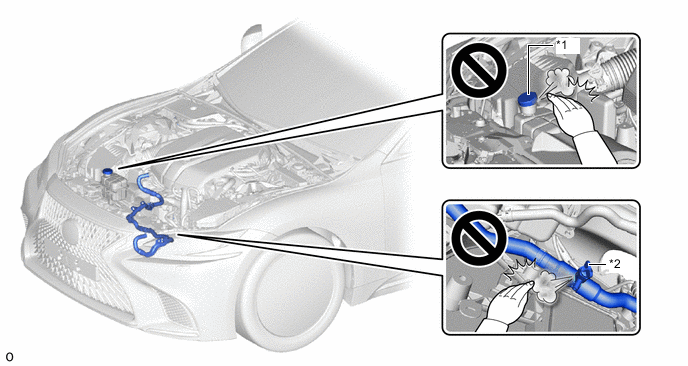
| *1 | Inverter Reserve Tank Cap | *2 | Drain Cock Plug |
-
To avoid the danger of being burned, do not remove the reserve tank cap or drain cock plug while the coolant (for inverter) is still hot.
-
Pressurized, hot coolant (for inverter) and steam may be released and cause serious burns.
PROCEDURE
- Click here
AIR SUSPENSION CONTROL PROHIBITED (w/ Air Suspension)
- Click here
REMOVE UPPER RADIATOR SUPPORT SEAL
- Click here
REMOVE RADIATOR COVER PLATE
- Click here
REMOVE LOWER RADIATOR AIR DEFLECTOR
- Click here
REMOVE OIL PAN PROTECTOR
-
for 2WD:
-
for AWD:
-
- Click here
DRAIN COOLANT (for Inverter)
CAUTION:
-
To avoid the danger of being burned, do not remove the reserve tank cap or drain cock plug while the coolant (for inverter) is still hot.
-
Pressurized, hot coolant (for inverter) and steam may be released and cause serious burns.
Note:
-
Do not reuse the drained coolant because it may contain foreign objects.
-
Collect the drained coolant and measure its volume to establish a benchmark. When adding coolant, make sure to add more coolant than the measured amount.
-
Remove the inverter reserve tank cap from the inverter reserve tank assembly.
-
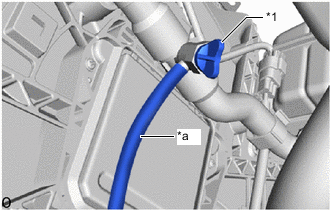
*1 Drain Cock Plug *a Hose Connect a hose to the drain cock as shown in the illustration.
-
Loosen the drain cock plug and drain the coolant.
-
Tighten the drain cock plug.
-
Disconnect the hose from the radiator drain cock.
-
- Click here
ADD COOLANT (for Inverter)
Note:
-
Do not reuse the drained coolant because it may contain foreign objects.
-
If the vehicle is driven with air in the inverter cooling system, damage may occur and the following DTCs may be set.
DTC Code Detection Item P0A9300 Inverter "A" Cooling System Performance P0C7396 Motor Electronics Coolant Pump "A" Component Internal Failure P0A001C Motor Electronics Coolant Temperature Sensor Circuit Voltage Out of Range P0A0011 Motor Electronics Coolant Temperature Sensor Circuit Short to Ground P0A0015 Motor Electronics Coolant Temperature Sensor Circuit Short to Battery or Open P0A789E Drive Motor "A" Inverter Stuck On P1C5D19 Drive Motor "A" Inverter Circuit Current Above Threshold P0A7A9E Generator Inverter Stuck On P1C5F19 Generator Inverter Circuit Current Above Threshold P0A949E DC/DC Converter Stuck On P0D3319 DC/DC Converter Circuit Current Above Threshold P0AED1C Drive Motor Inverter Temperature Sensor "A" Circuit Voltage Out of Range P0AED11 Drive Motor Inverter Temperature Sensor "A" Circuit Short to Ground P0AED15 Drive Motor Inverter Temperature Sensor "A" Circuit Short to Battery or Open P0AED46 Drive Motor Inverter Temperature Sensor "A" Calibration / Parameter Memory Failure P0C381C DC/DC Converter Temperature Sensor "A" Circuit Voltage Out of Range P0C381F DC/DC Converter Temperature Sensor "A" Circuit Intermittent P0C3846 DC/DC Converter Temperature Sensor "A" Calibration / Parameter Memory Failure P0C3D1C DC/DC Converter Temperature Sensor "B" Circuit Voltage Out of Range P0C3D1F DC/DC Converter Temperature Sensor "B" Circuit Intermittent P0C3D46 DC/DC Converter Temperature Sensor "B" Calibration / Parameter Memory Failure P1CCC96 DC/DC Converter Enable Component Internal Failure P0BCC1C Generator Inverter Temperature Sensor Circuit Voltage Out of Range P0BCC11 Generator Inverter Temperature Sensor Circuit Short to Ground P0BCC15 Generator Inverter Temperature Sensor Circuit Short to Battery or Open P0BCC46 Generator Inverter Temperature Sensor Calibration / Parameter Memory Failure P0C3811 DC/DC Converter Temperature Sensor "A" Circuit Short to Ground P0C3815 DC/DC Converter Temperature Sensor "A" Circuit Short to Battery or Open P0C3D11 DC/DC Converter Temperature Sensor "B" Circuit Short to Ground P0C3D15 DC/DC Converter Temperature Sensor "B" Circuit Short to Battery or Open
-
Slowly pour coolant into the inverter reserve tank assembly until it reaches the FULL line.
Standard Capacity Item Specified Condition for LHD 2.5 liters (2.6 US qts, 2.2 Imp. qts) for RHD 2.4 liters (2.5 US qts, 2.1 Imp. qts) Note:To prevent foreign matter such as dust or dirt from entering the cooling system, make sure to confirm that the container used to add coolant is clean and free of foreign matter.
-
When using the GTS:
-
Connect the GTS to the DLC3.
-
Turn the power switch on (IG).
-
Enter the following menus: Powertrain / Hybrid Control / Active Test / Activate the Inverter Water Pump.
- Powertrain > Hybrid Control > Active Test
Tester Display Activate the Inverter Water Pump -
-
-
-
- Powertrain > Hybrid Control > Active Test
-
While adding coolant to the inverter reserve tank assembly to keep the coolant at the FULL line and compensate for the drop in the coolant level as the air bleeds, operate and stop the inverter water pump assembly at 1 minute intervals.
Standard Air bleeding from the inverter cooling system is completed when the noise made by the inverter water pump assembly becomes smaller and the circulation of coolant in the inverter reserve tank assembly improves. Tip:Loud noises made by the inverter water pump assembly and poor circulation of coolant in the inverter reserve tank assembly indicate that there is air in the cooling system.
-
-
When not using the GTS:
-
Turn the power switch on (READY). [*1]
-
Turn the power switch off and add coolant to the FULL line as the coolant level will drop as the air bleeds. [*2]
Note:
-
Be sure to turn the power switch off before adding SLLC.
-
Do not work on the components in the engine compartment while the power switch is on (READY) as the engine will operate intermittently.
-
-
Repeat steps [*1] and [*2] until air bleeding from the cooling system is completed.
Standard Air bleeding from the inverter cooling system is completed when the noise made by the inverter water pump assembly becomes smaller and the circulation of coolant in the inverter reserve tank assembly improves. Tip:Loud noises made by the inverter water pump assembly and poor circulation of coolant in the inverter reserve tank assembly indicate that there is air in the cooling system.
-
-
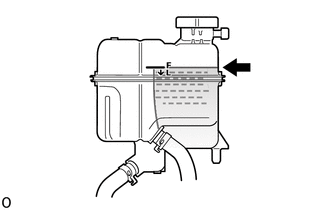
After the air is completely bled from the cooling system, add coolant to the FULL line of inverter reserve tank assembly and install the reserve tank cap.
-
- Click here
INSPECT FOR COOLANT LEAK (for Inverter)
- Click here
INSTALL OIL PAN PROTECTOR
-
for 2WD:
-
for AWD:
-
- Click here
INSTALL LOWER RADIATOR AIR DEFLECTOR
- Click here
INSTALL RADIATOR COVER PLATE
- Click here
INSTALL UPPER RADIATOR SUPPORT SEAL