HV BATTERY RECOVERY INSPECTION

| DTC Code | DTC Name |
|---|---|
| RECOVERY INSPECTION |
CAUTION / NOTICE / HINT
CAUTION:
-
When disposing of an HV battery, make sure to return it through an authorized collection agent who is capable of handling it safely. If the HV battery is returned via the manufacturer specified route, it will be returned properly and in a safe manner by an authorized collection agent.
-
Before returning the HV battery, make sure to perform a recovery inspection.
-
Accidents such as electric shock may result if the HV battery is disposed of improperly or abandoned.
Therefore, make sure to return all HV batteries through an authorized collection agent.
-
To reduce the risk of fire, HV batteries must not be stored in an area where they will be exposed to fire or high temperatures.
-
If the temperature of the HV battery is high, leave it until the temperature drops.
Tech Tips
In order to return the HV battery in a safe manner, discharge it as necessary. By performing a recovery inspection, whether discharging the HV battery will be required or not and the discharge method can be checked.
PROCEDURE
-
INSPECT FOR ELECTROLYTE LEAK
CAUTION:
Be sure to wear insulated gloves and protective goggles.
-
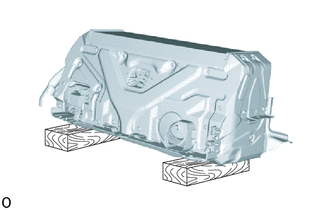
Position the HV battery as shown in the illustration and leave it for 5 minutes.
-
Check that no electrolyte is leaking from the HV battery.
OK There is no electrolyte leaking from the HV battery. CAUTION:
-
Perform this procedure in an area where the battery will not be exposed to fire.
-
Do not touch the HV battery, unless absolutely necessary, as electrolyte may be leaking.
Note
If there is an electrolyte leak, make sure to wear insulated gloves and goggles and clean it using a piece of cloth. Do not leave electrolyte-contaminated cloths unattended. Dispose of them according to law or local regulations.
Result Result OK NG -
NG 
DISCHARGING (WHEN USING THE SALT WATER SOLUTION)
OK 
-
-
CHECK FOR DTCS
-
Check the previously recorded DTCs which resulted in replacement of the HV battery.
Result Result Proceed to DTC record not available. A The HV battery was replaced due to one of the DTCs listed in the following table. B The HV battery was replaced due to a reason other than the DTCs listed in the following table. C DTC No. P1A6017 P31AA17 P0C3000 P31B300 P1C7D49
B 
GO TO STEP 5 Click here
C
HV BATTERY CONNECTORS VISUAL CHECK Click here
A
-
-
CHECK HV BATTERY VOLTAGE
CAUTION:
Wear insulated gloves.
-
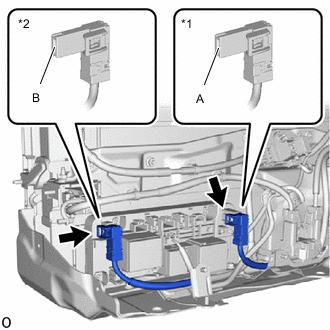
*1 No. 1 HV Battery Main Cable (A) *2 No. 2 HV Battery Main Cable (B) Measure the voltage according to the value(s) in the table below.
Standard Voltage Tester Connection Condition Specified Condition A - B Always Below 233.8 V CAUTION:
Make sure not to cross the probes of the electrical tester.
Result Result OK NG
NG
GO TO STEP 6 Click here
OK
-
-
INSULATION INSPECTION OF HV BATTERY
CAUTION:
Wear insulated gloves.
-
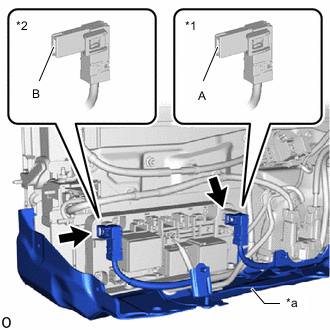
*1 No. 1 HV Battery Main Cable (A) *2 No. 2 HV Battery Main Cable (B) *a Battery Outer Case Using a megohmmeter set to 500 V, measure the insulation resistance according to the value(s) in the table below.
Note
Be sure to set the megohmmeter to 500 V when performing this test. Using a setting higher than 500 V can result in damage to the component being inspected.
Standard Resistance Tester Connection Condition Specified Condition A - Battery Outer Case Always 1 MΩ or higher B - Battery Outer Case Always 1 MΩ or higher Result Result OK NG
NG
GO TO STEP 6 Click here
OK
-
-
HV BATTERY VISUAL CHECK
CAUTION:
Wear insulated gloves.
-
Check that the HV battery is not deformed or damaged.
OK The HV battery is not deformed or damaged. Result Result OK NG
OK
RETURN HV BATTERY
NG
-
-
HV BATTERY CONNECTORS VISUAL CHECK
CAUTION:
Be sure to wear insulated gloves and protective goggles.
-
Check that the orange connectors connected to the battery ECU assembly are not deformed or damaged.
OK The connectors are not deformed or damaged. Tech Tips
If any of the connectors are damaged, a Li-ion battery discharger will not be able to be connected to the HV battery. Soak the HV battery in a saltwater solution to discharge it.
Result Result OK NG
OK
DISCHARGING (WHEN USING THE LI-ION BATTERY DISCHARGER)
NG
DISCHARGING (WHEN USING THE SALT WATER SOLUTION)
-