AIR CONDITIONING SYSTEM ON-VEHICLE INSPECTION
PROCEDURE
-
COOLING PERFORMANCE TEST
-
Install the air conditioning tool set to the vehicle.
-
Set the vehicle to the following conditions. [*1]
Item Condition Vehicle body Vehicle stopped in shade Door Fully open A/C Switch ON Fresh/recirculation Mode Control Damper Position Recirculation Air Vent Damper Position FACE Set Temperature MAX COLD Blower Speed HI Air Conditioning Air iIlet Temperature*2 25 to 34 °C (77 to 93.2 °F) Condenser Pressure (Gauge High Pressure Side)*3 1.37 to 1.57 MPaG (14 to 16 kgf/cm2)
Tech Tips
*2: This inspection can be judged correctly only if the air inlet temperature is within a range of 25 to 34 °C (77 to 93.2 °F). Therefore, postpone the test if the temperature is low.
If the condenser pressure (gauge high pressure side) is high, splash the condenser with water to lower the pressure. Conversely, if the condenser pressure is low, cover the front of the condenser to raise the pressure.
-
Place a wet and dry bulb thermometer at the air inlet (necessary for measuring the humidity), and insert its dry bulb at the center of the air vent to measure.
-
Operate the air conditioning in the conditions of [*1], and allow the temperature at the air vent to stabilize. (Approximately 5 to 6 minutes)
-
Measure the wet and dry temperatures of the air inlet and the temperature of the air vent.
-
Map the measurement values of the air inlet to the psychometric diagram to find the relative humidity.
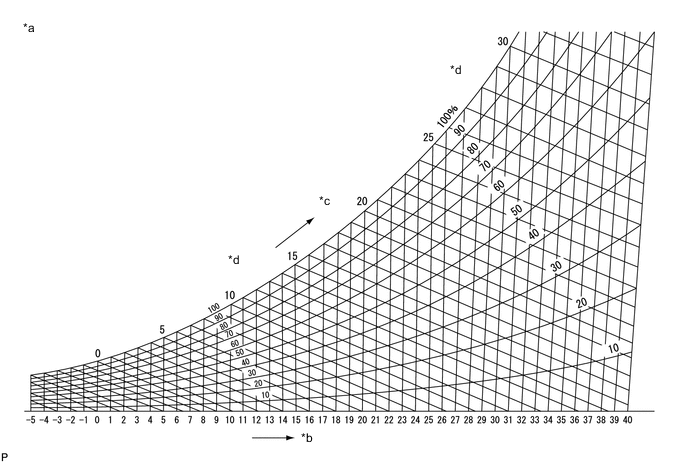
*a Psychrometric Diagram *b Dry Bulb Temperature (°C) *c Wet Bulb Temperature (°C) *d Relative Humidity (%)
-
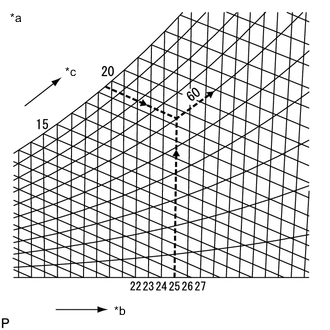
*a Example *b Dry Bulb Temperature (°C) *c Wet Bulb Temperature (°C) One way of finding the relative humidity is to find the intersection point of the wet and dry bulb temperatures, 19.5°C and 25°C, respectively, of the wet and dry bulb thermometer set at the air inlet. In this case, the relative humidity is 60%.
-
-
Check the cooling performance by mapping the relative humidity and the difference between the measured dry bulb temperatures of the air inlet and air vent in the standard performance chart.
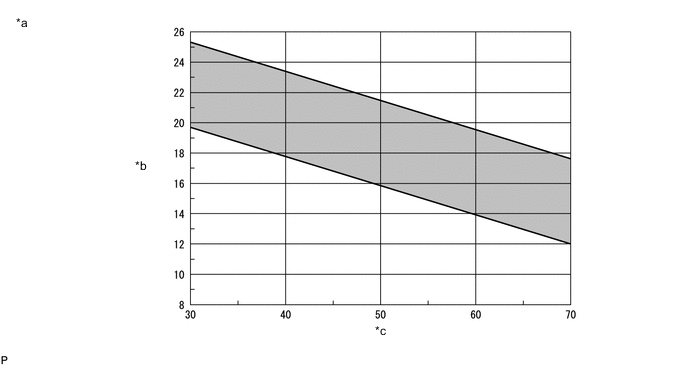
*a Standard Performance Chart *b Air Inlet/air Vent Temperature Difference (°C) *c Relative Humidity (%) - - Standard Must be within the range between the diagonal lines in the chart
-
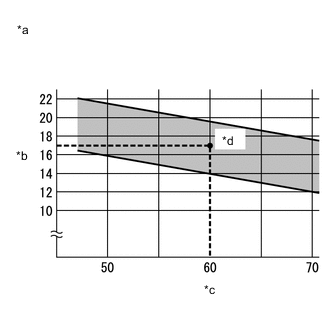
*a Example *b Air inlet/air vent temperature difference (°C) *c Relative humidity (%) *d Intersection One example of how to check the cooling performance using a standard performance chart is to find the intersection point of the relative humidity (60%) and the difference in dry bulb temperatures at the air inlet and vent (17°C). In this example, the cooling performance is inside the standard range.
-
-
-
CHECK REFRIGERANT GAS PRESSURE
-
Check refrigerant pressure using gauge
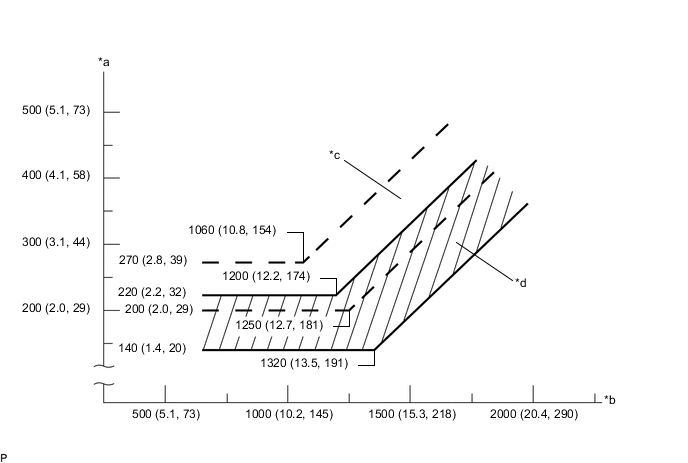
*a Pressure on Low Pressure Side kPa (kgf/cm2, psi)
*b Pressure on High Pressure Side kPa (kgf/cm2, psi)
*c Blower High Zone *d Blower Low Zone
-
Install the air conditioning tool set.
-
Set the vehicle to the following conditions. [*3]
Item Condition Door Fully closed (windows also fully closed) A/C Switch On Recirculation/fresh Control Switch Recirculation Set Temperature MAX COLD Blower Speed HI Air Conditioning Air Inlet Temperature 25 to 35 °C (77 to 95 °F) -
In conditions [*3], read the gauge and check the numerical value.
-
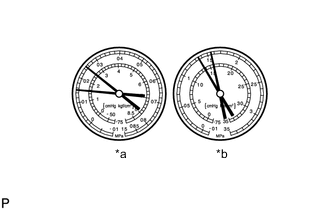
*a LO *b HI Normal
Specified Condition Gauge Reading Pressure Side Refrigerant Volume Low 150 to 250 kPa (1.5 to 2.5 kgf/cm2, 22 to 36 psi)
High 1370 to 1570 kPa (14.0 to 16.0 kgf/cm2, 199 to 228 psi)
Tech Tips
The illustration shows the gauges when the refrigerant gas volume is normal.
-
During malfunction
-
-
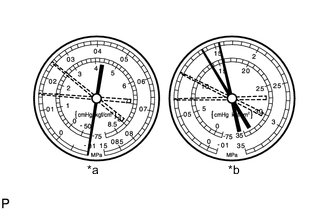
*a LO *b HI Symptom 1: During cooling operation, pressure on low pressure side cycles between normal and vacuum.
Standard Value Measurement Result Symptom The air conditioning system works intermittently Cause Moisture in the cooling system freezes at the cooler expansion valve orifice and temporarily prevents refrigerant gas from circulating. The condition, however, is restored to normal after the ice is melted. Diagnosis
-
Cooler dryer is overly saturated
-
Moisture in the cooling system freezes at the cooler expansion valve orifice and blocks circulation of the refrigerant gas
Action Taken
-
Replace the cooler dryer
-
Remove moisture from cycle by repeatedly evacuating air
-
Add an appropriate volume of new refrigerant gas
Tech Tips
The illustration shows the gauges when moisture has got into the cooling system.
-
-
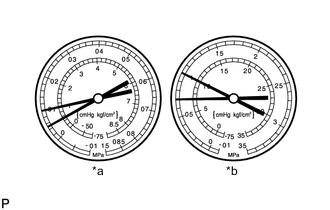
*a LO *b HI Symptom 2: Pressure on both the low and high pressure sides is low.
Standard Value Measurement Result Symptoms
-
Cooling is not working well
-
Coolant performance is insufficient
Cause There is a gas leak somewhere in the cooling system Diagnosis
-
Insufficient refrigerant gas volume
-
Refrigerant Gas Leak
Action Taken
-
Check for refrigerant gas leak and repair if necessary
-
Add an appropriate volume of new refrigerant gas
-
If the pressure readout value when the gauge is connected is near 0, check for leaking points, make necessary repairs, and then evacuate the air conditioning system
Tech Tips
The illustration shows the gauges when cooling is not working well.
-
-
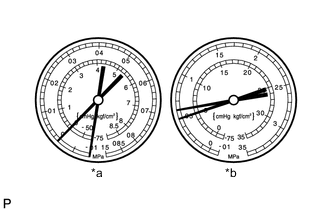
*a LO *b HI Symptom 3: The pressure on both the low and high sides is low, which causes condensation on the pipe from the cooler condenser assembly to the A/C unit.
Standard Value Measurement Result Symptoms Cooling is not working well Cause Dust in the cooler condenser core blocks the flow of refrigerant gas Diagnosis Blockage of cooler condenser core Action Taken Replace the cooler condenser assembly Tech Tips
The illustration shows the gauges when cooling by refrigerant gas is not working well.
-
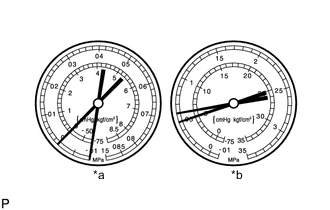
*a LO *b HI Symptom 4: The pressure on both the low and high sides is low, that causes frost or condensation on the pipe before and after the cooler condenser core or cooler expansion valve.
Standard Value Measurement Result Symptoms Cooling is not functioning (also functioning occasionally) Cause
-
The flow of refrigerant gas is blocked by moisture or dust in the cooling system
-
The flow of refrigerant gas is impaired by refrigerant gas leak from the cooler expansion valve
Diagnosis Refrigerant gas cannot circulate Action Taken
-
Check the cooler expansion valve
-
Remove dust in the cooler expansion valve with an air gun
-
Replace the cooler condenser assembly
-
Evacuate the air conditioning system, and then add an appropriate volume of new refrigerant gas
-
If there is a refrigerant gas leak from the cooler expansion valve, replace the valve
Tech Tips
The illustration shows the gauges when refrigerant gas does not circulate.
-
-
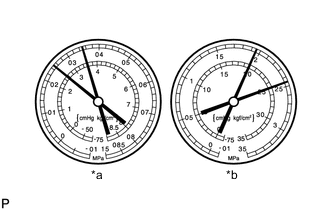
*a LO *b HI Symptom 5: The pressure on both the low and high pressure sides is high.
Standard Value Measurement Result Symptoms Cooling is not working well Cause
-
The flow of refrigerant gas is blocked by moisture or dust in the cooling system
-
The flow of refrigerant gas is impaired by refrigerant gas leak from the cooler expansion valve
Diagnosis
-
Excessive refrigerant gas volume
-
Cooling of cooler condenser core is insufficient
Action Taken
-
Clean the cooler condenser core fin
-
Check the operation of the condenser fan
-
Adjust the refrigerant gas volume
Tech Tips
The illustration shows the gauges when the refrigerant gas volume is excessive or cooling of the cooler condenser core is insufficient.
-
-
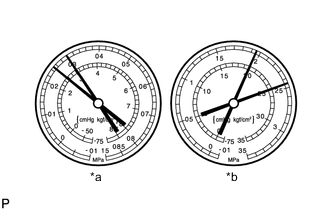
*a LO *b HI Symptom 6: The pressure on both the low and high pressure sides is high, and the low pressure line is too hot to touch.
Standard Value Measurement Result Symptoms Cooling is not functioning Cause Air in refrigeration system Diagnosis
-
Air is in the refrigeration system
-
Evacuation of the air conditioning system is insufficient
Action Taken
-
Check if the compressor oil is dirty or insufficient
-
Evacuate the air conditioning system, and then add an appropriate volume of new refrigerant gas
Tech Tips
-
Notes: The gauge indicates when the cooling system is open without the system being evacuated and filled with refrigerant gas.
-
The illustration shows the gauges when air has got into the refrigerant system.
-
-
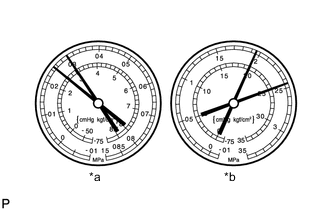
*a LO *b HI Symptom 7: The pressure on both the low and high pressure sides is high, and frost or condensation is forming on the low pressure side.
Standard Value Measurement Result Symptoms Cooling is not working well Cause Trouble with the cooler expansion valve Diagnosis
-
Refrigerant gas volume is excessive on the low pressure pipe line
-
Cooler expansion valve opened too far
Action Taken Replace the cooler expansion valve Tech Tips
The illustration shows the gauges when the cooler expansion valve is improper.
-
-
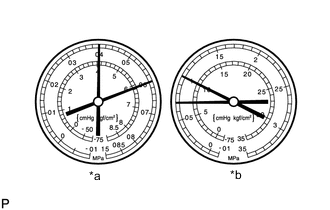
*a LO *b HI Symptom 8: The pressure on the low pressure side is high and the pressure on the high pressure side is low.
Standard Value Measurement Result Symptoms Cooling is not functioning Cause Compression leak inside the compressor with motor assembly Diagnosis
-
Compression malfunction
-
Valve leak or damaged sliding parts
Action Taken Repair or replace the compressor with motor assembly Tech Tips
The illustration shows the gauges when the compression in the compressor with motor assembly is poor.
-
-
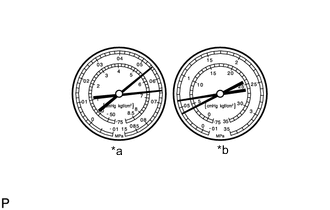
*a LO *b HI Symptom 9: Pressure is the same on both the low- and high-pressure sides.
Standard Value Measurement Result Symptoms Cooling is not functioning Cause Trouble with the compressor with motor assembly Diagnosis Compressor with motor assembly does not rotate Action Taken Repair or replace the compressor with motor assembly Tech Tips
The illustration shows the gauges when the compressor with motor assembly is malfunctioning.
-
-
-
-
-
CHECK COOLER CONDENSER ASSEMBLY
-
When the fins of the cooler condenser assembly are dirty, clean with water and dry with compressed air.
Note
-
Do not damage the cooler condenser assembly fins.
-
When the cooler condenser assembly fins are bent, use a screwdriver or pliers to straighten them.
-
-
-
CHECK FOR REFRIGERANT GAS LEAK
-
Using a halogen leak detector, check for refrigerant gas leak from connections on the pipe line.
-
If refrigerant gas is leaking from a connection on the pipe line, check the tightening torque of the joint.
-
-
CHECK MEMOERY CALL FUNCTION
-
Register memory
Note
Prepare all of the electrical key transmitter sub-assemblies (electrical key) before performing registration.
-
Use the electrical key transmitter sub-assembly (electrical key) and unlock the doors before performing registration.
-
Hold only the electrical key transmitter sub-assembly (electrical key) to be registered, unlock the doors and sit in the driver seat.
-
Start the engine and operate the air conditioning.
-
Turn the engine switch off.
Tech Tips
Registration is required for each electrical key transmitter sub-assembly (electrical key).
-
-
Check the memory recall operation
-
With the electrical key transmitter sub-assembly (electrical key) recognition code registered in the memory, check that the air conditioner resumes the previously selected operation when the engine switch is turned on (IG).
Tech Tips
The operating condition varies for each electrical key transmitter sub-assembly (electrical key).
-
-
-
CHECK TUNNEL-LINKED RECIRCULATION FUNCTION
-
Check that the automatic fresh/recirculation mode control can be prohibited and canceled by linking with the navigation system through the tunnel-linked recirculation setting on the safety and comfortable driving setting operation screen on the multi-display.
-
-
CHECK LEXUS CLIMATE CONCIERGE
-
LEXUS climate concierge control function:
-
Set the vehicle to the following conditions.
Inspection Condition Item Condition Front Passenger Seat Unoccupied Seat Heater AUTO Comfortable Air Seat System AUTO Heated Steering Wheel System AUTO -
Press the "Concierge" switch on the multi-display sub menu screen.
-
Check that the seat heater (seat air conditioning) and steering wheel heater link with the air conditioning system and operate accordingly when the concierge switch on the "Concierge" screen is pressed.
-
Check that the seat heater (seat air conditioning) turns off when the front passenger seat becomes unoccupied.
-
When the following conditions are met, check that the LEXUS climate concierge function turns off.
-
AUTO function canceled
-
Operate the air conditioning, seat heater, comfortable air seat or steering wheel heater system manually.
-
-
-
-
CHECK ECO DRIVE MODE
Tech Tips
Depending on the environment (condition), the actual control may not change in some situations even if ECO drive mode is activated.
-
Check that the indicator illuminates and airflow volume from the air outlet is controlled when the ECO drive mode switch is turned on.
-
Check that the indicator light turns off and that airflow control is canceled when the ECO drive mode switch is turned off.
-