VEHICLE STABILITY CONTROL SYSTEM, Diagnostic DTC:C1330, C1331, C1332, C1333, C1464, C1465, C1466, C1467
| DTC Code | DTC Name |
|---|---|
| C1330 | Open in Front Speed Sensor RH |
| C1331 | Open in Front Speed Sensor LH |
| C1332 | Open in Rear Speed Sensor RH |
| C1333 | Open in Rear Speed Sensor LH |
| C1464 | Front Speed Sensor RH |
| C1465 | Front Speed Sensor LH |
| C1466 | Rear Speed Sensor RH |
| C1467 | Rear Speed Sensor LH |
DESCRIPTION
Each speed sensor detects wheel speed and sends signals to the skid control ECU (brake actuator assembly). These signals are used by the ABS control.
Tech Tips
The output voltage values shown below are for when the vehicle wire harnesses are connected to the skid control ECU (brake actuator assembly) and the speed sensors.
Figure 1. for Front

Figure 2. for Rear

| DTC No. | Detection Item | DTC Detection Condition | Trouble Area |
|---|---|---|---|
| C1330 | Open in Front Speed Sensor RH | An open or short in the speed sensor signal circuit. |
|
| C1331 | Open in Front Speed Sensor LH | An open or short in the speed sensor signal circuit. |
|
| C1332 | Open in Rear Speed Sensor RH | An open or short in the speed sensor signal circuit. |
|
| C1333 | Open in Rear Speed Sensor LH | An open or short in the speed sensor signal circuit. |
|
| C1464 | Front Speed Sensor RH | Any of the following is detected:
|
|
| C1465 | Front Speed Sensor LH | Any of the following is detected:
|
|
| C1466 | Rear Speed Sensor RH | Any of the following is detected:
|
|
| C1467 | Rear Speed Sensor LH | Any of the following is detected:
|
|
Tech Tips
-
DTCs C1330 and C1464 are for the front speed sensor RH.
-
DTCs C1331 and C1465 are for the front speed sensor LH.
-
DTCs C1332 and C1466 are for the rear speed sensor RH.
-
DTCs C1333 and C1467 are for the rear speed sensor LH.
| Vehicle Condition | |||||
|---|---|---|---|---|---|
| Pattern 1 | Pattern 2 | Pattern 3 | Pattern 4 | ||
| Diagnosis Condition | The vehicle speed is more than 50.4 km/h (31 mph). | ○ | - | - | - |
| After the initial start or restart and when the vehicle speed has reached 12 km/h (7 mph). | - | ○ | - | - | |
| After the initial start or restart and when the vehicle speed has reached 20 km/h (12 mph). | - | - | ○ | - | |
| Malfunction Status | Pulses are not detected. | ○ | - | - | - |
| A wheel speed of 0 km/h (0 mph) is detected. | - | ○ | - | - | |
| A front wheel speed of 0 km/h (0 mph) is detected. | - | - | ○ | - | |
| The difference between the speed of the fastest wheel and the speed of the slowest wheel is 5% or more of the vehicle speed. (If the speed of any wheel is less than 5 km/h (3 mph), a speed difference of up to 15% is allowable.) | - | - | - | ○ | |
| Detection Time | 0.4 seconds | - | - | 9 to 72 seconds or more (varies depending on the driving conditions) | |
| Number of Trips | 1 trip | 1 trip | 1 trip | 1 trip | |
Tech Tips
DTC will be output when conditions for either of the patterns in the table above are met.
| Vehicle Condition | |||||
|---|---|---|---|---|---|
| Pattern 5 | Pattern 6 | Pattern 7 | Pattern 8 | ||
| Diagnosis Condition | The vehicle speed is less than 100 km/h (62 mph). | ○ | - | - | - |
| The vehicle speed is 100 km/h (62 mph) or more. | - | ○ | - | - | |
| Malfunction Status | The difference between the speed of the fastest wheel and the speed of the slowest wheel is 5 km/h (3 mph) or more. (If the speed of any wheel is less than 5 km/h (3 mph), a speed difference of up to 16 km/h (10 mph) is allowable.) | ○ | - | - | - |
| The difference between the speed of the fastest wheel and the speed of the slowest wheel is 6% or more of the vehicle speed. (If the speed of any wheel is less than 5 km/h (3 mph), a speed difference of up to 15% is allowable.) | - | ○ | - | - | |
| Wheel speed sensor signal fluctuation is equivalent to 98 G or more, or alternates between 50 G or more and -50 G or less. | - | - | ○ | - | |
| An abnormal signal is received from a wheel speed sensor. | - | - | - | ○ | |
| Detection Time | 9 to 72 seconds or more (varies depending on the driving conditions) | 9 to 72 seconds or more (varies depending on the driving conditions) | - | - | |
| Number of Trips | 1 trip | 1 trip | 1 trip | 1 trip | |
Tech Tips
DTC will be output when conditions for either of the patterns in the table above are met.
| Vehicle Condition | |||||
|---|---|---|---|---|---|
| Pattern 1 | Pattern 2 | Pattern 3 | Pattern 4 | ||
| Diagnosis Condition | The vehicle speed is more than 50.4 km/h (31 mph). | ○ | - | - | - |
| After the initial start or restart and when the vehicle speed has reached 12 km/h (7 mph). | - | ○ | - | - | |
| After the initial start or restart and when the vehicle speed has reached 20 km/h (12 mph). | - | - | ○ | - | |
| Malfunction Status | Pulses are not detected. | ○ | - | - | - |
| A wheel speed of 0 km/h (0 mph) is detected. | - | ○ | - | - | |
| A front wheel speed of 0 km/h (0 mph) is detected. | - | - | ○ | - | |
| The difference between the speed of the fastest wheel and the speed of the slowest wheel is 5% or more of the vehicle speed. (If the speed of any wheel is less than 5 km/h (3 mph), a speed difference of up to 15% is allowable.) | - | - | - | ○ | |
| Detection Time | 0.4 seconds | - | - | 9 to 72 seconds or more (varies depending on the driving conditions) | |
| Number of Trips | 1 trip | 1 trip | 1 trip | 1 trip | |
Tech Tips
DTC will be output when conditions for either of the patterns in the table above are met.
| Vehicle Condition | |||||
|---|---|---|---|---|---|
| Pattern 5 | Pattern 6 | Pattern 7 | Pattern 8 | ||
| Diagnosis Condition | The vehicle speed is less than 100 km/h (62 mph). | ○ | - | - | - |
| The vehicle speed is 100 km/h (62 mph) or more. | - | ○ | - | - | |
| Malfunction Status | The difference between the speed of the fastest wheel and the speed of the slowest wheel is 5 km/h (3 mph) or more. (If the speed of any wheel is less than 5 km/h (3 mph), a speed difference of up to 16 km/h (10 mph) is allowable.) | ○ | - | - | - |
| The difference between the speed of the fastest wheel and the speed of the slowest wheel is 6% or more of the vehicle speed. (If the speed of any wheel is less than 5 km/h (3 mph), a speed difference of up to 15% is allowable.) | - | ○ | - | - | |
| Wheel speed sensor signal fluctuation is equivalent to 98 G or more, or alternates between 50 G or more and -50 G or less. | - | - | ○ | - | |
| An abnormal signal is received from a wheel speed sensor. | - | - | - | ○ | |
| Detection Time | 9 to 72 seconds or more (varies depending on the driving conditions) | 9 to 72 seconds or more (varies depending on the driving conditions) | - | - | |
| Number of Trips | 1 trip | 1 trip | 1 trip | 1 trip | |
Tech Tips
DTC will be output when conditions for either of the patterns in the table above are met.
| Vehicle Condition | |||||
|---|---|---|---|---|---|
| Pattern 1 | Pattern 2 | Pattern 3 | Pattern 4 | ||
| Diagnosis Condition | The vehicle speed is more than 50.4 km/h (31 mph). | ○ | - | - | - |
| After the initial start or restart and when the vehicle speed has reached 12 km/h (7 mph). | - | ○ | - | - | |
| After the initial start or restart and when the vehicle speed has reached 20 km/h (12 mph). | - | - | ○ | - | |
| Malfunction Status | Pulses are not detected. | ○ | - | - | - |
| A wheel speed of 0 km/h (0 mph) is detected. | - | ○ | - | - | |
| A rear wheel speed of 0 km/h (0 mph) is detected. | - | - | ○ | - | |
| The difference between the speed of the fastest wheel and the speed of the slowest wheel is 5% or more of the vehicle speed. (If the speed of any wheel is less than 5 km/h (3 mph), a speed difference of up to 15% is allowable.) | - | - | - | ○ | |
| Detection Time | 0.4 seconds | - | - | 9 to 72 seconds or more (varies depending on the driving conditions) | |
| Number of Trips | 1 trip | 1 trip | 1 trip | 1 trip | |
Tech Tips
DTC will be output when conditions for either of the patterns in the table above are met.
| Vehicle Condition | |||||
|---|---|---|---|---|---|
| Pattern 5 | Pattern 6 | Pattern 7 | Pattern 8 | ||
| Diagnosis Condition | The vehicle speed is less than 100 km/h (62 mph). | ○ | - | - | - |
| The vehicle speed is 100 km/h (62 mph) or more. | - | ○ | - | - | |
| Malfunction Status | The difference between the speed of the fastest wheel and the speed of the slowest wheel is 5 km/h (3 mph) or more. (If the speed of any wheel is less than 5 km/h (3 mph), a speed difference of up to 16 km/h (10 mph) is allowable.) | ○ | - | - | - |
| The difference between the speed of the fastest wheel and the speed of the slowest wheel is 6% or more of the vehicle speed. (If the speed of any wheel is less than 5 km/h (3 mph), a speed difference of up to 15% is allowable.) | - | ○ | - | - | |
| Wheel speed sensor signal fluctuation is equivalent to 98 G or more, or alternates between 50 G or more and -50 G or less. | - | - | ○ | - | |
| An abnormal signal is received from a wheel speed sensor. | - | - | - | ○ | |
| Detection Time | 9 to 72 seconds or more (varies depending on the driving conditions) | 9 to 72 seconds or more (varies depending on the driving conditions) | - | - | |
| Number of Trips | 1 trip | 1 trip | 1 trip | 1 trip | |
Tech Tips
DTC will be output when conditions for either of the patterns in the table above are met.
| Vehicle Condition | |||||
|---|---|---|---|---|---|
| Pattern 1 | Pattern 2 | Pattern 3 | Pattern 4 | ||
| Diagnosis Condition | The vehicle speed is more than 50.4 km/h (31 mph). | ○ | - | - | - |
| After the initial start or restart and when the vehicle speed has reached 12 km/h (7 mph). | - | ○ | - | - | |
| After the initial start or restart and when the vehicle speed has reached 20 km/h (12 mph). | - | - | ○ | - | |
| Malfunction Status | Pulses are not detected. | ○ | - | - | - |
| A wheel speed of 0 km/h (0 mph) is detected. | - | ○ | - | - | |
| A rear wheel speed of 0 km/h (0 mph) is detected. | - | - | ○ | - | |
| The difference between the speed of the fastest wheel and the speed of the slowest wheel is 5% or more of the vehicle speed. (If the speed of any wheel is less than 5 km/h (3 mph), a speed difference of up to 15% is allowable.) | - | - | - | ○ | |
| Detection Time | 0.4 seconds | - | - | 9 to 72 seconds or more (varies depending on the driving conditions) | |
| Number of Trips | 1 trip | 1 trip | 1 trip | 1 trip | |
Tech Tips
DTC will be output when conditions for either of the patterns in the table above are met.
| Vehicle Condition | |||||
|---|---|---|---|---|---|
| Pattern 5 | Pattern 6 | Pattern 7 | Pattern 8 | ||
| Diagnosis Condition | The vehicle speed is less than 100 km/h (62 mph). | ○ | - | - | - |
| The vehicle speed is 100 km/h (62 mph) or more. | - | ○ | - | - | |
| Malfunction Status | The difference between the speed of the fastest wheel and the speed of the slowest wheel is 5 km/h (3 mph) or more. (If the speed of any wheel is less than 5 km/h (3 mph), a speed difference of up to 16 km/h (10 mph) is allowable.) | ○ | - | - | - |
| The difference between the speed of the fastest wheel and the speed of the slowest wheel is 6% or more of the vehicle speed. (If the speed of any wheel is less than 5 km/h (3 mph), a speed difference of up to 15% is allowable.) | - | ○ | - | - | |
| Wheel speed sensor signal fluctuation is equivalent to 98 G or more, or alternates between 50 G or more and -50 G or less. | - | - | ○ | - | |
| An abnormal signal is received from a wheel speed sensor. | - | - | - | ○ | |
| Detection Time | 9 to 72 seconds or more (varies depending on the driving conditions) | 9 to 72 seconds or more (varies depending on the driving conditions) | - | - | |
| Number of Trips | 1 trip | 1 trip | 1 trip | 1 trip | |
Tech Tips
DTC will be output when conditions for either of the patterns in the table above are met.
WIRING DIAGRAM
Figure 3. for Front
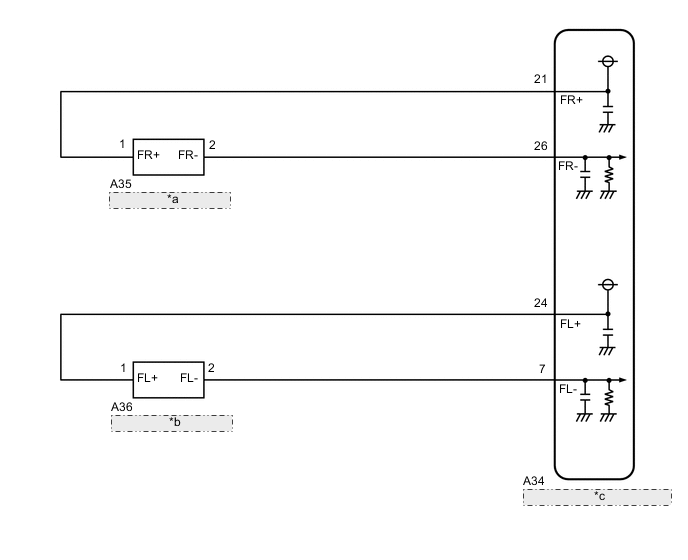
| *a | Front Speed Sensor RH |
| *b | Front Speed Sensor LH |
| *c | Skid Control ECU (Brake Actuator Assembly) |
Figure 4. for Rear
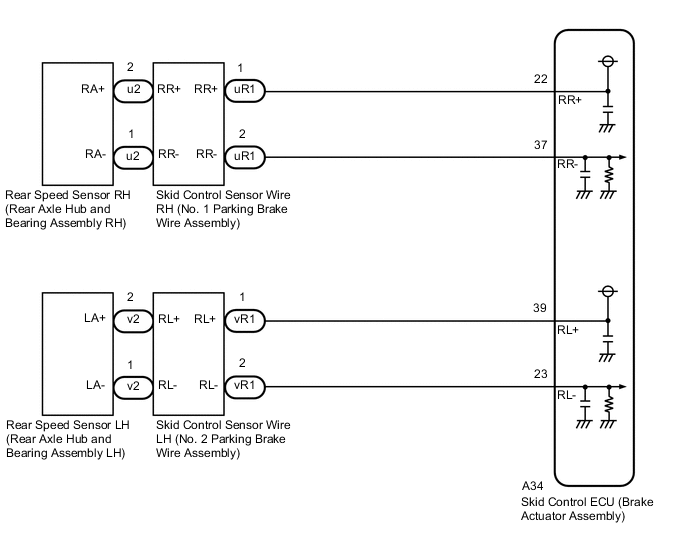
CAUTION / NOTICE / HINT
Note
When replacing the skid control ECU (brake actuator assembly), perform system variant learning and acceleration sensor zero point calibration.
PROCEDURE
-
RECONFIRM DTC
-
Clear the DTCs.
Chassis > ABS/VSC/TRC > Clear DTCs -
Turn the ignition switch off.
-
Start the engine.
-
Drive the vehicle at a speed of 54 km/h (34 mph) or more for at least 120 seconds.
-
Check if the same DTC is output.
Chassis > ABS/VSC/TRC > Trouble CodesResult Result Proceed to C1330, C1331, C1464 or C1465 is output A C1332, C1333, C1466 or C1467 is output B
B 
CHECK REAR SPEED SENSOR INSTALLATION Click here
A 
-
-
CHECK FRONT SPEED SENSOR INSTALLATION
-
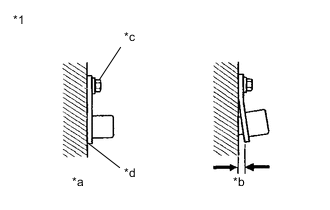
*1 Front Speed Sensor *a Correct *b Incorrect *c 8.5 N*m *d No clearance Turn the ignition switch off.
-
Check the speed sensor installation.
OK There is no clearance between the sensor and the front steering knuckle. The installation bolt is tightened properly. Torque 8.5 N*m (87 kgf*cm, 75 in.*lbf) Result Proceed to OK NG
NG 
REINSTALL OR REPLACE FRONT SPEED SENSOR Click here
OK
-
-
CHECK FRONT SPEED SENSOR (CHECK FOR FOREIGN MATTER)
-
Remove the front speed sensor.
-
Check the front speed sensor tip.
OK The sensor tip is free of scratches, oil, and foreign matter. Note
-
If there is oil or foreign matter on the speed sensor, clean the speed sensor.
-
If the speed sensor is damaged, replace the speed sensor with a new one.
-
Check the speed sensor signal after cleaning or replacement.
Result Proceed to OK NG -
NG
CLEAN OR REPLACE FRONT SPEED SENSOR
OK
-
-
INSPECT BRAKE ACTUATOR ASSEMBLY (POWER SOURCE CIRCUIT)
-
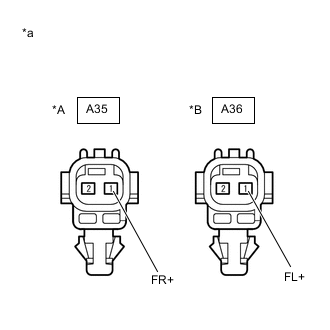
*A for RH *B for LH *a Front view of wire harness connector
(to Front Speed Sensor)
Make sure that there is no looseness at the locking part and the connecting part of the connectors.
OK The connector is securely connected. -
Disconnect the A35 or A36 front speed sensor connector.
-
Check both the connector case and the terminals for deformation and corrosion.
OK No deformation or corrosion. -
Turn the ignition switch to ON.
-
Measure the voltage according to the value(s) in the table below.
Standard Voltage for RH Tester Connection Condition Specified Condition A35-1 (FR+) - Body ground Ignition switch ON 11 to 14 V for LH Tester Connection Condition Specified Condition A36-1 (FL+) - Body ground Ignition switch ON 11 to 14 V Result Proceed to OK NG
NG
CHECK HARNESS AND CONNECTOR (BRAKE ACTUATOR ASSEMBLY - FRONT SPEED SENSOR) Click here
OK
-
-
INSPECT BRAKE ACTUATOR ASSEMBLY (GROUND CIRCUIT)
-
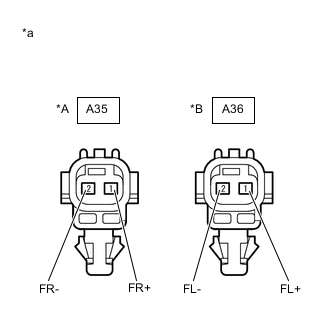
*A for RH *B for LH *a Front view of wire harness connector
(to Front Speed Sensor)
Measure the voltage according to the value(s) in the table below.
Standard Voltage for RH Tester Connection Condition Specified Condition A35-1 (FR+) - A35-2 (FR-) Ignition switch ON 11 to 14 V for LH Tester Connection Condition Specified Condition A36-1 (FL+) - A36-2 (FL-) Ignition switch ON 11 to 14 V Result Proceed to OK NG
NG
CHECK HARNESS AND CONNECTOR (BRAKE ACTUATOR ASSEMBLY - FRONT SPEED SENSOR) Click here
OK
-
-
CHECK FRONT SPEED SENSOR ROTOR (CHECK FOR FOREIGN MATTER)
-
Remove the front speed sensor rotor (front axle hub sub-assembly).
-
Check the speed sensor rotor.
OK The rotor is free of scratches, oil, and foreign matter. Note
-
If there is oil or foreign matter on the speed sensor rotor, clean the speed sensor rotor.
-
If the speed sensor rotor is damaged, replace the speed sensor rotor with a new one.
-
Check the speed sensor signal after cleaning or replacement.
Tech Tips
-
The front speed sensor rotor is incorporated into the front axle hub sub-assembly.
-
If the front speed sensor rotor needs to be replaced, replace it together with the front axle hub sub-assembly.
Result Result Proceed to OK A NG (The speed sensor rotor is damaged) B NG (There is foreign matter on the speed sensor rotor) C -
A
REPLACE FRONT SPEED SENSOR Click here
B
REPLACE FRONT AXLE HUB SUB-ASSEMBLY Click here
C
CLEAN FRONT SPEED SENSOR ROTOR
-
-
CHECK HARNESS AND CONNECTOR (BRAKE ACTUATOR ASSEMBLY - FRONT SPEED SENSOR)
-
Turn the ignition switch off.
-
Make sure that there is no looseness at the locking part and the connecting part of the connectors.
OK The connector is securely connected. -
Disconnect the A34 skid control ECU (brake actuator assembly) connector.
-
Check both the connector case and the terminals for deformation and corrosion.
OK No deformation or corrosion. -
Measure the resistance according to the value(s) in the table below.
Standard Resistance for RH: Tester Connection Condition Specified Condition A34-26 (FR-) - A35-2 (FR-) Always Below 1 Ω A34-26 (FR-) or A35-2 (FR-) - Body ground Always 10 kΩ or higher for LH: Tester Connection Condition Specified Condition A34-7 (FL-) - A36-2 (FL-) Always Below 1 Ω A34-7 (FL-) or A36-2 (FL-) - Body ground Always 10 kΩ or higher Result Proceed to OK NG
OK
REPLACE BRAKE ACTUATOR ASSEMBLY for LHD: Click here
REPLACE BRAKE ACTUATOR ASSEMBLY for RHD: Click hereNG
REPAIR OR REPLACE HARNESS OR CONNECTOR
-
-
CHECK HARNESS AND CONNECTOR (BRAKE ACTUATOR ASSEMBLY - FRONT SPEED SENSOR)
-
Turn the ignition switch off.
-
Make sure that there is no looseness at the locking part and the connecting part of the connectors.
OK The connector is securely connected. -
Disconnect the A34 skid control ECU (brake actuator assembly) connector.
-
Check both the connector case and the terminals for deformation and corrosion.
OK No deformation or corrosion. -
Measure the resistance according to the value(s) in the table below.
Standard Resistance for RH: Tester Connection Condition Specified Condition A34-21 (FR+) - A35-1 (FR+) Always Below 1 Ω A34-21 (FR+) or A35-1 (FR+) - Body ground Always 10 kΩ or higher for LH: Tester Connection Condition Specified Condition A34-24 (FL+) - A36-1 (FL+) Always Below 1 Ω A34-24 (FL+) or A36-1 (FL+) - Body ground Always 10 kΩ or higher Result Proceed to OK NG
OK
REPLACE BRAKE ACTUATOR ASSEMBLY for LHD: Click here
REPLACE BRAKE ACTUATOR ASSEMBLY for RHD: Click hereNG
REPAIR OR REPLACE HARNESS OR CONNECTOR
-
-
CHECK REAR SPEED SENSOR INSTALLATION
-
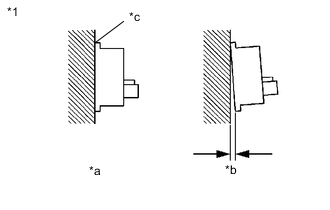
*1 Rear Speed Sensor *a OK *b NG *c No Clearance Turn the ignition switch off.
-
Check the speed sensor installation.
OK There is no clearance between the sensor and the rear axle hub. Tech Tips
Because the rear axle hub and bearing assembly cannot be disassembled, if the rear speed sensor needs replacement, replace the rear axle hub and bearing assembly.
Result Proceed to OK NG
NG
REPLACE REAR AXLE HUB AND BEARING ASSEMBLY Click here
OK
-
-
INSPECT BRAKE ACTUATOR ASSEMBLY (POWER SOURCE CIRCUIT)
-
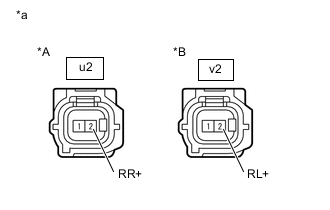
*A for RH *B for LH *a Front view of wire harness connector
(to Rear Speed Sensor)
Make sure that there is no looseness at the locking part and the connecting part of the connectors.
OK The connector is securely connected. -
Disconnect the u2 or v2 rear speed sensor connector.
-
Check both the connector case and the terminals for deformation and corrosion.
OK No deformation or corrosion. -
Turn the ignition switch to ON.
-
Measure the voltage according to the value(s) in the table below.
Standard Voltage for RH Tester Connection Condition Specified Condition u2-2 (RR+) - Body ground Ignition switch ON 11 to 14 V for LH Tester Connection Condition Specified Condition v2-2 (RL+) - Body ground Ignition switch ON 11 to 14 V Result Proceed to OK NG
NG
INSPECT PARKING BRAKE WIRE ASSEMBLY Click here
OK
-
-
INSPECT BRAKE ACTUATOR ASSEMBLY (GROUND CIRCUIT)
-
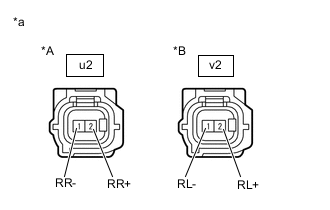
*A for RH *B for LH *a Front view of wire harness connector
(to Rear Speed Sensor)
Measure the voltage according to the value(s) in the table below.
Standard Voltage for RH Tester Connection Condition Specified Condition u2-2 (RR+) - u2-1 (RR-) Ignition switch ON 11 to 14 V for LH Tester Connection Condition Specified Condition v2-2 (RL+) - v2-1 (RL-) Ignition switch ON 11 to 14 V Result Proceed to OK NG
OK
REPLACE REAR AXLE HUB AND BEARING ASSEMBLY Click here
NG
-
-
INSPECT PARKING BRAKE WIRE ASSEMBLY
-
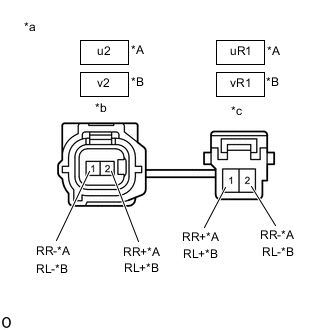
*A for RH *B for LH *a Front view of skid control sensor wire (parking brake wire assembly) *b Front view of wire harness connector
(to Sensor Side Connector)
*c Front view of wire harness connector
(to Vehicle Side Connector)
Turn the ignition switch off.
-
Make sure that there is no looseness at the locking part and the connecting part of the connectors.
OK The connector is securely connected. -
Remove the skid control sensor wire RH (No. 1 parking brake wire assembly) or the skid control sensor wire LH (No. 2 parking brake wire assembly).
-
Check both the connector case and the terminals for deformation and corrosion.
OK No deformation or corrosion. -
Measure the resistance according to the value(s) in the table below.
Standard Resistance for RH Tester Connection Condition Specified Condition u2-1 (RR-) - uR1-2 (RR-) Always Below 1 Ω u2-1 (RR-) - uR1-1 (RR+) Always 10 kΩ or higher u2-1 (RR-) or uR1-2 (RR-) - Body ground Always 10 kΩ or higher for LH Tester Connection Condition Specified Condition v2-1 (RL-) - vR1-2 (RL-) Always Below 1 Ω v2-1 (RL-) - vR1-1 (RL+) Always 10 kΩ or higher v2-1 (RL-) or vR1-2 (RL-) - Body ground Always 10 kΩ or higher Result Proceed to OK NG
NG
REPLACE PARKING BRAKE WIRE ASSEMBLY
OK
-
-
CHECK HARNESS AND CONNECTOR (BRAKE ACTUATOR ASSEMBLY - PARKING BRAKE WIRE ASSEMBLY)
-
Make sure that there is no looseness at the locking part and the connecting part of the connector.
OK The connector is securely connected. -
Disconnect the A34 skid control ECU (brake actuator assembly) connector.
-
Check both the connector case and the terminals for deformation and corrosion.
OK No deformation or corrosion. -
Measure the resistance according to the value(s) in the table below.
Standard Resistance for RH Tester Connection Condition Specified Condition A34-37 (RR-) - uR1-2 (RR-) Always Below 1 Ω A34-37 (RR-) or uR1-2 (RR-) - Body ground Always 10 kΩ or higher for LH Tester Connection Condition Specified Condition A34-23 (RL-) - vR1-2 (RL-) Always Below 1 Ω A34-23 (RL-) or vR1-2 (RL-) - Body ground Always 10 kΩ or higher Result Proceed to OK NG
OK
REPLACE BRAKE ACTUATOR ASSEMBLY for LHD: Click here
REPLACE BRAKE ACTUATOR ASSEMBLY for RHD: Click hereNG
REPAIR OR REPLACE HARNESS OR CONNECTOR
-
-
INSPECT PARKING BRAKE WIRE ASSEMBLY
-
*A for RH *B for LH *a Front view of skid control sensor wire (parking brake wire assembly) *b Front view of wire harness connector
(to Sensor Side Connector)
*c Front view of wire harness connector
(to Vehicle Side Connector)
Turn the ignition switch off.
-
Make sure that there is no looseness at the locking part and the connecting part of the connectors.
OK The connector is securely connected. -
Remove the skid control sensor wire RH (No. 1 parking brake wire assembly) or the skid control sensor wire LH (No. 2 parking brake wire assembly).
-
Check both the connector case and the terminals for deformation and corrosion.
OK No deformation or corrosion. -
Measure the resistance according to the value(s) in the table below.
Standard Resistance for RH Tester Connection Condition Specified Condition u2-2 (RR+) - uR1-1 (RR+) Always Below 1 Ω u2-2 (RR+) - uR1-2 (RR-) Always 10 kΩ or higher u2-2 (RR+) or uR1-1 (RR+) - Body ground Always 10 kΩ or higher for LH Tester Connection Condition Specified Condition v2-2 (RL+) - vR1-1 (RL+) Always Below 1 Ω v2-2 (RL+) - vR1-2 (RL-) Always 10 kΩ or higher v2-2 (RL+) or vR1-1 (RL+) - Body ground Always 10 kΩ or higher Result Proceed to OK NG
NG
REPLACE PARKING BRAKE WIRE ASSEMBLY
OK
-
-
CHECK HARNESS AND CONNECTOR (BRAKE ACTUATOR ASSEMBLY - PARKING BRAKE WIRE ASSEMBLY)
-
Make sure that there is no looseness at the locking part and the connecting part of the connector.
OK The connector is securely connected. -
Disconnect the A34 skid control ECU (brake actuator assembly) connector.
-
Check both the connector case and the terminals for deformation and corrosion.
OK No deformation or corrosion. -
Measure the resistance according to the value(s) in the table below.
Standard Resistance for RH Tester Connection Condition Specified Condition A34-22 (RR+) - uR1-1 (RR+) Always Below 1 Ω A34-22 (RR+) or uR1-1 (RR+) - Body ground Always 10 kΩ or higher for LH Tester Connection Condition Specified Condition A34-39 (RL+) - vR1-1 (RL+) Always Below 1 Ω A34-39 (RL+) or vR1-1 (RL+) - Body ground Always 10 kΩ or higher Result Proceed to OK NG
OK
REPLACE BRAKE ACTUATOR ASSEMBLY for LHD: Click here
REPLACE BRAKE ACTUATOR ASSEMBLY for RHD: Click hereNG
REPAIR OR REPLACE HARNESS OR CONNECTOR
-