CYLINDER BLOCK DISASSEMBLY
CAUTION / NOTICE / HINT
The necessary procedures (adjustment, calibration, initialization, or registration) that must be performed after parts are removed and installed, or replaced during engine unit removal/installation are shown below.
| Replaced Part or Performed Procedure | Necessary Procedure | Effect/Inoperative Function when Necessary Procedure not Performed | Link |
|---|---|---|---|
| Battery terminal is disconnected/reconnected | Perform steering sensor zero point calibration | Lane departure alert system (w/ Steering Control) | |
| Pre-collision system | |||
| Memorize steering angle neutral point | Parking assist monitor system | ||
| Replacement of ECM | Vehicle Identification Number (VIN) registration | MIL comes on | w/ Canister Pump Module: Click here w/o Canister Pump Module: Click here |
| Perform code registration (Immobiliser system) | Engine start function | See Service Bulletin for the registration method. | |
|
Inspection After Repair |
|
w/ Canister Pump Module: Click here w/o Canister Pump Module: Click here |
| Replacement of automatic transaxle assembly |
|
|
Click here for UB80E Initialization Click here for UB80E Registration |
| Replacement of ECM (If possible, read the transaxle compensation code from the previous ECM) |
|
||
| Replacement of ECM (If impossible, read the transaxle compensation code from the previous ECM) |
|
||
| Replacement of ECM | Perform code registration (Immobiliser function) |
|
See Service Bulletin for the registration method. |
| Suspension, tires, etc. (The vehicle height changes because of suspension or tire replacement) |
Rear television camera assembly optical axis (Back camera position setting) | Parking assist monitor system | Click here for Initialization Click here for Calibration |
| Perform headlight ECU sub-assembly LH initialization | Lighting system (EXT) (w/ Automatic Headlight Beam Level Control System) | ||
| Front wheel alignment adjustment | Perform system variant learning and acceleration sensor zero point calibration. |
|
PROCEDURE
-
REMOVE NO. 1 VENTILATION CASE
Note
Perform this procedure only when replacement of the No. 1 ventilation case is necessary.
-
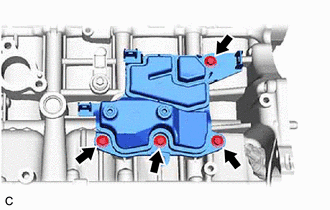
Remove the 4 bolts and No. 1 ventilation case from the cylinder block sub-assembly.
-
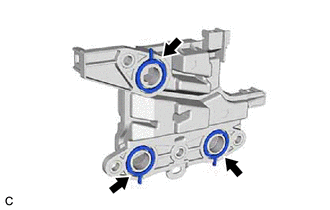
Remove the 3 oil separator gaskets from the No. 1 ventilation case.
-
-
REMOVE CYLINDER BLOCK WITH HEAD STRAIGHT SCREW PLUG (w/o Oil Cooler)
-
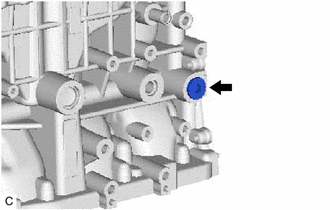
Using a 10 mm hexagon socket wrench, remove the cylinder block with head straight screw plug and gasket from the cylinder block sub-assembly.
-
-
INSPECT CONNECTING ROD THRUST CLEARANCE
-
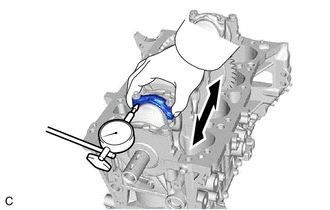
Using a dial indicator, measure the thrust clearance while moving the connecting rod sub-assembly back and forth.
Standard Thrust Clearance 0.160 to 0.512 mm (0.00630 to 0.0202 in.) Maximum Thrust Clearance 0.512 mm (0.0202 in.) Tech Tips
If the thrust clearance is more than the maximum, replace the connecting rod. If necessary, replace the crankshaft.
-
-
INSPECT CONNECTING ROD OIL CLEARANCE
-
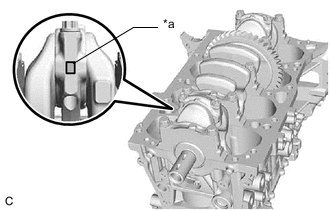
*a Alignment Mark Note the alignment marks on the connecting rod and connecting rod cap so that they can be reinstalled to their original locations.
-
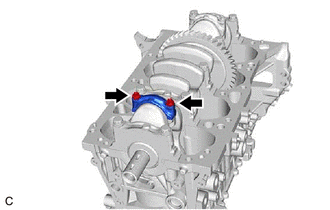
Using an E12 "TORX" socket wrench, remove the 2 connecting rod bolts and connecting rod cap.
Tech Tips
Keep the connecting rod bearing and connecting rod cap together.
-
Clean the crank pin and connecting rod bearing.
-
Check the crank pin and connecting rod bearing for pitting and scratches.
Tech Tips
If the crank pin or connecting rod bearing is damaged, replace the connecting rod bearings. If necessary, replace the crankshaft.
-
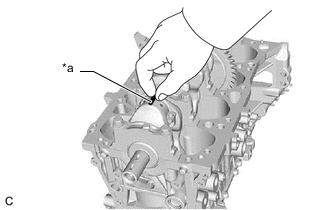
*a Plastigage Lay a strip of Plastigage on the crank pin.
-
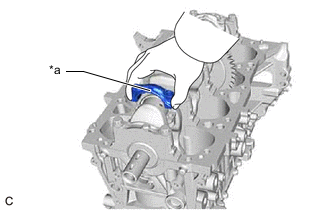
*a Front Mark Check that the front mark of the connecting rod cap is facing the correct direction, and install the connecting rod cap to the connecting rod.
-
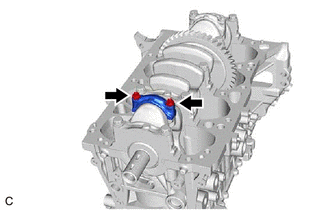
Apply a light coat of engine oil to the threads and under the heads of the 2 connecting rod bolts.
-
Using an E12 "TORX" socket wrench, install and alternately tighten the 2 connecting rod bolts in several steps.
- Torque:
- 38 N*m { 387 kgf*cm, 28 ft.*lbf }
-
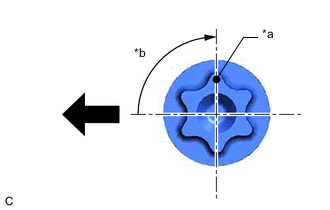
*a Paint Mark *b 90° 
Front of Engine Mark the front of each connecting rod bolt with paint.
-
Tighten the connecting rod bolts 90° as shown in the illustration.
Note
Do not turn the crankshaft during the measurement.
-
Remove the 2 connecting rod bolts and connecting rod cap.
Tech Tips
Keep the connecting rod bearing and connecting rod cap together.
-
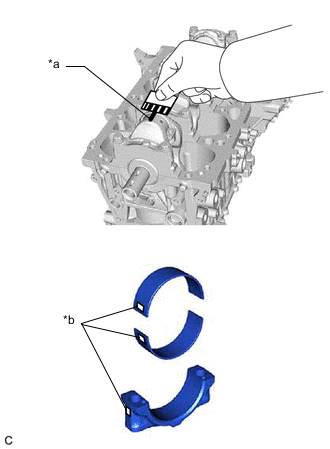
*a Plastigage *b 1, 2 or 3 Mark Measure the Plastigage at its widest point.
Standard Oil Clearance 0.027 to 0.059 mm (0.00106 to 0.00232 in.) Maximum Oil Clearance 0.059 mm (0.00232 in.) Tech Tips
-
If the oil clearance is more than the maximum, replace the connecting rod bearings. If necessary, replace the crankshaft.
-
If replacing a connecting rod bearing, select a new one with the same number as marked on the connecting rod cap. There are 3 sizes of standard connecting rod bearings, marked "1", "2" or "3" accordingly.
Standard Connecting Rod Big End Inside Diameter Mark Specified Condition 1 51.000 to 51.008 mm (2.00787 to 2.00818 in.) 2 51.009 to 51.016 mm (2.00822 to 2.00850 in.) 3 51.017 to 51.024 mm (2.00854 to 2.00881 in.) Standard Connecting Rod Bearing Center Wall Thickness Mark Specified Condition 1 1.487 to 1.491 mm (0.058543 to 0.058701 in.) 2 1.492 to 1.495 mm (0.058740 to 0.058860 in.) 3 1.496 to 1.499 mm (0.058900 to 0.059016 in.) Standard Crank Pin Diameter 47.992 to 48.000 mm (1.88945 to 1.88976 in.) Note
Remove the Plastigage completely after the measurement.
-
-
Perform the inspection above for each cylinder.
-
-
REMOVE PISTON WITH CONNECTING ROD
-
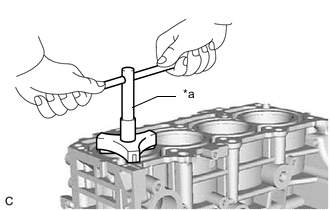
*a Ridge Reamer Using a ridge reamer, remove all the carbon from the top of each cylinder.
-
Remove the 8 connecting rod bolts, 4 connecting rod caps and 4 connecting rod bearings.
-
Push the 4 pistons, 4 connecting rods and 4 connecting rod bearings out through the top of the cylinder block sub-assembly.
Tech Tips
-
Keep the connecting rod bearings, connecting rods and connecting rod caps together.
-
Arrange the removed parts in such a way that they can be reinstalled to their original locations.
-
-
-
REMOVE CONNECTING ROD BEARING
-
Remove the 8 connecting rod bearings from the 4 connecting rods and 4 connecting rod caps.
Tech Tips
Arrange the removed parts in such a way that they can be reinstalled to their original locations.
-
-
INSPECT CRANKSHAFT THRUST CLEARANCE
-
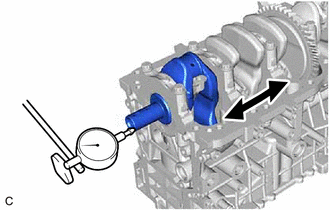
Using a dial indicator, measure the crankshaft thrust clearance while prying the crankshaft back and forth with a screwdriver.
Standard Thrust Clearance 0.09 to 0.190 mm (0.00354 to 0.00748 in.) Maximum Thrust Clearance 0.25 mm (0.00984 in.) Tech Tips
If the thrust clearance is more than the maximum, replace the crankshaft thrust washers as a set. If necessary, replace the crankshaft.
Standard Thrust Washer Thickness 2.43 to 2.48 mm (0.0957 to 0.0976 in.)
-
-
REMOVE CRANKSHAFT
-
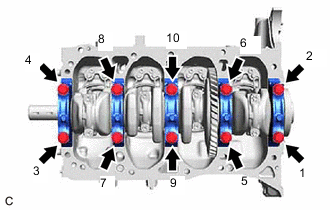
Uniformly loosen and remove the 10 crankshaft bearing cap set bolts in several steps in the order shown in the illustration.
-
Remove the 5 crankshaft bearing caps from the cylinder block sub-assembly.
Tech Tips
-
Keep the No. 2 crankshaft bearings and crankshaft bearing caps together.
-
Arrange the removed parts in such a way that they can be reinstalled to their original locations.
-
-
Remove the crankshaft from the cylinder block sub-assembly.
Tech Tips
Keep the crankshaft bearings and crankshaft thrust washers together with the cylinder block sub-assembly.
-
Check each crankshaft journal and crankshaft bearing for pitting and scratches.
If the journal or crankshaft bearing is damaged, replace the crankshaft bearings. If necessary, replace the crankshaft.
-
-
REMOVE CRANKSHAFT THRUST WASHER
-
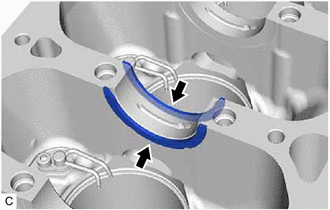
Remove the 2 crankshaft thrust washers from the No. 3 journal position of the cylinder block sub-assembly.
-
-
REMOVE CRANKSHAFT BEARING
-
Remove the 5 crankshaft bearings and 5 No. 2 crankshaft bearings from the cylinder block sub-assembly and 5 crankshaft bearing caps.
Tech Tips
Arrange the removed parts in such a way that they can be reinstalled to their original locations.
-
-
REMOVE PISTON RING SET
-
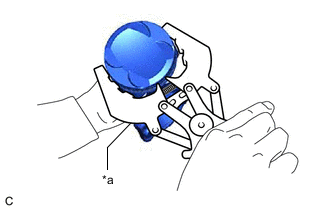
*a Piston Ring Expander Using a piston ring expander, remove the No. 1 compression ring and No. 2 compression ring from the piston.
-
Remove the oil ring expander, upper side rail and lower side rail from the piston by hand.
Tech Tips
Arrange the removed parts in such a way that they can be reinstalled to their original locations.
-
-
REMOVE PISTON PIN HOLE SNAP RING
-
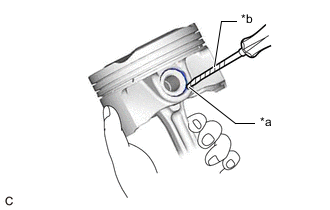
*a Front Mark Cutout Portion *b Protective Tape Using a screwdriver, pry out the 2 piston pin hole snap rings from the piston.
Tech Tips
Tape the screwdriver tip before use.
-
-
REMOVE PISTON
-
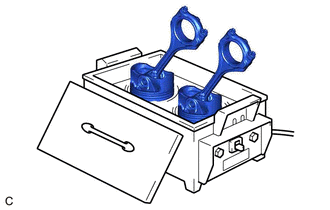
Gradually heat each piston to between 80 and 90°C (176 to 194°F).
CAUTION:
Be sure to wear protective gloves.
-
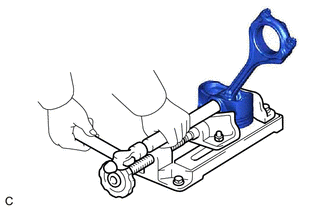
Using a brass bar and a hammer, lightly tap out the piston pin and remove the connecting rod.
Tech Tips
-
The piston and piston pin are a matched set.
-
Arrange the removed parts in such a way that they can be reinstalled to their original locations.
-
-
-
REMOVE NO. 1 OIL NOZZLE SUB-ASSEMBLY
-
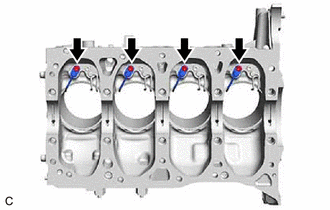
Using a 5 mm hexagon wrench, remove the 4 bolts and 4 No. 1 oil nozzle sub-assemblies from the cylinder block sub-assembly.
-
-
REMOVE NO. 2 OIL NOZZLE SUB-ASSEMBLY
-
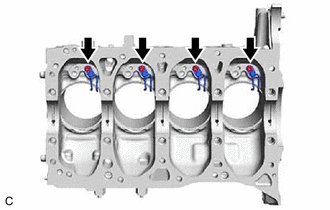
Using a 5 mm hexagon wrench, remove the 4 bolts and 4 No. 2 oil nozzle sub-assemblies from the cylinder block sub-assembly.
-