SFI SYSTEM(w/o Canister Pump Module), Diagnostic DTC:P036511, P036515
| DTC Code | DTC Name |
|---|---|
| P036511 | Camshaft Position Sensor "B" Bank 1 Circuit Short to Ground |
| P036515 | Camshaft Position Sensor "B" Bank 1 Circuit Short to Battery or Open |
DESCRIPTION
The camshaft position sensor (for exhaust camshaft) (EV1 signal) consists of a magnet and MRE (Magneto Resistance Element).
The exhaust camshaft has a timing rotor for the camshaft position sensor. When the exhaust camshaft rotates, changes occur in the air gaps between the timing rotor and MRE, which affects the magnetic field. As a result, the resistance of the MRE material fluctuates. The camshaft position sensor converts the camshaft rotation data to pulse signals, uses the pulse signals. The ECM uses the pulse signals to determine the camshaft angle. Then the ECM uses this data to control fuel injection duration, injection timing and the Variable Valve Timing (VVT) system.
| DTC No. | Detection Item | DTC Detection Condition | Trouble Area | MIL | Memory | Note |
|---|---|---|---|---|---|---|
| P036511 | Camshaft Position Sensor "B" Bank 1 Circuit Short to Ground | The camshaft position sensor (for exhaust camshaft) output voltage is less than 0.3 V for 4 seconds or more (1 trip detection logic). |
|
Comes on | DTC stored | SAE Code: P0367 |
| P036515 | Camshaft Position Sensor "B" Bank 1 Circuit Short to Battery or Open | The camshaft position sensor (for exhaust camshaft) output voltage is higher than 4.7 V for 4 seconds or more (1 trip detection logic). |
|
Comes on | DTC stored | SAE Code: P0368 |
Reference: Inspection using an oscilloscope.
MONITOR DESCRIPTION
If the output voltage transmitted by the camshaft position sensor (for exhaust camshaft) remains low or high, the ECM interprets this as a malfunction in the sensor circuit, illuminates the MIL and stores a DTC.
MONITOR STRATEGY
| Required Sensors/Components (Main) | Camshaft position sensor (for exhaust camshaft) |
| Required Sensors/Components (Related) | Crankshaft position sensor |
| Frequency of Operation | Continuous |
CONFIRMATION DRIVING PATTERN
-
Connect the GTS to the DLC3.
-
Turn the ignition switch to ON.
-
Turn the GTS on.
-
Clear the DTCs (even if no DTCs are stored, perform the clear DTC procedure).
-
Turn the ignition switch off and wait for at least 30 seconds.
-
Turn the ignition switch to ON.
-
Turn the GTS on.
-
Wait 5 seconds or more.
-
Enter the following menus: Powertrain / Engine / Trouble Codes.
-
Read the pending DTCs.
Tech Tips
-
If a pending DTC is output, the system is malfunctioning.
-
If a pending DTC is not output, perform the following procedure.
-
-
Enter the following menus: Powertrain / Engine / Utility / All Readiness.
-
Input the DTC: P036511 or P036515.
-
Check the DTC judgment result.
GTS Display Description NORMAL
-
DTC judgment completed
-
System normal
ABNORMAL
-
DTC judgment completed
-
System abnormal
INCOMPLETE
-
DTC judgment not completed
-
Perform driving pattern after confirming DTC enabling conditions
Tech Tips
-
If the judgment result is NORMAL, the system is normal.
-
If the judgment result is ABNORMAL, the system is malfunctioning.
-
WIRING DIAGRAM
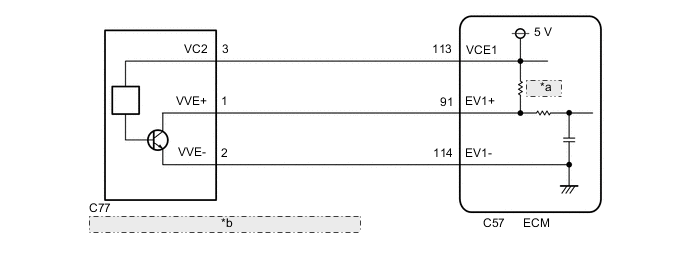
| *a | 1.5 kΩ |
| *b | Camshaft Position Sensor (for Exhaust Camshaft) |
CAUTION / NOTICE / HINT
Tech Tips
Read Freeze Frame Data using the GTS. The ECM records vehicle and driving condition information as Freeze Frame Data the moment a DTC is stored. When troubleshooting, Freeze Frame Data can help determine if the vehicle was moving or stationary, if the engine was warmed up or not, if the air fuel ratio was lean or rich, and other data from the time the malfunction occurred.
PROCEDURE
-
CHECK HARNESS AND CONNECTOR
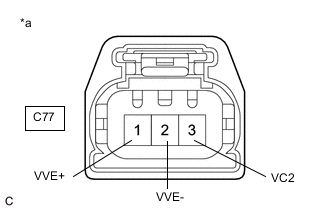
*a Front view of wire harness connector
(to Camshaft Position Sensor (for Exhaust Camshaft))
Tech Tips
Make sure that the connector is properly connected. If it is not, securely connect it and check for DTCs again.
-
Disconnect the camshaft position sensor (for exhaust camshaft) connector.
-
Turn the ignition switch to ON.
-
Measure the voltage according to the value(s) in the table below.
Standard Voltage Tester Connection Condition Specified Condition C77-3 (VC2) - Body ground Ignition switch ON 4.5 to 5.5 V C77-1 (VVE+) - Body ground Ignition switch ON 3.0 to 5.0 V -
Turn the ignition switch off and wait for at least 30 seconds.
-
Measure the resistance according to the value(s) in the table below.
Standard Resistance Tester Connection Condition Specified Condition C77-3 (VC2) - C77-1 (VVE+) Ignition switch off 1.425 to 1.575 kΩ C77-2 (VVE-) - Body ground Ignition switch off Below 1 Ω Result Proceed to OK NG
OK 
REPLACE CAMSHAFT POSITION SENSOR (FOR EXHAUST CAMSHAFT) Click here
NG 
-
-
CHECK HARNESS AND CONNECTOR (CAMSHAFT POSITION SENSOR (FOR EXHAUST CAMSHAFT) - ECM)
-
Disconnect the camshaft position sensor (for exhaust camshaft) connector.
-
Disconnect the ECM connector.
-
Measure the resistance according to the value(s) in the table below.
Standard Resistance Tester Connection Condition Specified Condition C77-1 (VVE+) - C57-91 (EV1+) Always Below 1 Ω C77-2 (VVE-) - C57-114 (EV1-) Always Below 1 Ω C77-3 (VC2) - C57-113 (VCE1) Always Below 1 Ω C77-1 (VVE+) or C57-91 (EV1+) - Body ground and other terminals Always 10 kΩ or higher C77-2 (VVE-) or C57-114 (EV1-) - Body ground and other terminals Always 10 kΩ or higher C77-3 (VC2) or C57-113 (VCE1) - Body ground and other terminals Always 10 kΩ or higher Result Proceed to OK NG
OK
REPLACE ECM Click here
NG
REPAIR OR REPLACE HARNESS OR CONNECTOR
-