Refer to Precaution of Cruise Control System for the name of each switch on the cruise control switch.
Click here
-
GENERAL
The steering pad switch assembly is used to turn the dynamic radar cruise control system on and off, as well as operate 7 functions: SET, - (COAST), TAP-DOWN, RES (RESUME), + (ACCEL), TAP-UP and CANCEL. The SET, TAP-DOWN, and - (COAST) functions, and the RES (RESUME), TAP-UP, and + (ACCEL) functions are operated with the steering pad switch assembly.
Tip:The dynamic radar cruise control system has two cruise control modes: constant speed control mode and vehicle-to-vehicle distance control mode.
-
Vehicle-to-vehicle distance control mode is selected by default when the dynamic radar cruise control system is turned on using the cruise control main switch.
-
Operation of constant speed control mode is the same as that for a conventional cruise control system.
-
This system maintains the vehicle at the speed that the driver has set, as long as there are no vehicles ahead. In addition to this, the system maintains the vehicle-to-vehicle distance that has been set by the driver. If the system detects a vehicle driving at a slower speed ahead while the driver is driving at a constant speed, it controls the engine to decelerate the vehicle. If further deceleration is required, the system controls the skid control ECU (brake actuator assembly) in order to apply the brakes. Thereafter, if there are no vehicles ahead within the set vehicle-to-vehicle distance because either the vehicle ahead or the driver has changed lanes, the system accelerates slowly to reach the set speed and resumes driving at this speed.
-
Vehicle-to-vehicle distance control mode is designed to control vehicle speed and vehicle-to-vehicle distance using the constant speed function, deceleration cruising function, follow-up cruising function, and acceleration cruising function.
-
The millimeter wave radar sensor assembly and forward recognition camera control the system while vehicle-to-vehicle distance control mode is operating, and send signals to each actuator and ECU.
-
In vehicle-to-vehicle distance control mode, the dynamic radar cruise control system receives signals from the forward recognition camera, yaw rate and acceleration sensor (airbag sensor assembly) and the steering sensor. Based on these signals, the system calculates the turn radius and uses it when calculating information on the preceding vehicle. It also uses this information for brake control when approaching another vehicle.
-
This system judges the presence of a vehicle in front and the distance to it based on the signals from the millimeter wave radar sensor assembly and forward recognition camera while vehicle-to-vehicle distance control mode is operating. Using this information, the system warns the driver by sounding the buzzer, performs brake control, and turns on the stop lights when approaching a vehicle in front.
-
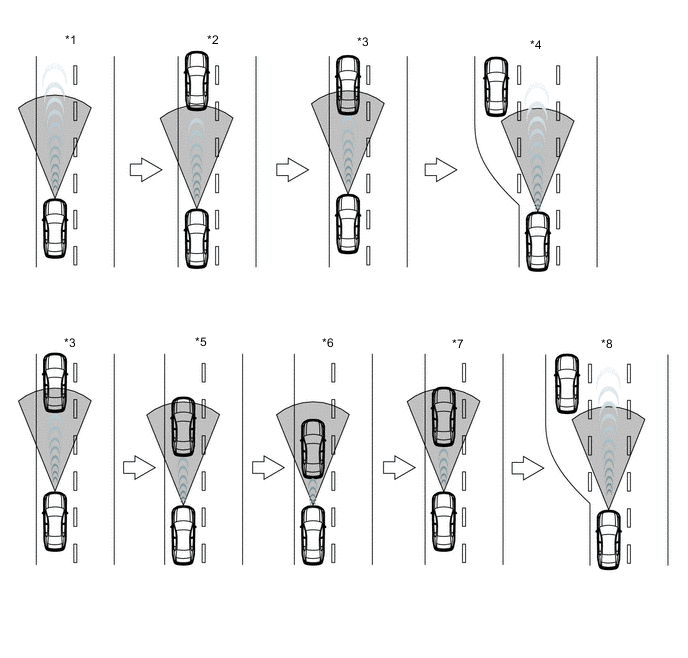
*1 Drives the vehicle at a constant speed (set speed: 100 km/h (60 mph)) *2 Decelerates the vehicle from the set speed to the speed of the preceding vehicle (80 km/h (50 mph))* *3 Follows the preceding vehicle while maintaining an appropriate vehicle-to-vehicle distance according to the speed of the preceding vehicle *4 Gradually accelerates the vehicle to the set speed and maintains the speed *5 Decelerates and stops the vehicle while maintaining an appropriate distance with the preceding vehicle *6 Keeps the vehicle stopped in conjunction with the brake hold function *7 When the +RES switch is pushed or the accelerator pedal is depressed after the preceding vehicle starts off, follow-up control is resumed *8 If a preceding vehicle is not detected when the vehicle speed is approximately 40 km/h (25 mph) or less, control is canceled *: Throttle valve control and brake control are performed to decelerate the vehicle. If deceleration is insufficient and the distance to the preceding vehicle becomes too short, the vehicle approach warning buzzer sounds to warn the driver to take an appropriate action (braking, etc.).
The dynamic radar cruise control system performs the following controls (example).
Tip:
-
Vehicle distance increases and decreases in accordance with vehicle speed.
-
Control conditions are indicated on the multi-information display in the combination meter assembly.
-
-
-
FUNCTION OF MAIN COMPONENTS
-
The main components of the dynamic radar cruise control system have the following functions:
Component Outline Combination Meter Assembly Cruise Control Indicator (Vehicle-to-vehicle Distance Control Mode)
-
Illuminates based on signals from the ECM when the dynamic radar cruise control system is turned on using the cruise control main switch.
-
Turns off based on signals from the ECM or millimeter wave radar sensor assembly when a malfunction is detected in the dynamic radar cruise control system.
Cruise Control Indicator (Constant Speed Control Mode) Illuminates when the dynamic radar cruise control system is turned on using the cruise control main switch and constant speed control mode is selected. Cruise SET Indicator Illuminates when the vehicle speed is set. Multi-information Display
-
Displays dynamic radar cruise control system information based on signals from the ECM when the dynamic radar cruise control system is turned on using the cruise control main switch.
-
Displays a warning message if the ECM or millimeter wave radar sensor assembly detects a malfunction signal while the dynamic radar cruise control system is controlling vehicle speed.
Warning Buzzer Sounds once to inform the ECM or driver if the millimeter wave radar sensor assembly detects an automatic cancel signal while the dynamic radar cruise control system is controlling vehicle speed. Steering Pad Switch Assembly Cruise Control Main Switch
-
Turns the dynamic radar cruise control system on and off.
-
Switches the control mode between constant speed control mode and vehicle-to-vehicle distance control mode.
CANCEL Switch Outputs a cancel signal to the ECM. +RES Switch Outputs acceleration and resume stored speed signals to the ECM. -SET Switch Outputs deceleration and set vehicle speed signals to the ECM. Vehicle-to-vehicle Distance Control Switch When vehicle-to-vehicle distance control mode is controlling vehicle speed, changes the vehicle-to-vehicle distance to long, middle or short. Stop Light Switch Assembly Outputs brake pedal depression signals to the ECM. Millimeter Wave Radar Sensor Assembly
-
Sends information such as vehicle-to-vehicle distance, relative speed and presence of a vehicle in front to the ECM based on reflected millimeter waves.
-
Detects a preceding vehicle based on signals from the millimeter wave radar sensor assembly when the dynamic radar cruise control system is in vehicle-to-vehicle distance control mode. Then, the millimeter wave radar sensor assembly calculates the acceleration or deceleration required to achieve the target vehicle-to-vehicle distance, and outputs request signals to the ECM.
-
Stores DTCs if a malfunction is detected in the dynamic radar cruise control system.
Forward Recognition Camera Captures the image in front of the vehicle to detect lane markers and objects on the road ahead. Steering Sensor Outputs steering angle signals to the millimeter wave radar sensor assembly. Speed Sensor Outputs wheel speed signals to the skid control ECU (brake actuator assembly). Yaw Rate and Acceleration Sensor (Airbag Sensor Assembly) Outputs yaw rate signals to the millimeter wave radar sensor assembly. Skid Control ECU (Brake Actuator Assembly) Operates the brake actuator assembly in accordance with brake request signals received from the ECM when the dynamic radar cruise control system is in vehicle-to-vehicle distance control mode. ECM
-
Controls the dynamic radar cruise control system in accordance with signals received from switches, sensors, and the millimeter wave radar sensor assembly.
-
Stores DTCs if a malfunction is detected in the dynamic radar cruise control system.
Throttle with Motor Body Assembly Throttle Control Motor Adjusts the throttle valve opening angle in accordance with signals received from the ECM. Throttle Position Sensor Outputs the throttle valve opening angle to the ECM. Park/Neutral Position Switch Assembly Outputs the shift lever position to the ECM. VSC OFF Switch Outputs VSC off signals to the skid control ECU (brake actuator assembly). Shift Lock Control Unit Assembly Transmission Control Switch While the vehicle is being driven in S mode, outputs "+" (upshift) or "-" (downshift) request signals to the ECM. Shift Paddle Switch (Transmission Shift Switch Assembly)* Outputs upshift or downshift request signals to the ECM. Electric Parking Brake Switch Assembly Detects operation of the electric parking brake and cancels control of vehicle speed by the dynamic radar cruise control system. Parking Brake Actuator Operates the parking brake actuator according to signals from the skid control ECU (brake actuator assembly). *: w/ Shift Paddle Switch
-
-
-
OPERATION OF DYNAMIC RADAR CRUISE CONTROL
-
Controls performed by the dynamic radar cruise control system in each control mode (constant speed control mode and vehicle-to-vehicle distance control mode) are as follows:
Mode Outline Constant Speed Control Mode Operation of constant speed control mode is the same as that for the conventional cruise control system. However, the difference is as follows:
-
The lowest possible set speed for the dynamic radar cruise control system (constant speed control mode) is approximately 40 km/h (25 mph).
Vehicle-to-vehicle Distance Control Mode In vehicle-to-vehicle distance control mode, the system detects a preceding vehicle and maintains an appropriate vehicle-to-vehicle distance according to the speed of the preceding vehicle (follow-up control).
-
The driver can operate the vehicle-to-vehicle distance control switch (steering pad switch assembly) to select the vehicle-to-vehicle distance in 3 levels: long, middle, or short.
-
This mode performs 4 controls: constant speed control, deceleration control, follow-up control, and acceleration control.
-
This mode performs follow-up control over the entire speed range, including when stopping and starting the vehicle, while maintaining an appropriate distance to the preceding vehicle.
-
Vehicle-to-vehicle Distance Control Mode:
Function Outline Set Control
-
The vehicle speed is stored and control of vehicle speed begins when the -SET switch is pushed while driving at a speed of between approximately 0 km/h (0 mph) and 180 km/h (112 mph) with the dynamic radar cruise control system on.
-
The lowest possible set speed is stored and follow-up control begins when the -SET switch is pushed to while driving behind a vehicle at a speed less than approximately 50 km/h (31 mph) with the dynamic radar cruise control system on.
-
The lowest possible set speed is approximately 50 km/h (31 mph).
-
When the set speed is stored, the cruise SET indicator illuminates and the set speed is displayed on the multi-information display.
High Speed Limit Control The highest possible set speed is approximately 180 km/h (112 mph). The dynamic radar cruise control system cannot be set when the vehicle speed is over the high speed limit. Also, + (ACCEL)/RES (RESUME) cannot be used to increase the speed beyond the high speed limit. Constant Speed Control The millimeter wave radar sensor assembly compares the actual vehicle speed and the stored vehicle speed. When the vehicle speed is less than the stored vehicle speed, it increases the opening angle of the throttle valve. Follow-up Control The vehicle follows the preceding vehicle while maintaining an appropriate vehicle-to-vehicle distance according to the speed of the preceding vehicle. Stop Control When the preceding vehicle stops, motive force control is performed to stop the vehicle while maintaining an appropriate vehicle-to-vehicle distance. Stop Retention Control After the vehicle has stopped by stop control, the millimeter wave radar sensor assembly outputs a stop retention request signal to the skid control ECU (brake actuator assembly). Upon receiving this signal, the skid control ECU (brake actuator assembly) operates the brake hold function to keep the vehicle stationary. Start Control
-
When it is determined that the preceding vehicle has started off, a message prompting the driver to start-off is displayed on the multi-information display, and control of vehicle speed resumes when it is determined that the vehicle has started-off.
-
When the set vehicle speed is stored, the speed of the vehicle is controlled within a range up to the set vehicle speed, and when the set vehicle speed is not stored, the speed of the vehicle is controlled within a range up to the lowest possible set speed.
Mode Control When the cruise control main switch is pushed and held for 1.5 seconds or more with the dynamic radar cruise control system off, mode changes to constant speed control mode. + (ACCEL) Control When vehicle-to-vehicle distance control mode is controlling vehicle speed and the +RES switch is pushed and held, the stored vehicle speed increases in increments of approximately 5 km/h or 5 mph. Pushing the +RES switch while following a preceding vehicle using vehicle-to-vehicle distance control mode does not increase actual vehicle speed, but changes only the stored vehicle speed. Tap-up Control
(except Europe)
When vehicle-to-vehicle distance control mode is controlling vehicle speed and the +RES switch is tapped (for 0.6 seconds or less), the stored vehicle speed increases by approximately 1 km/h or 1 mph for each time the switch is tapped. Tap-up Control
(for Europe)
When vehicle-to-vehicle distance control mode is controlling vehicle speed and the +RES switch is tapped (for 0.6 seconds or less), the stored vehicle speed increases by approximately 5 km/h or 5 mph for each time the switch is tapped. - (COAST) Control When vehicle-to-vehicle distance control mode is controlling vehicle speed and the -SET switch is pushed and held, the stored vehicle speed decreases in increments of approximately 5 km/h or 5 mph. TAP-down Control
(except Europe)
When vehicle-to-vehicle distance control mode is controlling vehicle speed and the -SET switch is tapped (for 0.6 seconds or less), the stored vehicle speed decreases by approximately 1 km/h or 1 mph for each time the switch is tapped. TAP-down Control
(for Europe)
When vehicle-to-vehicle distance control mode is controlling vehicle speed and the -SET switch is tapped (for 0.6 seconds or less), the stored vehicle speed decreases by approximately 5 km/h or 5 mph for each time the switch is tapped. Auto Cancel Control This system has an automatic cancellation function (fail-safe).
Manual Cancel Control Performing any of the following cancels dynamic radar cruise control system control of vehicle speed (the stored vehicle speed in the ECM is maintained).
-
Depressing the brake pedal.
-
Moving the shift lever from D or S to any other position.
-
Selecting the S3, S2 or S1 range with the shift lever in S.
-
Selecting the D3, D2 or D1 range using the shift paddle switch (transmission shift switch assembly) with the shift lever in D.*
-
Pushing the CANCEL switch.
-
Turning the cruise control system off using the cruise control main switch (the stored vehicle speed in the ECM is not maintained).
Other Control Cancellation Conditions For details of other cancel controls, refer to the fail-safe chart.
RES (Resume) Control
-
When the vehicle speed is between the low and high speed limits, pushing the +RES switch resumes and maintains the stored vehicle speed from the time of cancellation.
-
If the preceding vehicle moves out of the lane while follow-up control is operating, the vehicle speed is gradually increased to the set vehicle speed. At this time, the vehicle speed can be increased by pushing the +RES switch.
-
After the preceding vehicle starts off, a message is displayed to inform the driver to perform the start-off operation. When the +RES switch is pushed follow-up control is resumed and the vehicle is accelerated up to the set speed.
Down Shift Control When driving on an uphill with the dynamic radar cruise control system controlling vehicle speed, the transmission may downshift from an overdrive gear. After the downshift, if the system determines that the uphill inclination has become smaller based on the throttle valve opening angle, the transmission automatically returns to the overdrive gear. Brake Control When a large amount of deceleration is required while vehicle-to vehicle distance control mode is controlling vehicle speed, the skid control ECU (brake actuator assembly) is operated to apply the brakes. The stop lights illuminate at this time. *: w/ Shift Paddle Switch
-
-
Constant Speed Control Mode:
Function Outline Constant Speed Control The millimeter wave radar sensor assembly compares the actual vehicle speed and the stored vehicle speed. When the vehicle speed is less than the stored vehicle speed, it increases the opening angle of the throttle valve. Set Control
-
The vehicle speed is stored and control of vehicle speed begins when the -SET switch is pushed while driving at a speed of between approximately 40 km/h (25 mph) or more with the dynamic radar cruise control system on.
-
When the set speed is stored, the cruise SET indicator illuminates and the set speed is displayed on the multi-information display.
Low Speed Limit Control The low speed limit is approximately 40 km/h (25 mph). If the vehicle speed drops below the low speed limit, speed control by the dynamic radar cruise control system is canceled automatically and the set vehicle speed is kept in memory. High Speed Limit Control The highest possible set speed is approximately 200 km/h (124 mph). The dynamic radar cruise control system cannot be set when the vehicle speed is over the high speed limit. Also, + (ACCEL)/RES (RESUME) cannot be used to increase the speed beyond the high speed limit. + (ACCEL) Control When the dynamic radar cruise control system is controlling vehicle speed and the +RES switch is pushed and held, the dynamic radar cruise control system sends a signal to the ECM to operate the throttle valve motor of the throttle body with motor assembly to open the throttle valve. Following this, the vehicle speed is stored and maintained when the +RES switch is released. If the vehicle speed exceeds the high speed limit (approximately 200 km/h (124 mph)) while the +RES switch is being pushed, the highest possible set speed is stored. Tap-up Control When the dynamic radar cruise control system is controlling vehicle speed and the +RES switch is tapped (for approximately 0.6 seconds), the stored vehicle speed increases by approximately 1 km/h or 1 mph for each time the switch is tapped. When the +RES switch is tapped and the difference between the current and stored vehicle speed is more than 5 km/h (3 mph), the stored vehicle speed will not be changed. - (COAST) Control When the dynamic radar cruise control system is controlling vehicle speed and the -SET switch is pushed and held, the cruise control system sends a "throttle valve opening angle 0°" demand signal to the ECM. Following this, the vehicle speed is stored and maintained when the -SET switch is released.
Tip:An actual throttle valve opening angle of 0° is not possible due to factors such as idle speed control.
Tap-down Control When the dynamic radar cruise control system is controlling vehicle speed and the -SET switch is tapped (for approximately 0.6 seconds), the stored vehicle speed decreases by approximately 1 km/h or 1 mph for each time the switch is tapped. When the -SET switch is tapped and the difference between the current and stored vehicle speed is more than 5 km/h (3 mph), the current vehicle speed is stored and speed control is performed. Auto Cancel Control This system has an automatic cancellation function (fail-safe).
Manual Cancel Control Performing any of the following cancels dynamic radar cruise control system control of vehicle speed.
-
Depressing the brake pedal.
-
Moving the shift lever from D or S to any other position.
-
Selecting the S3, S2 or S1 range with the shift lever in S.
-
Selecting the D3, D2 or D1 range using the shift paddle switch (transmission shift switch assembly) with the shift lever in D.*
-
Push the steering pad switch assembly to CANCEL switch.
-
Turning the cruise control system off using the cruise control main switch (the stored vehicle speed in the ECM is not maintained).
Other Control Cancellation Conditions For details of other cancel controls, refer to the fail-safe chart.
RES (Resume) Control If control of vehicle speed by the dynamic radar cruise control system was canceled due to any of the manual cancel conditions (other than turning the dynamic radar cruise control system off using the cruise control main switch), and if the vehicle speed is between the low and high speed limits, the stored vehicle speed from the time of cancellation will be resumed and maintained when the +RES switch is pushed. Down Shift Control When driving on an uphill with the dynamic radar cruise control system controlling vehicle speed, the transmission may downshift from an overdrive gear. After the downshift, if the system determines that the uphill inclination has become smaller based on the throttle valve opening angle, the transmission automatically returns to the overdrive gear. *: w/ Shift Paddle Switch
-
-
-