ADAPTIVE HIGH BEAM SYSTEM OPERATION CHECK
-
ADAPTIVE HIGH BEAM SYSTEM OPERATION CHECK
Note
Make sure that the customize settings are set to default when performing the adaptive high beam system operation check.
-
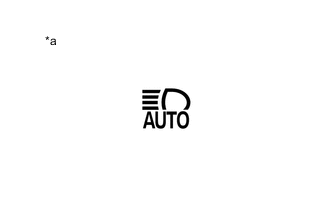
*a Adaptive High Beam Indicator When all of the following conditions are met, the adaptive high beam indicator illuminates (green) indicating the adaptive high beam system is on.
-
The engine switch is on (IG).
-
The light control switch is in the head or AUTO position.*
-
The low beams are operating.
-
The dimmer switch is in the high position.*
-
The integration control and panel assembly (adaptive high beam switch) is on.
-
*: If the condition is not met, the notification "To Activate AHS, Switch Headlights to High Beam" is displayed on the multi-information display in the combination meter assembly.
Note
-
When the forward recognition camera cannot correctly detect objects due to inclement weather such as thick fog or other visual obstructions, the adaptive high beam indicator may not turn on and consequently the adaptive high beam system may not operate.
-
When the cable is disconnected from the negative (-) battery terminal, the adaptive high beam system may not operate until the vehicle steering sensor zero point calibration has been performed. After reconnecting the cable, drive the vehicle to initialize the steering sensor zero point value.
-
If the temperature of the forward recognition camera is excessively high, or performing the forward recognition camera axis calibration due a change in the attitude of the vehicle, such as when fully loaded, the adaptive high beam indicator may not turn on and consequently the adaptive high beam system may not operate.
-
-
When the following conditions are met while the adaptive high beam system is on, after a short period of time the high beam headlights will turn on.
-
Vehicle speed is more than approximately 15 km/h (9 mph).
-
There are no illuminated head lamps or tail lamps of other vehicles in front of the vehicle.
-
The area in front of the vehicle has few street lights and is sufficiently dark.
-
The high beam control mode changes in accordance with vehicle speed.
Illumination Mode Description Vehicle Speed Except Europe Europe Residential Area Mode At low speeds, in consideration of the drivers field of vision, the illuminated area is widened. The brightness of the headlights is adjusted to ensure that pedestrians are visible while not being dazzled. Reduces illumination of the side of the road. 15 - 30 km/h
(9 - 25 mph)
- Normal Mode At medium speeds, the illuminated area in front of the vehicle is extended and necessary areas to the left and right of the vehicle are illuminated. 30 - 80km/h
(25 - 50mph)
60 - 100km/h
(37 - 62mph)
High Speed Mode At high speeds, the illuminated area in front of the vehicle is extended and increased in brightness and the additional high beams are used. 80 km/h or more
(50 mph or more)
100 km/h or more
(62 mph or more)
-
-
When the following conditions are met while the adaptive high beam system is on, cut-off line tilt control (function that adjusts the upper illumination area of the low beam headlights) will operates.
-
Vehicle speed is more than approximately 15 km/h (9 mph).
-
The area in front of the vehicle is dark.
-
The headlights of oncoming vehicles or taillights of preceding vehicles are detected.
-
-
When the following conditions are met while the adaptive high beam function is operating, after a short period of time the brightness and illumination area of the high beams will change according to the detected conditions.
-
Vehicle speed is more than approximately 15 km/h (9 mph).
-
The headlights of oncoming vehicles or taillights of preceding vehicles are detected.
-
The area in front of the vehicle has few street lights and is sufficiently dark.
-
-
When the following conditions are met while the adaptive high beam function is operating, headlight swivel control will operate.
-
Vehicle speed is more than approximately 30 km/h (25 mph).
-
The steering wheel is turned 10.5 degrees or more.
-
-
When the following conditions are met while the adaptive high beam function is operating, the high beam headlights will turn off.
-
Vehicle speed is less than approximately 15 km/h (9 mph).
-
The headlights of oncoming vehicles or taillights of preceding vehicles are detected.
-
The area in front of the vehicle is light.
-
Multiple vehicles are detected in front of the vehicle.
-
The movement of a vehicle in front is rapid and causing glare.
-
-
When the following conditions are met, operation of the adaptive high beam system is canceled and the adaptive high beam indicator in the combination meter assembly is turned off.
-
The engine switch is turned off.
-
The light control switch is turned to any position except the AUTO or head position.
-
The low beams are not operating.
-
The dimmer switch is moved to the low position.
-
The integration control and panel assembly (adaptive high beam switch) is off.
-
-
The adaptive high beam system may not operate correctly under the following conditions.
Cause Details Weather/Climate
-
Inclement weather such as heavy rain, fog or snow.
-
The temperature inside the vehicle is high.
-
The taillights of a proceeding vehicle are obscured by snow, etc.
Front windshield Refer to Forward Recognition System.
Forward recognition camera Refer to Forward Recognition System.
Nearby vehicles or lights
-
There are lights that resemble headlights or taillights in the surrounding area.
-
The headlights of an oncoming vehicle or taillights of a preceding vehicle are not illuminated.
-
The headlights of an oncoming vehicle or taillights of a preceding vehicle are dirty or discolored.
-
An oncoming or preceding vehicle has only one of its headlights or taillights on or is a motorcycle.
-
The headlights of an oncoming vehicle are misaligned.
-
The rear of a preceding vehicle is highly reflective or has a highly reflective object attached.
-
A bicycle or similar lightweight vehicle is detected.
-
There is a sudden change in brightness.
Road conditions
-
Driving on an undulating road.
-
Driving on a road with many curves or a sharp curve.
-
Driving on a road with a poor surface such as an unpaved road.
-
There is a strong reflection from a sign or mirror in front of the vehicle.
Own vehicle
-
The headlights are malfunctioning.
-
The attitude of the vehicle is abnormal such as when the vehicle is fully loaded with passengers and luggage, has a flat tire, or is towing a trailer.
Adaptive High beam System
-
"Headlight System Malfunction Visit Your Dealer" warning message is displayed on the multi-information display.
-
In the following situations, it may be necessary to manually turn the adaptive high beam system off:
-
When the adaptive high beam system does not seem to be changing the illuminated area properly.
-
When the adaptive high beam system constantly changes the illuminated area.
-
When the high beams may disturb pedestrians or the drivers of other vehicles.
-
-