LIGHTING SYSTEM Interior Light Auto Cut Circuit
DESCRIPTION
When the battery saving control operates, the main body ECU (multiplex network body ECU) controls the operation of the DOME CUT relay that is built into the instrument panel junction block assembly to turn off the interior lights.
WIRING DIAGRAM
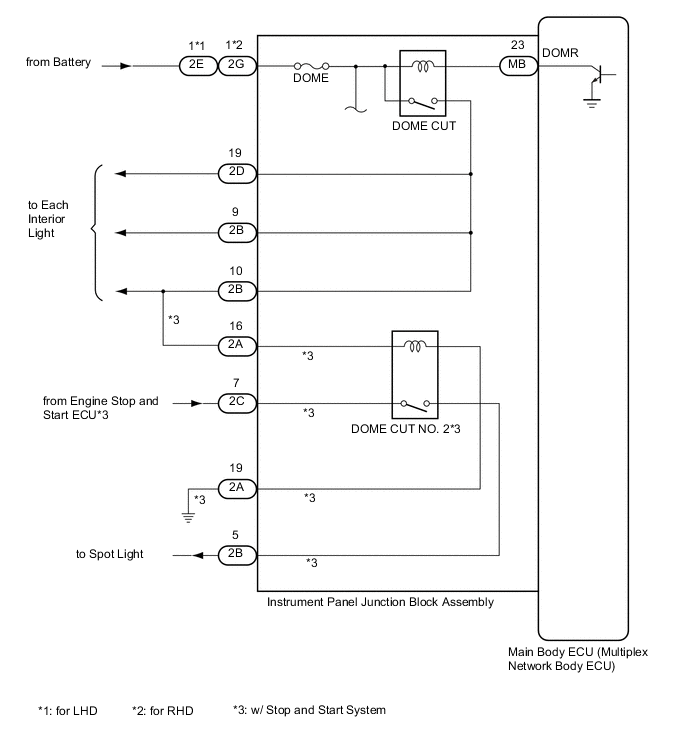
CAUTION / NOTICE / HINT
Note
-
Inspect the fuses for circuits related to this system before performing the following inspection procedure.
-
Before replacing the main ECU (multiplex network body ECU), refer to Service Bulletin.
-
The vehicle battery supplies power to the main body ECU (multiplex network body ECU) via the door control battery. Therefore, before proceeding with troubleshooting, perform an on-vehicle inspection and confirm that the main body ECU (multiplex network body ECU) power source circuit is normal.*
-
*: w/o Canister Pump Module with Door Ajar Warning Buzzer Function
PROCEDURE
-
PERFORM ACTIVE TEST USING GTS
-
Connect the GTS to the DLC3.
-
Turn the engine switch on (IG).
-
Turn the GTS on.
-
Enter the following menus: Body Electrical / Main Body / Active Test.
-
Perform the Active Test according to the display on the GTS.
Body Electrical > Main Body > Active TestTester Display Measurement Item Control Range Diagnostic Note Relay for Interior Light Auto Cut Function DOME CUT relay ON or OFF
-
ON: DOME CUT relay off (interior lights turn off)
-
OFF: DOME CUT relay on (interior lights turn on)
Body Electrical > Main Body > Active TestTester Display Relay for Interior Light Auto Cut Function OK All of the interior lights turn off when ON is selected. Result Proceed to OK NG -
OK 
PROCEED TO NEXT SUSPECTED AREA SHOWN IN PROBLEM SYMPTOMS TABLE Click here
NG 
-
-
CHECK HARNESS AND CONNECTOR (POWER SOURCE - INSTRUMENT PANEL JUNCTION BLOCK ASSEMBLY)
-
Disconnect the 2E*1 or 2G*2 instrument panel junction block assembly connector.
-
Measure the voltage according to the value(s) in the table below.
Standard Voltage Tester Connection Condition Specified Condition 2E-1 - Body ground*1 Always 11 to 14 V 2G-1 - Body ground*2 Always 11 to 14 V
-
*1: for LHD
-
*2: for RHD
Result Proceed to OK NG -
NG
REPAIR OR REPLACE HARNESS OR CONNECTOR
OK
-
-
INSPECT INSTRUMENT PANEL JUNCTION BLOCK ASSEMBLY
-
Remove the instrument panel junction block assembly.
-
Remove the main body ECU (multiplex network body ECU) from the instrument panel junction block assembly.
-
Measure the voltage and resistance according to the value(s) in the table below.
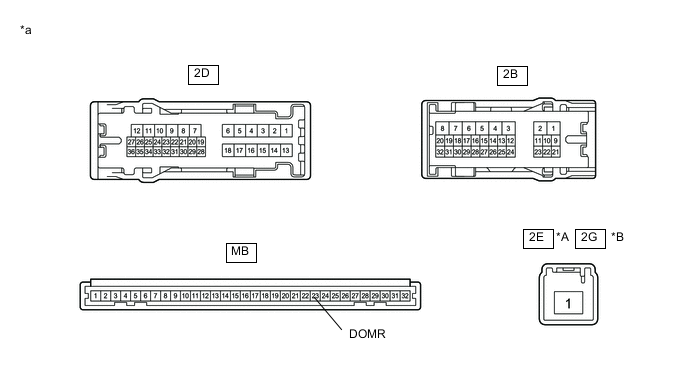
*A for LHD *B for RHD *a Component without harness connected
(Instrument Panel Junction Block Assembly)
- - Standard Voltage for LHD Tester Connection Condition Specified Condition 2D-19 - Battery negative terminal Battery positive (+) → 2E-1
Battery negative (-) → MB-23 (DOMR)
11 to 14 V 2B-9 - Battery negative terminal Battery positive (+) → 2E-1
Battery negative (-) → MB-23 (DOMR)
11 to 14 V 2B-10 - Battery negative terminal Battery positive (+) → 2E-1
Battery negative (-) → MB-23 (DOMR)
11 to 14 V for RHD Tester Connection Condition Specified Condition 2D-19 - Battery negative terminal Battery positive (+) → 2G-1
Battery negative (-) → MB-23 (DOMR)
11 to 14 V 2B-9 - Battery negative terminal Battery positive (+) → 2G-1
Battery negative (-) → MB-23 (DOMR)
11 to 14 V 2B-10 - Battery negative terminal Battery positive (+) → 2G-1
Battery negative (-) → MB-23 (DOMR)
11 to 14 V Standard Resistance for LHD Tester Connection Condition Specified Condition 2E-1 - 2D-19 Always 10 kΩ or higher 2E-1 - 2B-9 Always 10 kΩ or higher 2E-1 - 2B-10 Always 10 kΩ or higher for RHD Tester Connection Condition Specified Condition 2G-1 - 2D-19 Always 10 kΩ or higher 2G-1 - 2B-9 Always 10 kΩ or higher 2G-1 - 2B-10 Always 10 kΩ or higher Result Result Proceed to OK (w/o Stop and start system) A OK (w/ Stop and start system) B NG C
A
REPLACE MAIN BODY ECU (MULTIPLEX NETWORK BODY ECU) Click here
C
REPLACE INSTRUMENT PANEL JUNCTION BLOCK ASSEMBLY Click here
B
-
-
CHECK HARNESS AND CONNECTOR (ENGINE STOP AND START ECU - INSTRUMENT PANEL JUNCTION BLOCK ASSEMBLY)
-
Disconnect the 2C instrument panel junction block assembly connector.
-
Measure the voltage according to the value(s) in the table below.
Standard Voltage Tester Connection Condition Specified Condition 2C-7 - Body ground Engine switch on (IG) 10.5 to 16 V Result Proceed to OK NG
NG
GO TO STOP AND START SYSTEM Click here
OK
-
-
CHECK HARNESS AND CONNECTOR (INSTRUMENT PANEL JUNCTION BLOCK ASSEMBLY - BODY GROUND)
-
Disconnect the 2A instrument panel junction block assembly connector.
-
Measure the resistance according to the value(s) in the table below.
Standard Resistance Tester Connection Condition Specified Condition 2A-19 - Body ground Always Below 1 Ω Result Proceed to OK NG
NG
REPAIR OR REPLACE HARNESS OR CONNECTOR
OK
-
-
INSPECT INSTRUMENT PANEL JUNCTION BLOCK ASSEMBLY
-
Remove the instrument panel junction block assembly.
-
Remove the main body ECU (multiplex network body ECU) from the instrument panel junction block assembly.
-
Measure the voltage and resistance according to the value(s) in the table below.
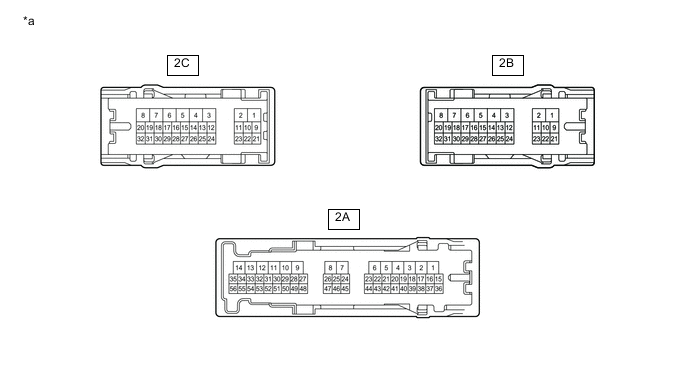
*a Component without harness connected
(Instrument Panel Junction Block Assembly)
- - Standard Voltage Tester Connection Condition Specified Condition 2C-7 - 2B-5 Battery not connected to 2A-16 and 2A-19 10 kΩ or higher 2C-7 - 2B-5 Battery positive (+) → 2A-16
Battery negative (-) → 2A-19
Below 1 Ω Result Proceed to OK NG
OK
PROCEED TO NEXT SUSPECTED AREA SHOWN IN PROBLEM SYMPTOMS TABLE Click here
NG
REPLACE INSTRUMENT PANEL JUNCTION BLOCK ASSEMBLY Click here
-