AUTOMATIC TRANSAXLE SYSTEM, Diagnostic DTC:P079513

| DTC Code | DTC Name |
|---|---|
| P079513 | Pressure Control Solenoid "C" Circuit Open |
DESCRIPTION
Changing from 1st to 6th gear is performed by the ECM turning solenoid (SL1, SL2, SL3, SL4 and SL) valves on and off. If an open or short occurs in any of the solenoid valve circuits, the ECM controls the remaining normal solenoid valves to allow the vehicle to be driven.
| DTC No. | Detection Item | DTC Detection Condition | Trouble Area | MIL | Memory | Note |
|---|---|---|---|---|---|---|
| P079513 | Pressure Control Solenoid "C" Circuit Open | 1. Diagnosis Condition 2. Malfunction Status 3. Malfunction Time 4. Other
|
|
Comes on | DTC stored | SAE Code: P0798 |
MONITOR DESCRIPTION
This DTC indicates an open or short in the solenoid (SL3) valve circuit. The ECM commands gear shifts by turning the solenoid valves on or off. When there is an open or short in any of the solenoid valve circuits, the ECM detects the problem, illuminates the MIL and stores a DTC. The ECM also performs the fail-safe function and turns the other normal solenoid valves on or off. (In the case of an open or short, the ECM stops sending current to the circuit.)
WIRING DIAGRAM
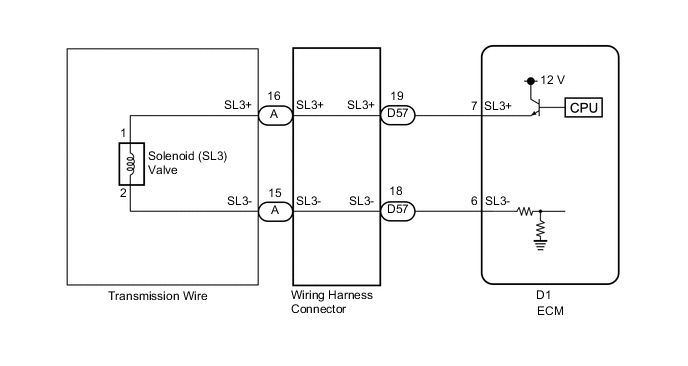
CAUTION / NOTICE / HINT
Note
Perform registration and/or initialization when parts related to the automatic transaxle are replaced.
Tech Tips
After performing repair, clear the DTCs and perform the following procedure to check that DTCs are not output.
-
Perform the D Position Shift Test inspection in Road Test.
-
Check for DTCs again.
PROCEDURE
-
CHECK HARNESS AND CONNECTOR (SOLENOID (SL3) VALVE CIRCUIT)
-
Disconnect the D1 ECM connector.
-
Measure the resistance according to the value(s) in the table below.
Standard Resistance Tester Connection Condition Specified Condition D1-7 (SL3+) - D1-6 (SL3-) 20°C (68°F) 5.0 to 5.6 Ω D1-7 (SL3+) - Body ground and other terminals Always 10 kΩ or higher D1-6 (SL3-) - Body ground and other terminals Always 10 kΩ or higher Result Proceed to OK NG
OK 
REPLACE ECM Click here
NG 
-
-
CHECK HARNESS AND CONNECTOR (WIRING HARNESS CONNECTOR - ECM)
-
Disconnect the D57 wiring harness connector connector.
-
Disconnect the D1 ECM connector.
-
Measure the resistance according to the value(s) in the table below.
Standard Resistance Tester Connection Condition Specified Condition D57-19 (SL3+) - D1-7 (SL3+) Always Below 1 Ω D57-18 (SL3-) - D1-6 (SL3-) Always Below 1 Ω D57-19 (SL3+) or D1-7 (SL3+) - Body ground and other terminals Always 10 kΩ or higher D57-18 (SL3-) or D1-6 (SL3-) - Body ground and other terminals Always 10 kΩ or higher Result Proceed to OK NG
NG
REPAIR OR REPLACE HARNESS OR CONNECTOR
OK
-
-
INSPECT TRANSMISSION WIRE (SOLENOID (SL3) VALVE)
-
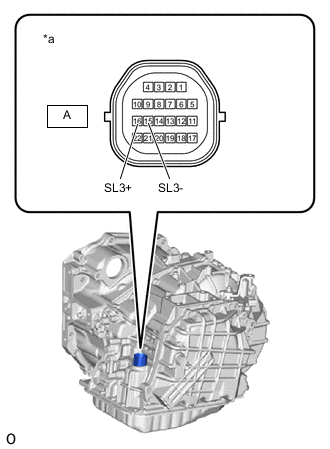
*a Component without harness connected
(Transmission Wire)
Remove the wiring harness connector.
-
Measure the resistance according to the value(s) in the table below.
Standard Resistance Tester Connection Condition Specified Condition A-16 (SL3+) - A-15 (SL3-) 20°C (68°F) 5.0 to 5.6 Ω A-16 (SL3+) - Body ground Always 10 kΩ or higher A-15 (SL3-) - Body ground Always 10 kΩ or higher Result Proceed to OK NG
OK
REPLACE WIRING HARNESS CONNECTOR Click here
NG
-
-
INSPECT SOLENOID (SL3) VALVE
-
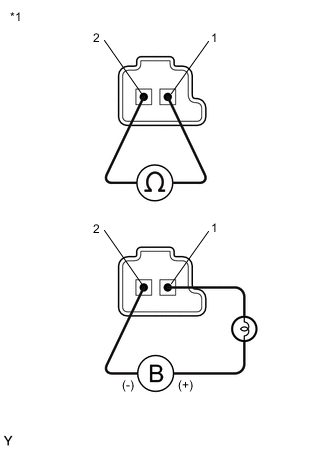
*1 Solenoid (SL3) Valve Remove the solenoid (SL3) valve.
-
Measure the resistance according to the value(s) in the table below.
Standard Resistance Tester Connection Condition Specified Condition 1 - 2 20°C (68°F) 5.0 to 5.6 Ω -
Connect a positive (+) lead with a 21 W bulb from the battery to terminal 1 and a negative (-) lead to terminal 2 of the solenoid valve connector. Check that the valve moves and makes an operating sound.
OK Valve moves and makes an operating sound. Result Proceed to OK NG
OK
REPLACE TRANSMISSION WIRE Click here
NG
REPLACE SOLENOID (SL3) VALVE Click here
-