CAN COMMUNICATION SYSTEM(for LHD) Check Bus 4 Line for Short to +B
DESCRIPTION
There may be a short circuit between one of the CAN bus wires and +B when no resistance exists between terminal 22 (CA2H) of the central gateway ECU (network gateway ECU) and terminal 16 (BAT) of the DLC3, or terminal 7 (CA2L) of the central gateway ECU (network gateway ECU) and terminal 16 (BAT) of the DLC3.
| Symptom | Trouble Area |
|---|---|
| No resistance exists between terminal 22 (CA2H) of the central gateway ECU (network gateway ECU) and terminal 16 (BAT) of the DLC3, or terminal 7 (CA2L) of the central gateway ECU (network gateway ECU) and terminal 16 (BAT) of the DLC3. |
|
-
*1: w/ Pre-crash Safety System
WIRING DIAGRAM
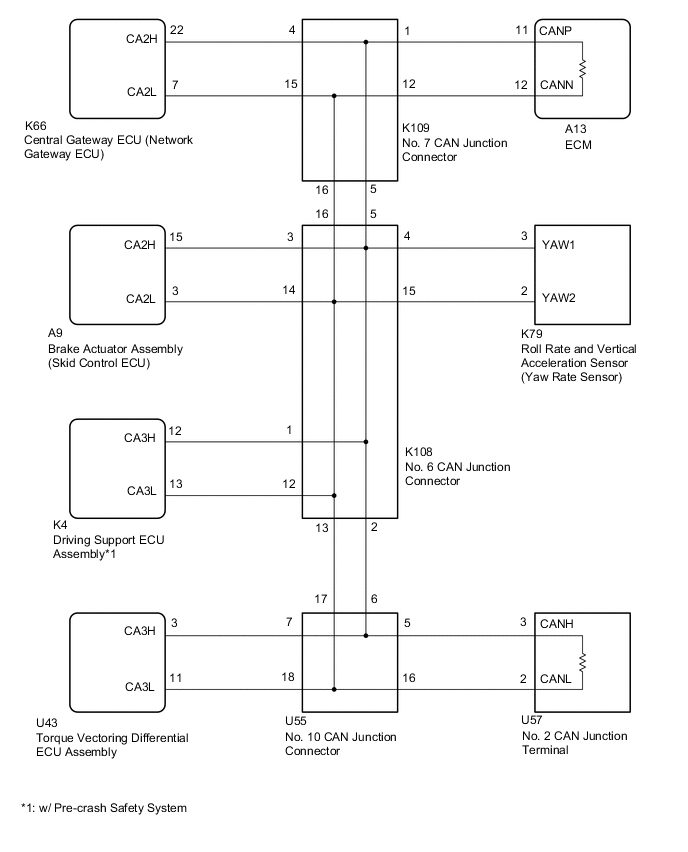
CAUTION / NOTICE / HINT
Note
-
Before measuring the resistance of the CAN bus, turn the engine switch off and leave the vehicle for 1 minute or more without operating the key or any switches, or opening or closing the doors. After that, disconnect the cable from the negative (-) battery terminal and leave the vehicle for 1 minute or more before measuring the resistance.
-
After turning the engine switch off, waiting time may be required before disconnecting the cable from the negative (-) battery terminal. Therefore, make sure to read the disconnecting the cable from the negative (-) battery terminal notices before proceeding with work.
-
Because the order of diagnosis is important to allow correct diagnosis, make sure to begin troubleshooting using How to Proceed with Troubleshooting when CAN communication system related DTCs are output.
-
After performing repairs, perform the DTC check procedure and confirm that the DTCs are not output again.
-
DTC check procedure: Turn the engine switch on (IG), wait at least 60 seconds, and then drive the vehicle at a speed of 40 km/h (25 mph) or more for 5 minutes or more.
-
After the repair, perform the CAN bus check and check that all the ECUs and sensors connected to the CAN communication system are displayed as normal.
-
Before replacing the ECM, refer to Service Bulletin.
Tech Tips
-
Operating the engine switch, any other switches or a door triggers related ECU and sensor communication on the CAN. This communication will cause the resistance value to change.
-
Even after DTCs are cleared, if a DTC is stored again after driving the vehicle for a while, the malfunction may be occurring due to vibration of the vehicle. In such a case, wiggling the ECUs or wire harness while performing the inspection below may help determine the cause of the malfunction.
PROCEDURE
-
CHECK FOR SHORT TO +B IN CAN BUS WIRE (ECM - NO. 7 CAN JUNCTION CONNECTOR)
-
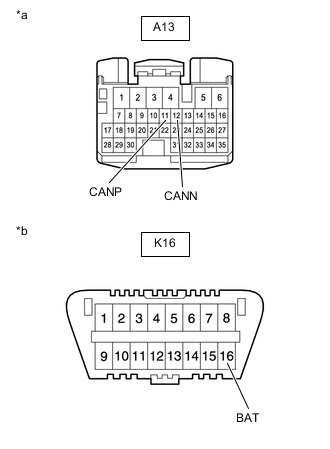
*a Front view of wire harness connector
(to ECM)
*b Front view of DLC3 Disconnect the cable from the negative (-) battery terminal.
-
Disconnect the ECM connector.
-
Measure the resistance according to the value(s) in the table below.
Standard Resistance Tester Connection Condition Specified Condition A13-11 (CANP) - K16-16 (BAT) Cable disconnected from negative (-) battery terminal 6 kΩ or higher A13-12 (CANN) - K16-16 (BAT) Cable disconnected from negative (-) battery terminal 6 kΩ or higher Result Proceed to OK NG
OK 
REPLACE ECM Click here
NG 
-
-
CONNECT CONNECTOR
-
Reconnect the A13 ECM connector.
Result Proceed to NEXT
NEXT
-
-
CHECK FOR SHORT TO +B IN CAN BUS WIRE (NO. 2 CAN JUNCTION TERMINAL - NO. 10 CAN JUNCTION CONNECTOR)
-
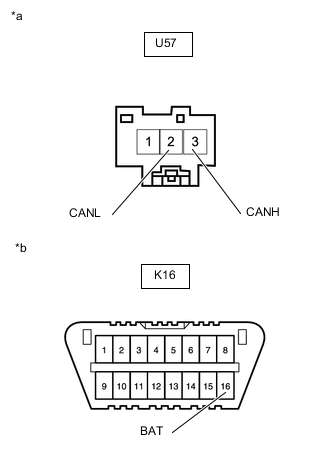
*a Front view of wire harness connector
(to No. 2 CAN Junction Terminal)
*b Front view of DLC3 Disconnect the No. 2 CAN junction terminal connector.
-
Measure the resistance according to the value(s) in the table below.
Standard Resistance Tester Connection Condition Specified Condition U57-3 (CANH) - K16-16 (BAT) Cable disconnected from negative (-) battery terminal 6 kΩ or higher U57-2 (CANL) - K16-16 (BAT) Cable disconnected from negative (-) battery terminal 6 kΩ or higher Result Proceed to OK NG
OK
REPLACE NO. 2 CAN JUNCTION TERMINAL
NG
-
-
CONNECT CONNECTOR
-
Reconnect the U57 No. 2 CAN junction terminal connector.
Result Proceed to NEXT
NEXT
-
-
CHECK FOR SHORT TO +B IN CAN BUS WIRE (CENTRAL GATEWAY ECU (NETWORK GATEWAY ECU) - NO. 7 CAN JUNCTION CONNECTOR)
-
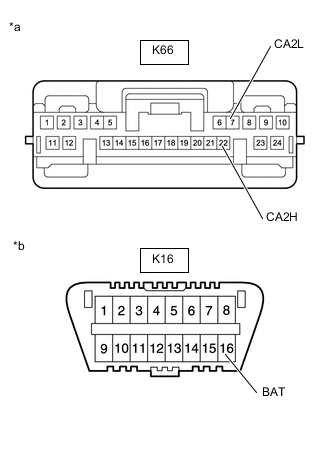
*a Front view of wire harness connector
(to Central Gateway ECU (Network Gateway ECU))
*b Front view of DLC3 Disconnect the central gateway ECU (network gateway ECU) connector.
-
Measure the resistance according to the value(s) in the table below.
Standard Resistance Tester Connection Condition Specified Condition K66-22 (CA2H) - K16-16 (BAT) Cable disconnected from negative (-) battery terminal 6 kΩ or higher K66-7 (CA2L) - K16-16 (BAT) Cable disconnected from negative (-) battery terminal 6 kΩ or higher Result Proceed to OK NG
OK
REPLACE CENTRAL GATEWAY ECU (NETWORK GATEWAY ECU) Click here
NG
-
-
CONNECT CONNECTOR
-
Reconnect the K66 central gateway ECU (network gateway ECU) connector.
Result Proceed to NEXT
NEXT
-
-
CHECK FOR SHORT TO +B IN CAN BUS WIRE (NO. 7 CAN JUNCTION CONNECTOR)
-
Disconnect the No. 7 CAN junction connector.
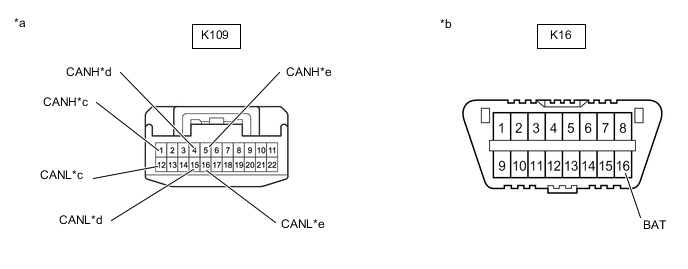
*a Front view of wire harness connector
(to No. 7 CAN Junction Connector)
*b Front view of DLC3 *c to ECM *d to Central Gateway ECU (Network Gateway ECU) *e to No. 6 CAN Junction Connector - - -
Measure the resistance according to the value(s) in the table below.
Standard Resistance Tester Connection Condition Specified Condition Connected to K109-1 (CANH) - K16-16 (BAT) Cable disconnected from negative (-) battery terminal 6 kΩ or higher ECM K109-12 (CANL) - K16-16 (BAT) Cable disconnected from negative (-) battery terminal 6 kΩ or higher K109-4 (CANH) - K16-16 (BAT) Cable disconnected from negative (-) battery terminal 6 kΩ or higher Central gateway ECU (network gateway ECU) K109-15 (CANL) - K16-16 (BAT) Cable disconnected from negative (-) battery terminal 6 kΩ or higher K109-5 (CANH) - K16-16 (BAT) Cable disconnected from negative (-) battery terminal 6 kΩ or higher No. 6 CAN junction connector K109-16 (CANL) - K16-16 (BAT) Cable disconnected from negative (-) battery terminal 6 kΩ or higher Result Result Proceed to OK A NG (ECM CAN main wire) B NG (No. 6 CAN junction connector CAN main wire) C NG (Central gateway ECU (network gateway ECU) CAN branch wire) D
A
REPLACE NO. 7 CAN JUNCTION CONNECTOR
B
REPAIR OR REPLACE CAN MAIN WIRE OR CONNECTOR (NO. 7 CAN JUNCTION CONNECTOR - ECM)
D
REPAIR OR REPLACE CAN BRANCH WIRE OR CONNECTOR (NO. 7 CAN JUNCTION CONNECTOR - CENTRAL GATEWAY ECU (NETWORK GATEWAY ECU))
C
-
-
CONNECT CONNECTOR
-
Reconnect the K109 No. 7 CAN junction connector.
Result Proceed to NEXT
NEXT
-
-
CHECK FOR SHORT TO +B IN CAN BUS WIRE (NO. 6 CAN JUNCTION CONNECTOR)
-
Disconnect the No. 6 CAN junction connector.
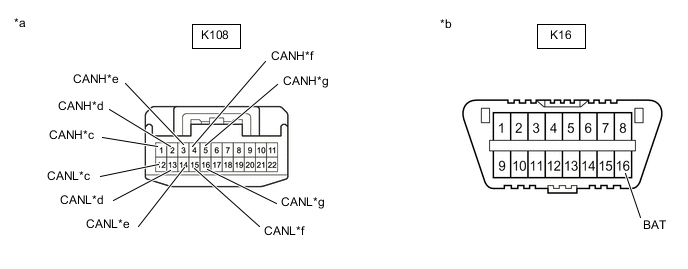
*a Front view of wire harness connector
(to No. 6 CAN Junction Connector)
*b Front view of DLC3 *c to Driving Support ECU Assembly (w/ Pre-crash Safety System) *d to No. 10 CAN Junction Connector *e to Brake Actuator Assembly (Skid Control ECU) *f to Roll Rate and Vertical Acceleration Sensor (Yaw Rate Sensor) *g to No. 7 CAN Junction Connector - - -
Measure the resistance according to the value(s) in the table below.
Standard Resistance Tester Connection Condition Specified Condition Connected to K108-1 (CANH) - K16-16 (BAT) Cable disconnected from negative (-) battery terminal 6 kΩ or higher Driving support ECU assembly*1 K108-12 (CANL) - K16-16 (BAT) Cable disconnected from negative (-) battery terminal 6 kΩ or higher K108-2 (CANH) - K16-16 (BAT) Cable disconnected from negative (-) battery terminal 6 kΩ or higher No. 10 CAN junction connector K108-13 (CANL) - K16-16 (BAT) Cable disconnected from negative (-) battery terminal 6 kΩ or higher K108-3 (CANH) - K16-16 (BAT) Cable disconnected from negative (-) battery terminal 6 kΩ or higher Brake actuator assembly (skid control ECU) K108-14 (CANL) - K16-16 (BAT) Cable disconnected from negative (-) battery terminal 6 kΩ or higher K108-4 (CANH) - K16-16 (BAT) Cable disconnected from negative (-) battery terminal 6 kΩ or higher Roll rate and vertical acceleration sensor (yaw rate sensor) K108-15 (CANL) - K16-16 (BAT) Cable disconnected from negative (-) battery terminal 6 kΩ or higher K108-5 (CANH) - K16-16 (BAT) Cable disconnected from negative (-) battery terminal 6 kΩ or higher No. 7 CAN junction connector K108-16 (CANL) - K16-16 (BAT) Cable disconnected from negative (-) battery terminal 6 kΩ or higher
-
*1: w/ Pre-crash Safety System
Result Result Proceed to OK A NG (No. 7 CAN junction connector CAN main wire) B NG (No. 10 CAN junction connector CAN main wire) C NG (ECU or sensor CAN branch wires) D -
A
REPLACE NO. 6 CAN JUNCTION CONNECTOR
B
REPAIR OR REPLACE CAN MAIN WIRE OR CONNECTOR (NO. 6 CAN JUNCTION CONNECTOR - NO. 7 CAN JUNCTION CONNECTOR)
D 
GO TO STEP 12 Click here
C
-
-
CONNECT CONNECTOR
-
Reconnect the K108 No. 6 CAN junction connector.
Result Proceed to NEXT
NEXT
-
-
CHECK FOR SHORT TO +B IN CAN BUS WIRE (NO. 10 CAN JUNCTION CONNECTOR)
-
Disconnect the No. 10 CAN junction connector.
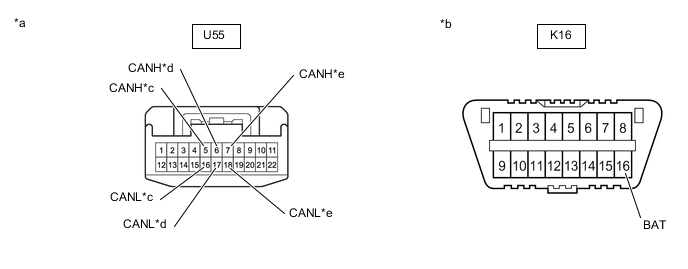
*a Front view of wire harness connector
(to No. 10 CAN Junction Connector)
*b Front view of DLC3 *c to No. 2 CAN Junction Terminal *d to No. 6 CAN Junction Connector *e to Torque Vectoring Differential ECU Assembly - - -
Measure the resistance according to the value(s) in the table below.
Standard Resistance Tester Connection Condition Specified Condition Connected to U55-5 (CANH) - K16-16 (BAT) Cable disconnected from negative (-) battery terminal 6 kΩ or higher No. 2 CAN junction terminal U55-16 (CANL) - K16-16 (BAT) Cable disconnected from negative (-) battery terminal 6 kΩ or higher U55-6 (CANH) - K16-16 (BAT) Cable disconnected from negative (-) battery terminal 6 kΩ or higher No. 6 CAN junction connector U55-17 (CANL) - K16-16 (BAT) Cable disconnected from negative (-) battery terminal 6 kΩ or higher U55-7 (CANH) - K16-16 (BAT) Cable disconnected from negative (-) battery terminal 6 kΩ or higher Torque vectoring differential ECU assembly U55-18 (CANL) - K16-16 (BAT) Cable disconnected from negative (-) battery terminal 6 kΩ or higher Result Result Proceed to OK A NG (No. 6 CAN junction connector CAN main wire) B NG (No. 2 CAN junction terminal CAN main wire) C NG (ECU or sensor CAN branch wires) D
A
REPLACE NO. 6 CAN JUNCTION CONNECTOR
B
REPAIR OR REPLACE CAN MAIN WIRE OR CONNECTOR (NO. 6 CAN JUNCTION CONNECTOR - NO. 10 CAN JUNCTION CONNECTOR)
C
REPAIR OR REPLACE CAN MAIN WIRE OR CONNECTOR (NO. 10 CAN JUNCTION CONNECTOR - NO. 2 CAN JUNCTION TERMINAL)
D
-
-
CHECK FOR SHORT TO +B IN CAN BUS WIRE (ECU, SENSOR)
-
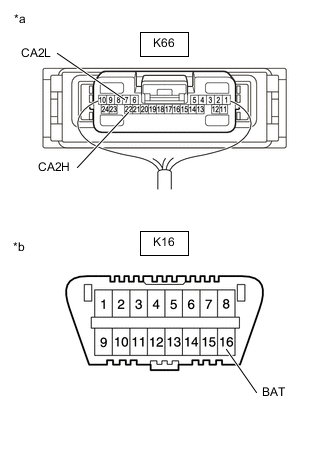
*a Component with harness connected
(Central Gateway ECU (Network Gateway ECU))
*b Front view of DLC3 Reconnect the CAN junction connector.
-
Disconnect the connector that includes terminals CANH and CANL from the ECU or sensor to which the short to +B is connected.
-
Measure the resistance according to the value(s) in the table below.
Standard Resistance Tester Connection Condition Specified Condition K66-22 (CA2H) - K16-16 (BAT) Cable disconnected from negative (-) battery terminal 6 kΩ or higher K66-7 (CA2L) - K16-16 (BAT) Cable disconnected from negative (-) battery terminal 6 kΩ or higher Tech Tips
If the resistance changes to 6 kΩ or higher when the connector is disconnected from the ECU or sensor, there may be a short in the ECU or sensor.
Result Proceed to OK NG
OK
REPAIR OR REPLACE CORRESPONDING ECU OR SENSOR CAN BRANCH WIRES OR CONNECTOR
NG
REPLACE CORRESPONDING ECU OR SENSOR
-