DYNAMIC RADAR CRUISE CONTROL SYSTEM, Diagnostic DTC:C1A4B
| DTC Code | DTC Name |
|---|---|
| C1A4B | Stop Light Relay Circuit |
DESCRIPTION
The brake actuator assembly (skid control ECU) sends a stop light operation signal to the No. 2 integration relay. When the brake actuator assembly (skid control ECU) detects a malfunction in the stop light circuit, the driving support ECU assembly stores DTC C1A4B.
| DTC No. | Detection Item | DTC Detection Condition | Trouble Area |
|---|---|---|---|
| C1A4B | Stop Light Relay Circuit | w/o Full-speed range following function: Either of the following conditions is met:
w/ Full-speed range following function: Either of the following conditions is met:
|
|
| Vehicle Condition | |||
|---|---|---|---|
| Pattern 1 | Pattern 2 | ||
| Diagnosis Condition | w/o Full-speed range following function: When the vehicle speed is approximately 50 km/h (30 mph) or more, the cruise control switch (ON/OFF button) is on w/ Full-speed range following function: When the vehicle speed is approximately 5 km/h (3 mph) or more, the cruise control switch (ON/OFF button) is on |
○ | ○ |
| Malfunction Status | When the stop light illumination output (STPO) signal is on, a signal has not been input to the STP2 terminal | ○ | - |
| When the stop light illumination output (STPO) signal is off, signals input to the STP terminal and STP2 terminal of the brake actuator assembly (skid control ECU) differ | - | ○ | |
| Detection Time | 0.4 seconds | 0.4 seconds | |
| Number of Trips | 1 trip | 1 trip | |
Tech Tips
DTC will be output when conditions for either of the patterns in the table above are met.
WIRING DIAGRAM
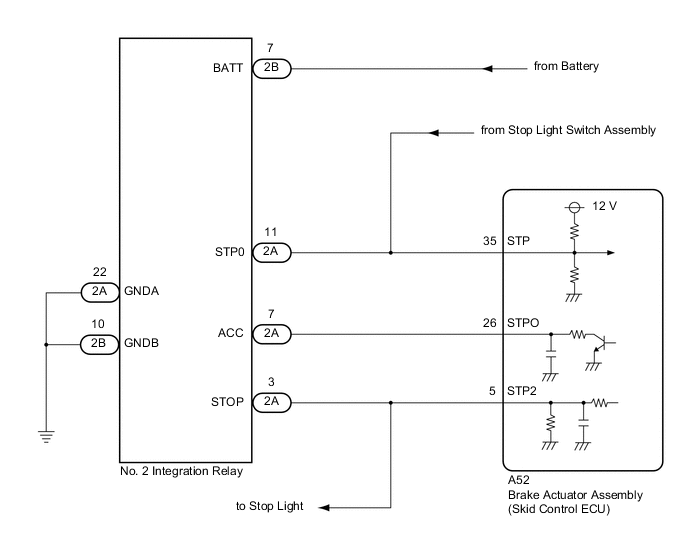
CAUTION / NOTICE / HINT
Note
-
Inspect the fuses for circuits related to this system before performing the following procedure.
-
When this DTC is output, a malfunction in the lighting system is suspected. Check if the lighting system is functioning normally.
-
When replacing the driving support ECU assembly, always replace it with a new one. If a driving support ECU assembly which was installed to another vehicle is used, the information stored in the driving support ECU assembly will not match the information from the vehicle. As a result, a DTC may be stored.
PROCEDURE
-
CHECK ENGINE START
-
Depress the brake pedal, push the engine switch and check that the engine starts.
OK The engine starts. Result Result Proceed to OK A NG (w/ Canister Pump Module) B NG (w/o Canister Pump Module) C
B 
GO TO SFI SYSTEM Click here
C
GO TO SFI SYSTEM Click here
A 
-
-
CHECK STOP LIGHT OPERATION
-
Check that the stop lights come on when the brake pedal is depressed and go off when the brake pedal is released.
OK Condition Illumination Condition Brake pedal depressed On Brake pedal released Off Result Proceed to OK NG
NG
GO TO LIGHTING SYSTEM Click here
OK
-
-
INSPECT NO. 2 INTEGRATION RELAY
-
Turn the engine switch off.
-
Inspect the No. 2 integration relay.
OK The No. 2 integration relay is normal. Result Proceed to OK NG
NG
REPLACE NO. 2 INTEGRATION RELAY Click here
OK
-
-
CHECK TERMINAL VOLTAGE (POWER SOURCE OF NO. 2 INTEGRATION RELAY)
-
Turn the engine switch off.
-
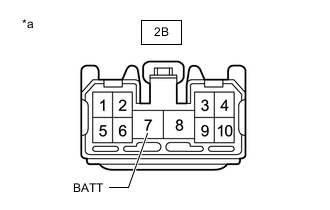
*a Front view of wire harness connector
(to No. 2 Integration Relay)
Disconnect the 2B No. 2 integration relay connector.
-
Measure the voltage according to the value(s) in the table below.
Standard Voltage Tester Connection Condition Specified Condition 2B-7 (BATT) - Body ground Always 11 to 14 V Result Proceed to OK NG
NG
REPAIR OR REPLACE HARNESS OR CONNECTOR
OK
-
-
CHECK HARNESS AND CONNECTOR (NO. 2 INTEGRATION RELAY - BODY GROUND)
-
Turn the engine switch off.
-
Disconnect the 2A and 2B No. 2 integration relay connectors.
-
Measure the resistance according to the value(s) in the table below.
Standard Resistance Tester Connection Condition Specified Condition 2A-22 (GNDA) - Body ground Always Below 1 Ω 2B-10 (GNDB) - Body ground Always Below 1 Ω Result Proceed to OK NG
NG
REPAIR OR REPLACE HARNESS OR CONNECTOR
OK
-
-
CHECK TERMINAL VOLTAGE (STP TERMINAL)
-
Turn the engine switch off.
-
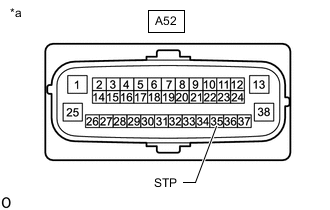
*a Front view of wire harness connector
(to Brake Actuator Assembly (Skid Control ECU))
Disconnect the brake actuator assembly (skid control ECU) connector.
-
Measure the voltage according to the value(s) in the table below.
Standard Voltage Tester Connection Condition Specified Condition A52-35 (STP) - Body ground Brake pedal depressed 11 to 14 V Brake pedal released Below 1.5 V Result Proceed to OK NG
NG
REPAIR OR REPLACE HARNESS OR CONNECTOR
OK
-
-
CHECK TERMINAL VOLTAGE (STP TERMINAL)
-
Turn the engine switch off.
-
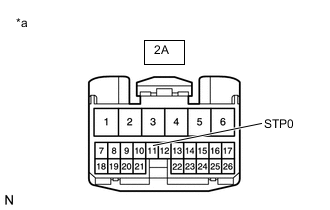
*a Front view of wire harness connector
(to No. 2 Integration Relay)
Disconnect the 2A No. 2 integration relay connector.
-
Measure the voltage according to the value(s) in the table below.
Standard Voltage Tester Connection Condition Specified Condition 2A-11 (STP0) - Body ground Engine switch on (IG) 11 to 14 V Result Proceed to OK NG
NG
REPAIR OR REPLACE HARNESS OR CONNECTOR
OK
-
-
PERFORM ACTIVE TEST USING GTS (STOP LIGHT RELAY)
-
Enter the following menus: Chassis / ABS/VSC/TRC / Active Test.
-
Perform "Active Test" according to the display on the GTS.
Chassis > ABS/VSC/TRC > Active TestTester Display Measurement Item Control Range Diagnostic Note Stop Light Relay Stop light control relay (STOP LP) ON or OFF Stop lights come on
Chassis > ABS/VSC/TRC > Active TestTester Display Stop Light Relay -
Enter the following menus: Chassis / ABS/VSC/TRC / Data List.
-
Check the stop light switch assembly (stop light control relay) operation using the Data List and stop light operation by performing an Active Test.
Chassis > ABS/VSC/TRC > Data ListTester Display Measurement Item Range Normal Condition Diagnostic Note Stop Light Relay Output Stop light control relay (STOP LP) output ON or OFF ON: Relay output on (Stop light on)
OFF: Relay output off (Stop light off)
-
Chassis > ABS/VSC/TRC > Data ListTester Display Stop Light Relay Output Result Result Proceed to Data List item changes between ON and OFF, but stop lights do not turn on A Data List item changes between ON and OFF and stop lights turn on and off B
B 
GO TO STEP 10 Click here
A
-
-
CHECK HARNESS AND CONNECTOR (BRAKE ACTUATOR ASSEMBLY (SKID CONTROL ECU) - NO. 2 INTEGRATION RELAY)
-
Turn the engine switch off.
-
Disconnect the A52 brake actuator assembly (skid control ECU) connector.
-
Disconnect the 2A No. 2 integration relay connector.
-
Measure the resistance according to the value(s) in the table below.
Standard Resistance Tester Connection Condition Specified Condition A52-26 (STPO) - 2A-7 (ACC) Always Below 1 Ω A52-26 (STPO) or 2A-7 (ACC) - Body ground Always 10 kΩ or higher Result Proceed to OK NG
NG
REPAIR OR REPLACE HARNESS OR CONNECTOR
OK
-
-
CHECK HARNESS AND CONNECTOR (BRAKE ACTUATOR ASSEMBLY (SKID CONTROL ECU) - NO. 2 INTEGRATION RELAY)
-
Turn the engine switch off.
-
Disconnect the A52 brake actuator assembly (skid control ECU) connector.
-
Disconnect the 2A No. 2 integration relay connector.
-
Measure the resistance according to the value(s) in the table below.
Standard Resistance Tester Connection Condition Specified Condition A52-5 (STP2) - 2A-3 (STOP) Always Below 1 Ω Result Proceed to OK NG
NG
REPAIR OR REPLACE HARNESS OR CONNECTOR
OK
-
-
CHECK TERMINAL VOLTAGE (STP2 TERMINAL)
-
Turn the engine switch off.
-
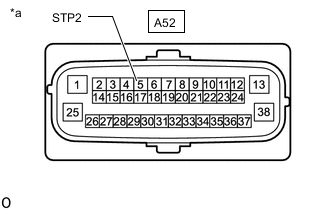
*a Front view of wire harness connector
(to Brake Actuator Assembly (Skid Control ECU))
Disconnect the brake actuator assembly (skid control ECU) connector.
-
Measure the voltage according to the value(s) in the table below.
Standard Voltage Tester Connection Condition Specified Condition A52-5 (STP2) - Body ground Brake pedal depressed 11 to 14 V Brake pedal released Below 1.5 V Result Proceed to OK NG
NG
REPLACE NO. 2 INTEGRATION RELAY Click here
OK
-
-
CHECK FOR DTCs (RADAR CRUISE)
-
Turn the engine switch off and wait for at least 2 minutes.
-
Clear the DTCs.
Powertrain > Radar Cruise > Clear DTCs -
Make sure that the DTC detection conditions are met.
Tech Tips
If the detection conditions are not met, the system cannot detect the malfunction.
-
Turn the engine switch on (IG).
-
Turn the dynamic radar cruise control system on using the cruise control main switch (ON/OFF button).
-
w/ Full-speed range following function: Drive the vehicle at 5 km/h (3 mph) or more for 1 second or more.
w/o Full-speed range following function: Drive the vehicle at 36 km/h (22 mph) or more for 1 second or more.
-
-
Check for DTCs.
Powertrain > Radar Cruise > Trouble CodesResult Result Proceed to DTC C1A4B is not output A DTC C1A4B is output B
A
END
B
REPLACE DRIVING SUPPORT ECU ASSEMBLY Click here
-