RADIATOR ON-VEHICLE INSPECTION
CAUTION / NOTICE / HINT
CAUTION:
-
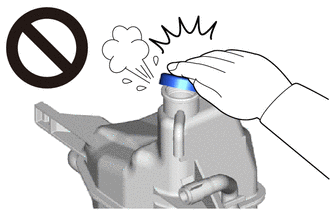
When engine assembly and radiator assembly is hot, do not remove the reserve tank cap.
-
Fluid and steam may spray out due to high pressure, possibly resulting in burns.
PROCEDURE
-
INSPECT RESERVE TANK CAP
-
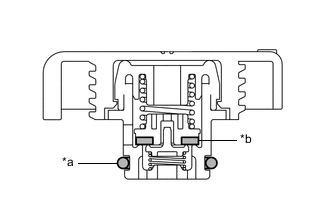
*a O-ring *b Rubber Packing Measure the valve opening pressure.
-
If there are water stains or foreign matter on the O-ring, clean it with water and finger scouring.
-
Check that the O-ring is not deformed, cracked or swollen.
-
Apply engine coolant to the O-ring and rubber packing before using a radiator cap tester.
-
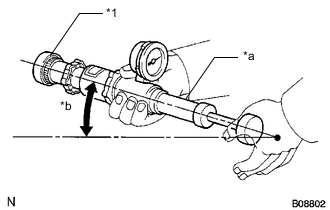
*1 Reserve Tank Cap *a Radiator Cap Tester *b 30° or more When using the radiator cap tester, tilt it upwards 30° or more.
-
Pump the radiator cap tester several times, and check the maximum pressure.*1
Pump Speed 1 pump per second Tech Tips
*1: Even if the reserve tank cap cannot maintain the maximum pressure, it is not a defect.
Result Item Specified Condition Standard pressure
(for brand-new cap)
93 to 123 kPa (0.9 to 1.3 kgf/cm2, 13.5 to 18.0 psi)
Minimum pressure
(for used cap)
79 kPa (0.8 kgf/cm2, 11.5 psi)
If the maximum pressure is less than the specified pressure for the minimum pressure, replace the reserve tank cap.
-
-
-
INSPECT FINS FOR BLOCKAGE
-
If the fins are clogged, wash them with water or a steam cleaner and dry them with compressed air.
Note
-
To avoid damaging the fins, the injection direction should be at right angles to the core surface.
-
If the steam cleaner is too close to the core, there is a possibility of damaging the fins, so maintain the following injection distances.
Standard Injection Distance Injection Pressure Specified Condition 2942 to 4903 kPa (30.0 to 50.0 kgf/cm2, 427 to 711 psi)
300 mm (11.8 in.) 4903 to 7845 kPa (50.0 to 80.0 kgf/cm2, 711 to 1138 psi)
500 mm (19.7 in.) -
If the fins are bent, straighten them with a screwdriver or pliers.
-
Do not expose electronic components to water.
-
-
Dry the fins with compressed air.
-