ELECTRIC VEHICLE CONVERTER INSTALLATION

Info Added 2017-10-06 
CAUTION / NOTICE / HINT
Note
Do not cross-thread the bolts when installing them.
PROCEDURE
-
HOW TO PREVENT STATIC ELECTRICITY
- SST
- 09890-47010
Note
-
Static electricity should be eliminated when removing/installing the inverter with converter assembly.
-
Do not touch the electronic components of a circuit board.
-
Keep clothes away from electronic components.
-
Place the inverter with converter assembly and any removed electronic components on SST (antistatic mat).
-
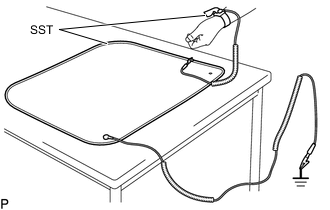
Wear an antistatic wrist strap.
-
Connect the ground clip of the antistatic mat securely to a ground point provided in the workshop or on a workbench (anchor bolt).
Tech Tips
If the ground clip cable is too short, use an extension cable.
-
Connect the ground clip of the antistatic wrist strap securely to the specified point of the antistatic mat.
-
When handling internal components of the inverter with converter assembly, use only antistatic gloves or bare hands to prevent damage from static electricity or the entry of foreign matter.
-
INSTALL HV CONVERTER KIT
CAUTION:
-
As there is a coolant passage underneath the HV converter kit, be careful not to spill any coolant (for inverter) into the filter condenser or the holes around the edge of the inverter with converter assembly.
-
If any coolant (for inverter) spills into the filter condenser or the holes around the edge of the inverter with converter assembly, do not reuse the inverter with converter assembly.
-
If any coolant (for inverter) spills onto any area other than the specified areas, remove it with a clean piece of cloth.
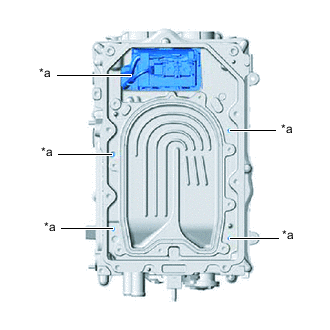
*a Do Not Allow Coolant (for Inverter) to Enter Note
-
Be careful not to touch any part of the HV converter kit other than the specified areas.
-
Do not allow any moisture to come into contact with the circuit board.
-
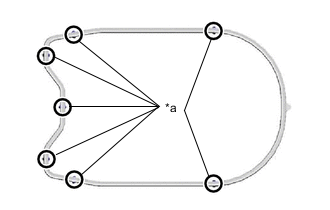
*a Press Area Install a new O-ring to the inverter with converter assembly and then press it at the 7 areas shown in the illustration to ensure it is installed securely.
Note
Make sure that the O-ring is free of foreign matter.
Tech Tips
The O-ring is symmetrical.
-
While holding the corners of the new HV converter kit, align it with the guide pins of the inverter with converter assembly and temporarily install it.
Note
Make sure that the sealing surfaces and contact surfaces are free of foreign matter.
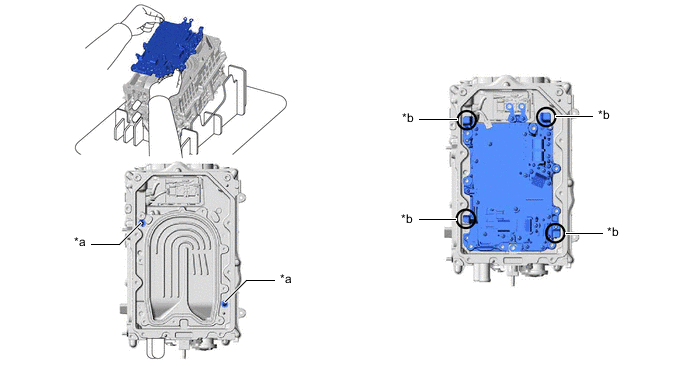
*a Guide Pins *b Hold Here -
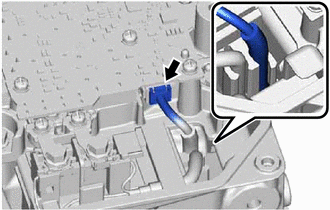
Connect the HV converter kit connector.
Note
-
Make sure that the inside of the connector is free of foreign matter.
-
Make sure that the connectors are connected securely.
-
Make sure that the wire harness of the connector is engaged to the filter condenser.
-
-
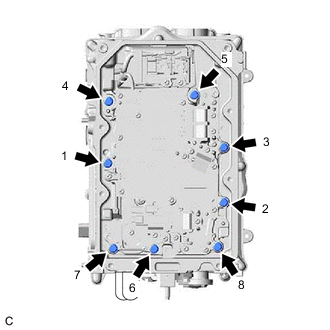
Temporarily install the new 8 bolts evenly in several steps in the order shown in the illustration, and then tighten them to the specified torque.
- Torque:
- 6.0 N*m { 61 kgf*cm, 53 in.*lbf }
-
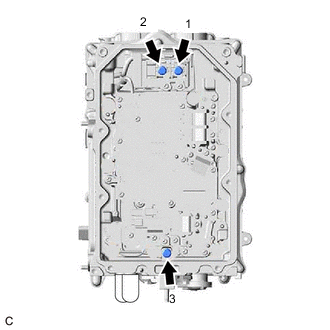
Temporarily install the new 3 bolts evenly in several steps in the order shown in the illustration, and then tighten them to the specified torque.
- Torque:
- 5.0 N*m { 51 kgf*cm, 44 in.*lbf }
-
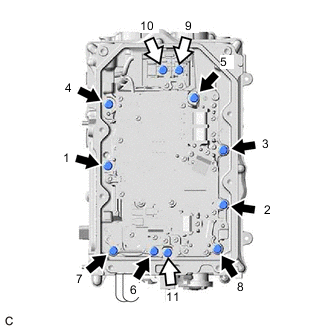

Bolt (A) 
Bolt (B) Check the torque of the 11 bolts in the order shown in the illustration.
- Torque:
- Bolt (A)
- 6.0 N*m { 61 kgf*cm, 53 in.*lbf }
- Bolt (B)
- 5.0 N*m { 51 kgf*cm, 44 in.*lbf }
-
-
CHECK FOR AIR LEAK
-
Remove the cap from the coolant pipe.
Tech Tips
Make sure to remove the cap from only the black colored coolant pipe.
-
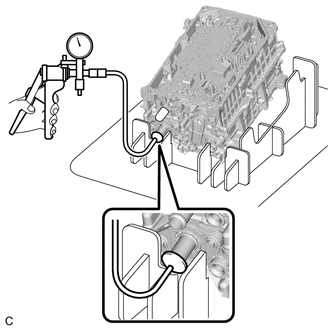
Using a vacuum pump, apply a vacuum of 50 kPa (375 mmHg) and check vacuum can be maintained.
Standard The vacuum pressure does not decrease for at least 30 seconds. Note
If the vacuum pressure decreases, check for a leak between the vacuum pump and coolant pipe. If a leak is not found, remove the HV converter kit and check the installation condition of the O-ring.
-
-
INSTALL CONVERTER COVER
Note
-
Do not touch the circuit board.
-
Do not allow any foreign matter or water to enter the inverter with converter assembly.
-
Do not touch or allow grease or oil to contact the sealing surfaces of the inverter with converter assembly.
-
Clean the seal packing removal cover.
-
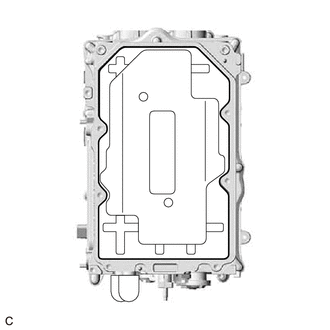
Set the seal packing removal cover on the inverter with converter assembly.
-
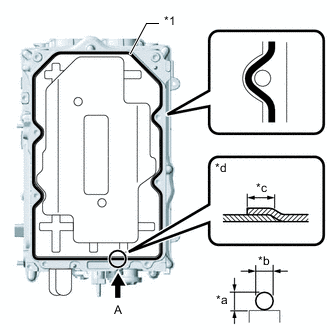
*1 Seal Packing *a 3.0 mm (0.118 in.) *b 3.0 mm (0.118 in.) *c Approximately 20 mm *d View A Apply seal packing (diameter: 3.0 mm (0.118 in.)) in a continuous line to the locations shown in the illustration.
Seal Packing Toyota Genuine Seal Packing 1207F Note
-
Install the converter cover with in 3 minutes of applying seal packing.
-
Tighten the bolts within 15 minutes of applying seal packing.
-
-
Remove the seal packing removal cover.
Note
Slowly remove the seal packing removal cover without touching the seal packing surface.
-
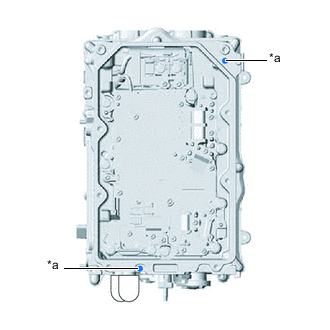
*a Guide Pin Align a new converter cover with the guide pins of the inverter with converter assembly and temporarily install it.
Note
-
Make sure that the converter cover is free of foreign matter.
-
Make sure to align the HV converter kit with the guide pins correctly.
-
-
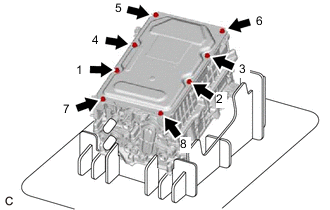
Temporarily install the new 8 bolts evenly in several steps in the order shown in the illustration, and then tighten them to the specified torque.
- Torque:
- 7.3 N*m { 74 kgf*cm, 65 in.*lbf }
-
Check the torque of the 8 bolts in the order shown in the illustration.
- Torque:
- 7.3 N*m { 74 kgf*cm, 65 in.*lbf }
Note
Make sure that the bolts are securely contacting the converter cover.
-
-
INSTALL WIRE HARNESS CLAMP BRACKET
-
INSTALL TRANSMISSION CONTROL CABLE BRACKET
-
INSTALL NO. 2 INVERTER BRACKET
-
INSTALL NO. 1 INVERTER BRACKET
-
INSTALL INVERTER WITH CONVERTER ASSEMBLY
-
INSPECT FOR COOLANT LEAK (for Inverter)
CAUTION:
To avoid the danger of being burned, do not remove the reserve tank cap while the coolant (for inverter) is still hot. Pressurized, hot coolant (for inverter) and steam may be released and cause serious burns.
-
Remove the reserve tank cap from the inverter reserve tank assembly.
-
Add coolant to the FULL line of the inverter reserve tank assembly.
-
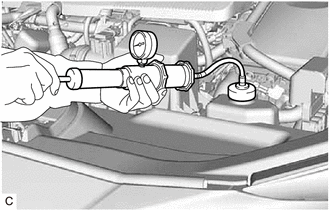
Install a radiator cap tester to the inverter reserve tank assembly.
-
Pump the radiator cap tester to 122 kPa (1.2 kgf/ cm2, 18 psi), and then check that the pressure does not drop.
Tech Tips
If the pressure drops, check the hoses, radiator assembly, inverter water pump assembly, hybrid vehicle transaxle assembly, and inverter with converter assembly for leaks.
-
Reinstall the reserve tank cap to the inverter reserve tank assembly.
-
-
OPERATION CHECK
Tech Tips
After the repair, perform the operation checks as follows. Then check for DTCs again.
-
Operation check 1
-
Connect the GTS to the DLC3.
-
Turn the power switch on (IG), turn the GTS on and clear the DTCs.
-
Turn the power switch on (READY).
-
Warm up the engine with the shift lever in P and the A/C turned off until the engine stops.
Tech Tips
The engine will stop automatically when it is warmed up.
-
Depress the accelerator pedal with the shift lever in P to start the engine.
-
As soon as the engine starts, release the accelerator pedal and wait until the engine stops.
-
Move the shift lever to D and creep the vehicle forward 5 m (16.4 ft.) with the engine stopped and without depressing the accelerator pedal.
Note
Confirm the safety of the surrounding area before moving the vehicle.
-
Move the shift lever to R and creep the vehicle backward 5 m (16.4 ft.) with the engine stopped and without depressing the accelerator pedal.
Note
Confirm the safety of the surrounding area before moving the vehicle.
-
-
Operation check 2
Tech Tips
The current at the AMD terminal cannot be measured directly because of space limitations. Measure the current flowing at the auxiliary battery instead.
-
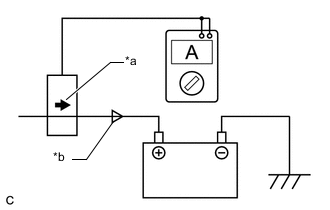
*a Probe Direction *b Current Flowing to Auxiliary Battery Connect the AC/DC 400 A probe of the tester to the positive (+) auxiliary battery cable.
-
Turn the power switch on (READY) and leave the vehicle as it is until the electric current flowing to the auxiliary battery becomes 10 A or less.
-
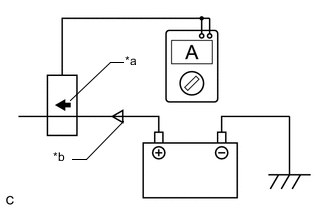
*a Probe Direction *b Current Flowing from Auxiliary Battery Change the orientation of the AC/DC 400 A probe.
-
Measure the current flowing from the auxiliary battery with the power switch on (READY), the headlight position switch and blower motor switch in the HI position, and the rear window defogger turned on.
Standard Current Item Condition Specified Condition Current flowing from auxiliary battery Power switch on (READY)
(Headlight position switch and blower motor switch in HI position, and rear window defogger on)
0 A or less
(No current from auxiliary battery)
-
Turn the power switch off.
-
-