CAN COMMUNICATION SYSTEM(w/ Central Gateway ECU) SYSTEM DESCRIPTION
-
BRIEF DESCRIPTION
-
The Controller Area Network (CAN) is a serial data communication system for real time application. It is a vehicle multiplex communication system which has a high communication speed and the ability to detect malfunctions.
-
Using the CANH and CANL bus lines as a pair, CAN communication is performed using a voltage differential. (A base voltage is applied to the pair of lines and a voltage differential is created when communicating.)
-
Many ECUs or sensors installed on the vehicle operate by sharing information and communicating with each other.
-
The V bus has a termination circuit with a resistor of 60 Ω, and the bus 5, bus 2, bus 3, sub bus 1 and sub bus 13 each have termination circuits with two resistors of 120 Ω.
-
The CAN communication system is composed of 6 buses.
-
-
DEFINITION OF TERMS
-
Main bus
-
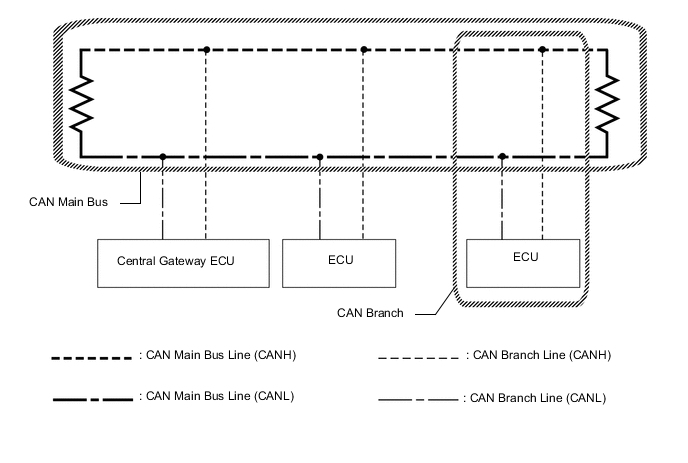
The main bus is a wire harness between the two terminating resistors on the bus. This is the main bus in the CAN communication system.
-
-
Branch
-
A branch is a wire harness which diverges from the main bus to an ECU or sensor.
-
-
Terminating resistors
-
Two resistors of 120 Ω are installed in parallel across the ends of the CAN main bus lines. They are called terminating resistors. These resistors allow the changes of the voltage differential between the CAN bus lines to be accurately judged. To allow proper function of CAN communication, it is necessary to have both terminating resistors installed. Since the two resistors are installed in parallel, this results in a measurement of approximately 60 Ω.
-
-
-
ECUS OR SENSORS WHICH COMMUNICATE THROUGH CAN COMMUNICATION SYSTEM (for LHD)
-
Bus 5
-
Central gateway ECU
-
Driving support ECU assembly*1
-
Forward recognition camera*1
-
Millimeter wave radar sensor assembly*1
-
Blind spot monitor sensor LH*2
-
-
Bus 2
-
Combination meter assembly
-
Power steering ECU with motor assembly
-
Main body ECU (multiplex network body ECU)
-
Steering sensor
-
Airbag sensor assembly
-
Headlight leveling ECU (headlight swivel ECU assembly)
-
Central gateway ECU
-
ECM
-
Brake actuator assembly (skid control ECU)
-
Air conditioning amplifier assembly
-
Certification ECU (smart key ECU assembly)
-
Clearance warning ECU assembly
-
Engine stop and start ECU*3
-
-
Bus 3
-
Central gateway ECU
-
Radio receiver assembly
-
Telematics transceiver*4
-
-
Sub Bus 1
-
Main body ECU (multiplex network body ECU)
-
Outer mirror control ECU assembly (for driver side)*5
-
Outer mirror control ECU assembly (for front passenger side)*5
-
Front power seat switch LH*6
-
Front power seat switch RH*6
-
Multiplex tilt and telescopic ECU*7
-
Luggage closer motor assembly*8
-
Rear television camera assembly*9
-
-
Sub Bus 13*1
-
Driving support ECU assembly
-
Forward recognition camera
-
Millimeter wave radar sensor assembly
Tech Tips
*1: w/ Lexus Safety System +
*2: w/ Blind Spot Monitor System
*3: for 6AR- FSE
*4: w/ Telematics Transceiver
*5: w/ Reverse Shift-linked Mirror
*6: w/ Seat Position Memory System
*7: w/ Power Tilt and Power Telescopic Steering Column System
*8: w/ Power Trunk Lid System
*9: w/ Parking Assist Monitor System without Parallel Parking Assist Function
-
-
-
ECUS OR SENSORS WHICH COMMUNICATE THROUGH CAN COMMUNICATION SYSTEM (for RHD)
-
Bus 5
-
Central gateway ECU
-
Driving support ECU assembly*1
-
Forward recognition camera*1
-
Millimeter wave radar sensor assembly*1
-
Blind spot monitor sensor LH*2
-
-
Bus 2
-
Combination meter assembly
-
Power steering ECU with motor assembly
-
Main body ECU (multiplex network body ECU)
-
Steering sensor
-
Airbag sensor assembly
-
Headlight leveling ECU (headlight swivel ECU assembly)
-
Central gateway ECU
-
ECM
-
Brake actuator assembly (skid control ECU)
-
Air conditioning amplifier assembly
-
Certification ECU (smart key ECU assembly)
-
Clearance warning ECU assembly
-
-
Bus 3
-
Central gateway ECU
-
Radio receiver assembly
-
-
Sub Bus 1
-
Main body ECU (multiplex network body ECU)
-
Outer mirror control ECU assembly (for driver side)
-
Outer mirror control ECU assembly (for front passenger side)
-
Front power seat switch LH*3
-
Front power seat switch RH
-
Multiplex tilt and telescopic ECU*4
-
Luggage closer motor assembly*5
-
Rear television camera assembly*6
-
-
Sub Bus 13*1
-
Driving support ECU assembly
-
Forward recognition camera
-
Millimeter wave radar sensor assembly
Tech Tips
*1: w/ Lexus Safety System +
*2: w/ Blind Spot Monitor System
*3: w/ Seat Position Memory System (for Front Passenger Side)
*4: w/ Power Tilt and Power Telescopic Steering Column System
*5: w/ Power Trunk Lid System
*6: w/ Parking Assist Monitor System without Parallel Parking Assist Function
-
-
-
CIRCUIT DESCRIPTION
-
The V bus has termination circuit with a resistor of 60 Ω.
-
The bus 5, bus 2, bus 3, sub bus 1 and sub bus 13 each have termination circuits with two resistors of 120 Ω.
-
-
TROUBLESHOOTING REMARKS
-
DTCs for the CAN communication system can be checked using the GTS. The DLC3 is connected to the CAN communication system, but no DTCs exist regarding problems in the DLC3 or the DLC3 main lines. If there is any trouble in the DLC3 or the DLC3 main lines, ECUs on the CAN cannot output DTCs to the GTS.
-
-
DIAGNOSTIC TROUBLE CODES FOR CAN COMMUNICATION SYSTEM
Tech Tips
See Diagnosis System Click here.
-
HOW TO DISTINGUISH CONNECTOR OF CAN JUNCTION CONNECTOR
-
In the CAN communication system, the shape of connectors connected to the CAN junction connector which has a ground terminal is the same. The connectors connected to the CAN junction connector can be distinguished by the colors of the bus lines and the connecting side of the junction connector.
Tech Tips
See Terminals of ECU for bus line color or the shape of connecting surface Click here.
-