STOP AND START SYSTEM Stop and Start Priority Control System
DESCRIPTION
Stop and start control has 2 control modes: standard control (NORMAL) mode and stop and start priority control (LONG) mode.
The stop and stop control mode can be changed by pressing and holding the stop and start cancel switch assembly.
When start priority control (LONG) mode is selected, "LONG" will be displayed on the multi-information display as an interruption message.
When the stop and start cancel switch assembly is pressed and held to change the stop and start control mode, a signal is sent from the stop and start cancel switch assembly to the engine stop and start ECU.
Cooperative control is performed by the air conditioning amplifier assembly and engine stop and start ECU based on the selected control mode.
When stop and start priority control (LONG) mode is selected, the operation time of the stop and start control with the air conditioning system on will be extended in order to improve fuel economy.
WIRING DIAGRAM
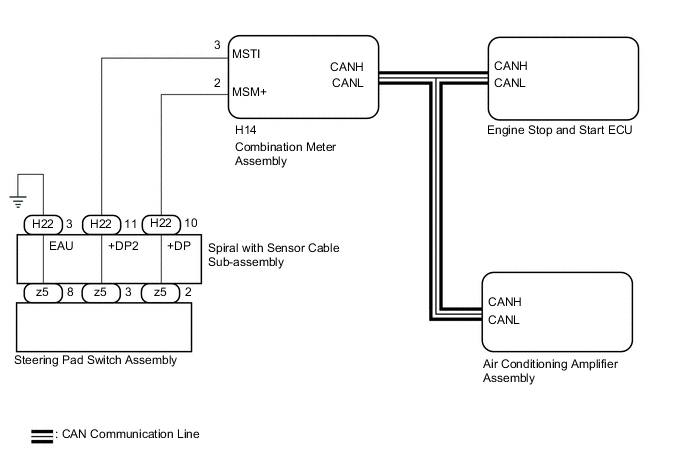
CAUTION / NOTICE / HINT
Note
-
Before replacing the engine stop and start ECU, read the number of starter operations and write it into a new engine stop and start ECU Click here.
-
After replacing the engine stop and start ECU or air conditioning amplifier assembly, reset and perform learning of the air conditioning information in the engine stop and start ECU Click here.
-
After replacing the engine stop and start ECU or airbag sensor assembly, clear and calibrate the deceleration sensor zero point in the engine stop and start ECU Click here.
Tech Tips
-
When stop and start priority control (LONG) is selected, the operation of the air conditioning system is limited. If the customer reports that the cooling effectiveness of the air conditioning system is poor, check the selected control mode. If stop and start priority control (LONG) is selected, cancel the control mode and check if the cooling effectiveness of the air conditioning system improves. If it improves, explain to the customer that the operation of the air conditioning system was limited by stop and start control.
-
Depending on the vehicle conditions, the stop and start operation time may not change even if stop and start priority control (LONG) is selected.
PROCEDURE
-
CHECK PROBLEM SYMPTOMS
-
Check the problem symptoms.
Tech Tips
-
Check each symptom by checking the suspected areas in the table below.
-
By using the GTS and entering the following menus, the selected mode can be confirmed.
Powertrain / Stop and Start / Data List / Stop & Start A/C Mode
Result Problem Symptoms Trouble Area Proceed to Multi-information display screen does not change after pressing steering pad switch assembly
-
Steering pad switch assembly
-
Spiral with sensor cable sub-assembly
-
Combination meter assembly
-
Engine stop and start ECU
-
Wire harness or connector (steering pad switch assembly - combination meter assembly)
-
Wire harness or connector (engine stop and start ECU - combination meter assembly)
-
CAN communication system
A Multi-information display screen changes without pressing steering pad switch assembly
-
Steering pad switch assembly
-
Spiral with sensor cable sub-assembly
-
Wire harness or connector (steering pad switch assembly - combination meter assembly)
B Multi-information display screen does not change but control mode changes Combination meter assembly C Multi-information display screen changes but control mode does not change
-
Air conditioning amplifier assembly
-
Wire harness or connector (engine stop and start ECU - air conditioning amplifier assembly)
D Control mode returns to default mode after turning engine switch on (IG) Engine stop and start ECU E -
B 
CHECK HARNESS AND CONNECTOR (SPIRAL WITH SENSOR CABLE SUB-ASSEMBLY - COMBINATION METER ASSEMBLY) Click here
C 
GO TO METER / GAUGE SYSTEM Click here
D
CHECK DTC OUTPUT Click here
E
CHECK DTC OUTPUT Click here
A 
-
-
CHECK OPERATION
-
Using the steering pad switch assembly, check that all functions other than "Stop and Start A/C Mode" can be selected.
Result Result Proceed to Only "Stop and Start A/C Mode" cannot be selected A No function can be selected using the steering pad switch assembly B
B
CHECK HARNESS AND CONNECTOR (SPIRAL WITH SENSOR CABLE SUB-ASSEMBLY - COMBINATION METER ASSEMBLY) Click here
A
-
-
CHECK DTC OUTPUT
-
Connect the GTS to the DLC3.
-
Turn the engine switch on (IG).
-
Turn the GTS on.
-
Enter the following menus: Powertrain / Stop and Start / Trouble Codes.
-
Read the DTCs.
Result Result Proceed to DTCs are not output A CAN DTCs are output (w/ Central Gateway ECU) B CAN DTCs are output (w/o Central Gateway ECU) C
A
REPLACE ENGINE STOP AND START ECU Click here
B
GO TO CAN COMMUNICATION SYSTEM Click here
C
GO TO CAN COMMUNICATION SYSTEM Click here
-
-
CHECK HARNESS AND CONNECTOR (SPIRAL WITH SENSOR CABLE SUB-ASSEMBLY - COMBINATION METER ASSEMBLY)
-
Turn the engine switch off.
-
Disconnect the H22 spiral with sensor cable sub-assembly connector.
-
Disconnect the H14 combination meter assembly connector.
-
Measure the resistance according to the value(s) in the table below.
Standard Resistance Tester Connection Condition Specified Condition H22-10 (+DP) - H14-2 (MSM+) Always Below 1 Ω H22-10 (+DP) - Body ground Always 10 kΩ or higher H14-2 (MSM+) - Body ground Always 10 kΩ or higher H22-11 (+DP2) - H14-3 (MSTI) Always Below 1 Ω H22-11 (+DP2) - Body ground Always 10 kΩ or higher H14-3 (MSTI) - Body ground Always 10 kΩ or higher H22-3 (EAU) - Body ground Always Below 1 Ω
NG
REPAIR OR REPLACE HARNESS OR CONNECTOR
OK
-
-
INSPECT SPIRAL WITH SENSOR CABLE SUB-ASSEMBLY
-
Inspect the spiral with sensor cable sub-assembly Click here.
NG
REPLACE SPIRAL WITH SENSOR CABLE SUB-ASSEMBLY Click here
OK
-
-
INSPECT STEERING PAD SWITCH ASSEMBLY
-
Inspect the steering pad switch assembly Click here.
OK
GO TO METER / GAUGE SYSTEM Click here
NG
REPLACE STEERING PAD SWITCH ASSEMBLY Click here
-
-
CHECK DTC OUTPUT
-
Connect the GTS to the DLC3.
-
Turn the engine switch on (IG).
-
Turn the GTS on.
-
Enter the following menus: Powertrain / Stop and Start / Trouble Codes.
-
Read the DTCs.
Result Result Proceed to DTCs are not output A CAN DTCs are output B
A
REPLACE AIR CONDITIONING AMPLIFIER ASSEMBLY Click here
B
GO TO CAN COMMUNICATION SYSTEM Click here
-
-
CHECK DTC OUTPUT
-
Connect the GTS to the DLC3.
-
Turn the engine switch on (IG).
-
Turn the GTS on.
-
Enter the following menus: Powertrain / Stop and Start / Trouble Codes.
-
Read the DTCs.
Result Result Proceed to DTCs are not output A DTCs are output B
A
REPLACE ENGINE STOP AND START ECU Click here
B
GO TO DIAGNOSTIC TROUBLE CODE CHART Click here
-