POWER SEAT CONTROL SYSTEM
-
OPERATING CONDITION
-
Memory Function
-
The memory, recall, memory call, and seat slide away conditions of the memory function are as follows:
Function Condition Operation Action Memory Engine switch is on (IG). Switch 1, 2 or 3 is pressed while the "SET" button is pressed.
-
Memorizes the seat position when switch 1, 2 or 3 is pressed.
-
When the memory setting is completed, the buzzer will sound for 0.5 seconds.
Switch 1, 2 or 3 is pressed within 3 seconds after the "SET" button is pressed. Recall Driver Seat
-
Engine switch is on (IG).
-
Shift lever is in P.
-
Memory switch is off.
-
Seat position is memorized.
Switch 1, 2 or 3 is pressed. Recalls the seat position that was memorized in the position control ECU.
-
Engine switch is off.
-
Memory switch is off.
-
Seat position is memorized.
-
Driver door is opened.
Switch 1, 2 or 3 is pressed within 180 seconds after engine switch is turned off and driver door is opened.
-
Engine switch is off.
-
Memory switch is off.
-
Seat position is memorized.
-
Open driver door is closed.
Switch 1, 2 or 3 is pressed within 60 seconds after engine switch is turned off and the open driver door is closed. Front Passenger Seat
-
Engine switch is on (IG).
-
Shift lever is in P.
-
Memory switch is off.
-
Seat position is memorized.
Switch 1, 2 or 3 is pressed.
-
Engine switch is off.
-
Memory switch is off.
-
Seat position is memorized.
-
Driver door is opened.
Switch 1, 2 or 3 is pressed within 180 seconds after engine switch is turned off and front passenger door is opened.
-
*: Seat movement distance can be changed using the customized body electronics system. For details, refer to the Repair Manual.
-
-
-
-
FUNCTION
-
Memory Function
-
The power seat control system has the following functions:
Function Outline Power Control The fore-and-aft slide, reclining, front vertical, lifter and lumbar support can be adjusted using the power seat switch. Memory Memory The memory function can memorize 3 different seat positions. Recall The recall function can recall 3 different memorized seat positions. Memory Call* The memory call function, which utilizes the key IDs, is used to memorize and retrieve the optimal driving positions for a person possessing the key. Seat Slide Away* The seat slide away function automatically slides the seat rearward, making it easier to enter and exit the vehicle. The seat slide away function automatically returns the seat to its original position before starting the vehicle. *: Only for Driver Seat
-
The memory function works in combination with the following systems, ensuring usability and enabling easy entering or exiting of the vehicle.
System Outline Power Tilt and Telescopic System The multiplex tilt and telescopic ECU memorizes the steering column position and recalls it when all conditions are met. Outside Rear View Mirror System The outer mirror control ECU assembly (LH/RH) memorizes the outside rear view mirror positions and recalls them when all conditions are met.
-
-
-
OPERATION
-
Seat Position Detection Method (Power Seats with Memory Function)
-
Slide Position (Driver Seat)
-
The Hall IC built into the slide motor generates pulses corresponding to the speed of the motor. These pulses are then picked up by the position control ECU and switch assembly (position control ECU) and are used to determine the seat position.
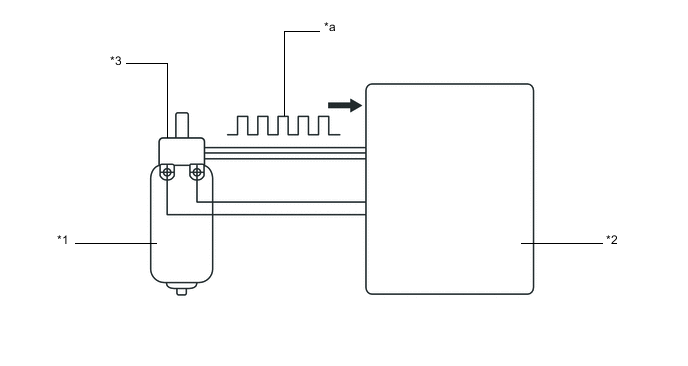
Text in Illustration *1 Power Seat Motor *2 Position Control ECU and Switch Assembly (Position Control ECU) *3 Hall IC - - *a Current pulsation generated by motor - - -
-
Seat Position (Except Driver Seat Slide Position)
-
Each seat adjuster motor (except the slide motor of the driver seat) has a ripple detection IC. The ripple of the current within the motor is proportional to the speed of the motor. Based on the ripple current, the position control ECU and switch assembly (position control ECU) determines the slide*, reclining, front vertical and lifter positions of each seat.
*: Front passenger seat only
-
-
-
-
DIAGNOSIS
-
The position control ECU (position control ECU and switch assembly) has a diagnosis function. It stores a record of any power seat control system failures in its memory in the form of Diagnostic Trouble Codes (DTCs).
-
The position control ECU (position control ECU and switch assembly) outputs malfunction data and 5-digit DTCs to the Global TechStream (GTS).
-
The 5-digit DTCs can be read after connecting the Global TechStream (GTS) to the DLC3. For details, refer to the Repair Manual.
-