COOLANT(for Inverter) REPLACEMENT
PROCEDURE
REMOVE NO. 1 ENGINE UNDER COVER
DRAIN COOLANT (for Inverter Coolant)
Note:Collect the drained coolant and measure its volume to establish a benchmark. When adding coolant, make sure to add more coolant than the measured amount.
Remove the inverter reserve tank cap.
CAUTION:To avoid the danger of being burned, do not remove the inverter reserve tank cap while the coolant for the inverter is still hot.
-
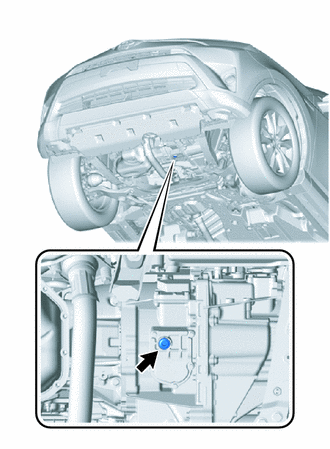
Using a 10 mm hexagon wrench, remove the drain plug and gasket at the position shown in the illustration, and drain the coolant.
CAUTION:Use caution when handling coolant immediately after driving or in summer because it may be hot.
Using a 10 mm hexagon wrench, install the drain plug with a new gasket.
39.2 N*m
400 kgf*cm
29 ft.*lbf
Measure the volume of coolant discharged from the drain.
ADD COOLANT (for Inverter Coolant)
Note:If the vehicle is driven with air in the coolant system, damage may occur and the following DTCs may be stored.
DTC No.
Detection Item
P0A01-726
Motor Electronics Coolant Temperature Sensor Circuit Range / Performance
P0A04-725
Motor Electronics Coolant Temperature Sensor Circuit Intermittent
P0A08-264
DC / DC Converter Status Circuit
P0A78-284
Drive Motor "A" Inverter Performance
P0A78-286
Drive Motor "A" Inverter Performance
P0A7A-322
Generator Inverter Performance
P0A7A-324
Generator Inverter Performance
P0A93-346
Inverter Cooling System Performance
P0A94-553
DC / DC Converter Performance
P0A94-557
DC / DC Converter Performance
P0AEE-277
Motor Inverter Temperature Sensor "A" Circuit Range / Performance
P0AF1-276
Drive Motor Inverter Temperature Sensor "A" Circuit Intermittent / Erratic
P0BCD-315
Generator Inverter Temperature Sensor Circuit Range / Performance
P0BD0-314
Generator Inverter Temperature Sensor Circuit Intermittent / Erratic
P0C39-626
DC / DC Converter Temperature Sensor "A" Range / Performance
P0C3C-625
DC / DC Converter Temperature Sensor "A" Intermittent / Erratic
P0C3E-628
DC / DC Converter Temperature Sensor "B" Range / Performance
P0C41-627
DC / DC Converter Temperature Sensor "B" Intermittent / Erratic
P0C73-776
Motor Electronics Coolant Pump "A" Control Performance
Slowly pour coolant into the inverter reserve tank until it reaches the FULL line.
Note:To prevent foreign matter such as dust or dirt from entering the cooling system, make sure to confirm that the container used to add coolant is clean and free of foreign matter such as dust or dirt.
Standard Capacity
1.5 liters (1.6 US qts, 1.3 Imp. qts)
When using the GTS:
Connect the GTS to the DLC3.
Turn the power switch on (IG).
Enter the following menus: Powertrain / Hybrid Control / Active Test / Activate the (Inverter) Water Pump.
Powertrain > Hybrid Control > Active Test
Tester Display
Activate the (Inverter) Water Pump
Keep the coolant at the FULL line in the inverter reserve tank to compensate for the drop in coolant level when the air bleeds.
Standard
Air bleeding from the inverter cooling system is completed when the noise made by the inverter water pump assembly becomes smaller and the circulation of coolant in the reserve tank improves.
Tip:If free spinning of the inverter water pump is detected for approximately 5 seconds, fail-safe control will be activated to suspend the operation of the pump for approximately 15 seconds and resume operation for approximately 4 seconds repeatedly. Operation of the inverter water pump will return to normal if coolant is added.
A loud noise made by the inverter water pump assembly and poor circulation of coolant in the inverter reserve tank indicates that there is air in the cooling system.
When not using the GTS:
Turn the power switch on (READY). [*1]
Turn the power switch off and add coolant to the FULL line because the coolant level drops as the air bleeds. [*2]
Note:Be sure to turn the power switch off before adding TOYOTA Super Long Life Coolant (SLLC).
Do not work on the components in the engine compartment while the power switch is on (READY) as the engine will operate intermittently.
Repeat steps [*1] and [*2] until air bleeding from the cooling system is completed.
Standard
Air bleeding from the inverter cooling system is completed when the noise made by the inverter water pump assembly becomes smaller and the circulation of coolant in the inverter reserve tank improves.
Tip:A loud noise made by the inverter water pump assembly and poor circulation of coolant in the inverter reserve tank indicates that there is air in the cooling system.
After the air is completely bled from the cooling system, add coolant to the FULL line of the inverter reserve tank.
Note:Collect the drained coolant and measure its volume to establish a benchmark. When adding coolant, make sure to add more coolant than the measured amount.
Tighten the inverter reserve tank cap.
INSPECT FOR COOLANT LEAK (for Inverter Coolant)
INSTALL NO. 1 ENGINE UNDER COVER