INTELLIGENT CLEARANCE SONAR SYSTEM
-
OUTLINE
-
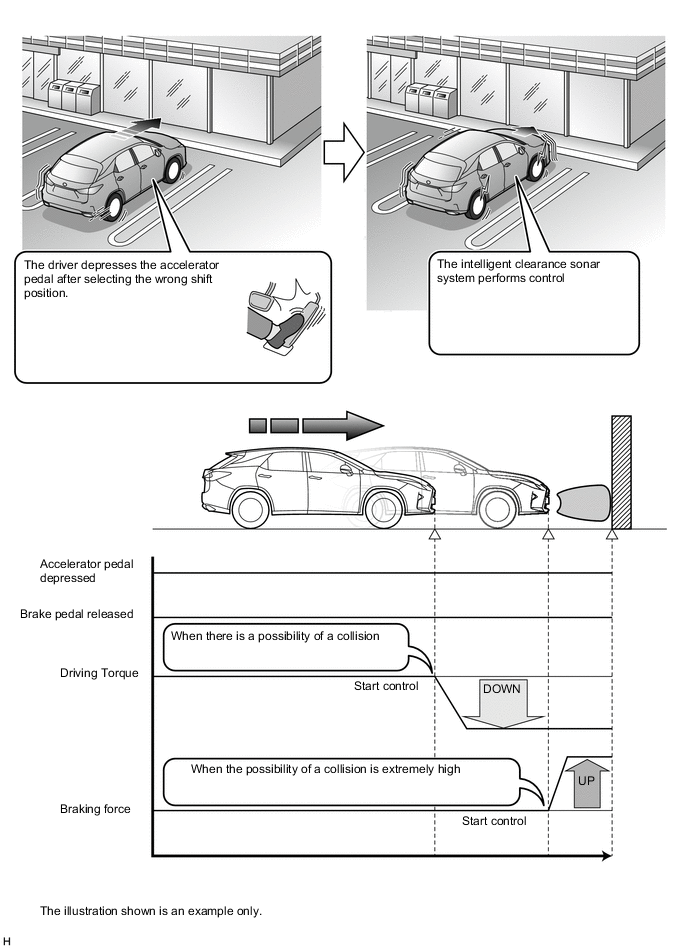
The intelligent clearance sonar system has been newly adopted for some models. This system performs driving torque restriction control or brake control while parking or traveling at low speeds and there is an obstacle in front of or behind the vehicle in order to avoid a collision or reduce the impact of a collision.
-
The ultrasonic sensors installed to the front corners, front center, rear corners and rear center of the vehicle send signals to the intelligent clearance sonar system. The intelligent clearance sonar system determines if there is an obstacle based on the signals and operates accordingly.
-
The rear crossing traffic auto brake function has been added to the intelligent clearance sonar system in order to reduce the impact of a collision while parking or traveling rearward and a vehicle approaching from the right or left at the rear of the vehicle is detected.*
*: Models with rear crossing traffic auto brake function
-
Each blind spot monitor sensor installed to the right or left side of the rear bumper detects vehicles approaching from the right or left at the rear of the vehicle and sends signals to the clearance warning ECU assembly. The clearance warning ECU assembly controls the rear crossing traffic auto brake function based on information received from various sensors installed to the vehicle.
*: Models with rear crossing traffic auto brake function
-
While driving torque restriction control or brake control is performed, a warning is displayed on the multi-information display and headup display* and a buzzer in the combination meter assembly sounds in order to notify the driver that the system is operating.
*: Models with headup display
-
When brake control is performed, the No. 1 clearance warning buzzer sounds to notify the driver that an obstacle is detected and the approximate distance to the obstacle.
-
When the intelligent clearance sonar system is turned off, the ICS OFF indicator light illuminates to notify the driver that the system is off.
Figure 1. Intelligent Clearance Sonar System
-
-
PRECAUTION
-
Make sure to observe the following points when using the intelligent clearance sonar system.
-
Do not rely solely upon the intelligent clearance sonar system. Relying solely upon the intelligent clearance sonar system may lead to an unexpected accident.
-
Driving safely is the sole responsibility of the driver. Pay careful attention to the surrounding conditions in order to ensure safe driving. The intelligent clearance sonar function can provide support to lessen the severity of collisions. However, it may not operate depending on the situation.
-
The intelligent clearance sonar system is not a system to stop the vehicle completely. If the vehicle is stopped by the intelligent clearance sonar system, the brake control by the intelligent clearance sonar system will be canceled in approximately 2 seconds. Depress the brake pedal immediately after the intelligent clearance sonar system operated.
-
Depending on the volume of the audio system or amount of airflow from the air conditioning system, the buzzer of the intelligent clearance sonar system may not be heard clearly.
-
-
For the intelligent clearance sonar system to operate correctly, make sure to observe the following points for the ultrasonic sensors. If not, the ultrasonic sensors may not operate correctly, resulting a serious injury.
-
Do not disassemble the ultrasonic sensor.
-
Do not paint the ultrasonic sensor.
-
When replacing an ultrasonic sensor, only use Toyota genuine parts.
-
Do not subject an ultrasonic sensor or the area around an ultrasonic sensor to any impact.
-
Do not damage the ultrasonic sensor. Always keep it clean.
-
-
Do not modify the suspension, as changes to the height or incline of the vehicle may prevent the sensors from correctly detecting obstacles. This may cause the system to fail to operate or to operate incorrectly.
-
If the area around a sensor is subjected to an impact, equipment may not operate properly due to a sensor malfunction. Refer to the repair manual and inspect the ultrasonic sensor.
-
When washing the vehicle with a high-pressure washer, do not spray water on the ultrasonic sensor or surrounding area. High-pressure water can damage the ultrasonic sensor.
-
When using steam to wash the vehicle, do not apply steam too close to the sensors. The sensors may not function properly if subjected to steam.
-
-
In the following situations, the intelligent clearance sonar system may not operate correctly.
-
Environmental influence
-
There is an object that poorly reflects ultrasonic waves between the ultrasonic sensor and an obstacle.
-
Objects not detected by the sensors
-
Thin objects such as wires, fences, ropes and signposts.
-
Objects directly underneath the bumpers cannot be detected. Some objects located lower than the ultrasonic sensors, or thin objects, may not be detected as the vehicle approaches the objects.
-
Objects too close to the vehicle.
-
When the vehicle is being driven in tall grass, on a bumpy road, an unpaved road or on a metal cover (grating), such as those used for drainage ditches.
-
The vehicle is driven toward a banner or flag, a low-hanging branch or a boom barrier (such as those used at railroad crossings, toll gates and parking lots).
-
Objects located lower than the ultrasonic sensors or thin objects.
-
There is a rut or hole in the surface of the road.
-
-
Influence from the weather
-
When the vehicle is operated under the hot sun or in a freezing climate.
-
When an ultrasonic sensor is frozen. If the ultrasonic sensor temperature rises, the system will return to normal.
-
When foreign matter such as ice, snow or mud is attached to the ultrasonic sensors. If the sensor is cleaned, the system will return to normal.
-
When there is a downpour, or water is splashing on the vehicle.
-
The wind is strong.
-
In severe weather such as fog, snow or a sandstorm.
-
-
Influence from other ultrasonic waves
-
When ultrasonic waves are received from the horn or parking sonar system of another vehicle, a motorcycle engine, or the air brakes of a large vehicle.
-
-
Influence from installed accessories
-
Electronic components such as a backlit license plate (especially fluorescent types), fog lights, a fender pole or a wireless antenna are installed near the sensors.
-
When a towing hitch is mounted on the vehicle.
-
-
Changes in the vehicle.
-
The height of the vehicle has drastically changed due to loading (the nose tilts up or down).
-
When the vehicle posture tilts significantly.
-
When the bumper is damaged.
-
-
Others
-
A material that blocks, absorbs or disrupts ultrasonic waves is attached to an ultrasonic sensor.
-
The vehicle is being loaded onto a ship, truck or other transport vessel.
-
The vehicle is driven continuously when using a drum tester such as a speedometer tester, brake/speedometer combination tester or chassis dynamometer.
-
-
-
In the following situations, an ultrasonic sensor may not operate correctly or the intelligent clearance sonar system may operate even when there is a low possibility of a collision.
-
Environmental influence
-
There is an obstacle on the shoulder of the road (when the vehicle is driven in a narrow tunnel, on a narrow bridge or on a narrow road).
-
When the vehicle is being driven on grass or a bumpy or gravel road.
-
The vehicle is driven toward a banner or flag, a low-hanging branch or a boom barrier (such as those used at railroad crossings, toll gates and parking lots).
-
When the vehicle is being driven toward a tall curbstone or the corner of a curbstone.
-
The vehicle is being parallel parked.
-
The vehicle is being driven on a steep slope.
-
Objects located lower than the ultrasonic sensors or thin objects.
-
The vehicle is being driven on a narrow road.
-
There is a rut or hole in the surface of the road.
-
When the vehicle is driven on a metal cover (grating), such as those used for drainage ditches.
Tech Tips
Even if the intelligent clearance sonar system operates while on a railroad crossing, brake control will be automatically be canceled after approximately 2 seconds. Brake control can also be canceled by depressing the brake pedal. After brake control is canceled, depress the accelerator pedal to drive out of the railroad crossing.
-
-
Influence from the weather
-
When the vehicle is operated under the hot sun or in a freezing climate.
-
When an ultrasonic sensor is frozen.
-
When foreign matter such as ice, snow or mud is attached to the ultrasonic sensors.
-
When there is a downpour, or water is splashing on the vehicle.
-
In severe weather such as fog, snow or a sandstorm.
-
-
Influence from other ultrasonic waves
-
When ultrasonic waves are received from the horn or parking sonar system of another vehicle, a motorcycle engine, or the air brakes of a large vehicle.
-
When an antenna for a wireless transmitter is mounted on the vehicle.
-
-
Influence from installed accessories
-
Electronic components such as a backlit license plate (especially fluorescent types), fog lights, a fender pole or a wireless antenna are installed near the sensors.
-
When a towing hitch is mounted on the vehicle.
-
-
Changes in the vehicle.
-
The height of the vehicle has drastically changed due to loading (the nose tilts up or down).
-
When the vehicle posture tilts significantly.
-
When the bumper is damaged.
-
-
Others
-
The vehicle is being loaded onto a ship, truck or other transport vessel.
-
The vehicle is driven continuously when using a drum tester such as a speedometer tester, brake/speedometer combination tester or chassis dynamometer.
-
-
-
The intelligent clearance sonar system is designed to detect objects that meet all of the following conditions. Other objects may not be detected by the intelligent clearance sonar system.
-
The object is in the path of the vehicle.
-
The object is 1000 mm (39.4 in.) or taller.
-
The width of the object is larger than the width of the vehicle.
-
Objects that are perpendicular to the path of the vehicle.
-
-
There are cases in which the objects listed below cannot be detected:
-
Objects that absorb ultrasonic waves such as cotton or snow.
-
Objects that are not perpendicular to the path of the vehicle, or are angled away from the sensors, or objects with uneven surfaces.
-
Thin objects such as wire or rope.
-
Objects that have sharp edges.
-
Objects that are short.
-
Objects that are tall and protrude toward the vehicle above the detection range of the sensors.
-
People wearing certain types of clothing.
-
-
The rear crossing traffic auto brake function is not designed to detect the following types of vehicles or objects (Models with rear crossing traffic auto brake function):
-
Stationary objects.
-
Vehicles moving away from the vehicle.
-
Small motorcycles, bicycles, pedestrians, etc.
-
Objects too close to the blind spot monitor sensor.
-
-
The rear crossing traffic auto brake function may not detect objects correctly under the following conditions (Models with rear crossing traffic auto brake function):
-
When the vehicle is operated under the hot sun or in a freezing climate.
-
When mud, snow, ice, etc. is covering the sensor or surrounding area on the rear bumper.
-
When there is a downpour, or water is splashing on the vehicle.
-
When either of the blind spot monitor sensors is blocked by an adjacent vehicle or something.
-
When the vehicle posture tilts significantly.
-
When a towing hitch is mounted on the vehicle.
-
When the vehicle is equipped with lowered suspension or tires with a diameter different from the original.
-
The height of the vehicle has drastically changed due to loading (the nose tilts up or down).
-
Electronic components such as a backlit license plate (especially fluorescent types), fog lights, a fender pole or a wireless antenna are installed near the sensors.
-
When a blind spot monitor sensor is misaligned.
-
When multiple vehicles approach with a small gap between each vehicle.
-
When a vehicle is approaching at high speed.
-
-
The rear crossing traffic auto brake function may not detect the following objects or operate correctly in the following situations (Models with rear crossing traffic auto brake function):
-
Vehicles approaching from directly behind.
-
When backing out of a shallow angle parking spot.
-
Vehicles that the sensors cannot detect due to obstructions.
-
When backing up on a slope with a sharp change in grade.
-
-
Refer to Blind Spot Monitor System for information regarding the blind spot monitor sensors. (Models with rear crossing traffic auto brake function)
-