ECD SYSTEM(w/o Glow Plug Controller) Black Smoke Emitted
| DTC Code | DTC Name |
|---|---|
| Black Smoke Emitted |
DESCRIPTION
Faults and Symptoms of Common Rail Diesel Components
Engine Control
Table 1. Intake System Component
Intake system
Symptom: Main fault
Lack of power (No black smoke): Air filter blockage, air duct is crushed/leaking
Black smoke (No lack of power): Leakage between the turbo and intake manifold
Data List
MAP (inside manifold absolute pressure)
Target Booster Pressure
When the accelerator is fully depressed, if MAP is 15 kPa lower than Target Booster Pressure for more than 5 seconds then a lack of power will be felt.
Table 2. Turbocharger System Component
Turbocharger system
Main fault
Air leak in the turbocharger air passage
Turbo motor driver not operating well
Turbocharger (turbine, bearing)
Symptoms
Lack of power (when vehicle starting, when heavy load)
(Black smoke is not emitted when racing the engine while the vehicle stopped)
Data List
MAP (inside manifold absolute pressure), Target Booster Pressure
When the accelerator is fully depressed, if MAP is 15 kPa lower than Target Booster Pressure for more than 5 seconds then a lack of power will be felt.
With the ignition switch ON or during idling, MAP = atmospheric pressure (standard atmospheric pressure = 101 kPa). When the engine speed is about 1500 rpm or more, the turbocharger starts to take effect and MAP becomes higher than atmospheric pressure.
Atmospheric pressure increases 1 kPa each time altitude increases by 100 m, and is also affected by the current weather conditions.
VN Turbo Command
0%: Vanes fully open (drive rod contracts)
Over 90%: Vanes fully closed (drive rod expands and turbo operates effectively)
Diagnostic Point
Using the Active Test "Test the Turbo Charger Step Motor", check the drive rod movement.
Check the drive rod movement when the ignition switch is turned from ON to off.
Table 3. Glow System Component
Glow system
Main fault
Open circuit, glow plug relay fault
Symptoms
Difficult to start, rough idle, knocking, white smoke (when cold)
Data List
Check the glow plug indicator light
Diagnostic Point
Try to measure the resistance of the glow plug
Table 4. Engine Component
Engine
Main fault
Loss of compression
Symptoms
Rough idle (lack of power always)
Data List
Engine Speed of Cyl
When cranking during the "Check the Cylinder Compression" Active Test, if there is a high speed cylinder, approx. 100 rpm more than the other cylinders, that cylinder may lose compression.
Injection Feedback Val
"Injection Feedback Val" more than 2.0 mm3/st: Injector assembly breakdown is causing injection volume deviation, or insufficient compression is causing poor combustion.
Diesel Injection
Table 5. Fuel Supply Pump Component
Supply pump assembly
Main fault
-
Symptoms
Difficult to start, engine stalling, rough idle, lack of power
Data List
Fuel Press, Target Common Rail Pressure, Target Pump SCV Current
When in a stable condition such as when idling, the fuel pressure is within +/-10000 kPa of the target fuel pressure.
If the fuel pressure is 20000 kPa below the target pressure then a lack of power will be felt.
If the fuel pressure is below 25000 kPa then idling will be rough.
Tip:The fuel pressure changes at engine starting, but is approx. 25000 kPa at engine start after the engine is warmed up.
When Target Pump SCV Current is 1530 mA or more, the suction control valve has a tendency to become stuck.
Diagnostic Trouble Code
Even if Fuel Press is less than Target Common Rail Pressure, a DTC may not be stored.
Table 6. Injector Assembly Component
Injector assembly
Main fault
Injection hole blockage
Nozzle needle or valve piston does not move smoothly
Symptoms
Rough idle, lack of power, black smoke, white smoke, knocking
Data List
Injection Feedback Val
"Injection Feedback Val" more than 2.0 mm3/st: Injector assembly breakdown is causing injection volume deviation, or insufficient compression is causing poor combustion.
Tip:When the sliding resistance of the internal parts of the injector assemblies (i.e. armature shaft, command piston and plunger) has increased due to internal contamination, injection volume will increase at high common rail pressure due to a delay in injector assembly closing.
When black smoke occurs due to contamination of the injector assemblies, there are usually other symptoms, such as engine knocking noise at cold idling, rough idling, difficult to start, etc. which are also present at low common rail pressure.
Table 7. Fuel Pressure Sensor Component
Fuel pressure sensor (common rail assembly)
Main fault
Open circuit, decrease in performance (foreign matter is attached)
Symptoms
Difficult to start, rough idle, engine stall, lack of power
Data List
Fuel Press, Target Common Rail Pressure
Slowly raise the engine speed from idling to 3000 rpm with the vehicle stopped, and check that Fuel Press follows Target Common Rail Pressure. If the fuel pressure sensor malfunctions, the actual fuel pressure may deviate from the target fuel pressure. (However, the value may not deviate even when a malfunction is present).
Diagnostic Trouble Code
When the fuel pressure sensor has a fault, some DTCs may be stored.
Table 8. Irregular Fuel Component
Irregular fuel
Main fault
-
Symptoms
Difficult to start, rough idle (especially when cold)
Diesel EGR
Table 9. EGR System Component
EGR system
Main fault
Does not move smoothly
Does not close completely
Symptoms
Rough idle
EGR valve stuck closed: Loud turbocharger sound.
EGR valve stuck open: Difficult to start (does not stall), black smoke, lack of power (if there is an excess in the quantity of recirculated exhaust gas and the engine is under heavy load, when the vehicle starts moving, a lack of power will be felt).
Data List
Actual EGR Valve Pos., Target EGR Pos.
Generally, Actual EGR Valve Pos. = Target EGR Pos. +/-5% (fully closed 0%, fully open 100%).
Using EGR valve Active Test, check whether Actual EGR Valve Pos. follows Target EGR Pos. (the engine coolant temperature and intake air temperature should be considered when a malfunction occurs).
EGR valve is fully closed when the ignition switch is turned to ON (engine stopped).
EGR valve opens to the halfway point at idling after the engine warmed up.
Diesel Throttle
Table 10. Diesel Throttle System Component
Diesel throttle system
Main fault
Stuck, does not move smoothly
Symptoms
Stuck closed: Lack of power, difficult to start, rough idle, engine stall, black smoke. These may occur when stuck almost fully closed.
Stuck open: Turbocharger sound increases. When the engine is stopped, engine vibrations may occur.
Data List
Actual Throttle Position, Target Throttle Position
0%: Fully open
100%: Fully closed
If there is a malfunction of the throttle actuator, compare the target and actual throttle position values for the troubleshooting.
WIRING DIAGRAM
Refer to DTC P1228.
CAUTION / NOTICE / HINT
When replacing the ECM, injector assembly and/or DPF catalyst, perform ECM Initialization and Registration.
When cleaning the electric EGR control valve assembly or diesel throttle body assembly, use a piece of cloth soaked with cleaning solvent. Spraying solvent directly onto these parts or soaking the parts in solvent may damage the parts.
When the ECM must be replaced, before replacing the ECM, perform the "Learning Values Save" function using the GTS. Then after installing a new ECM, perform all of the initialization and registration procedures for the "Learning Values Write" function by following the instructions shown on the GTS display.
Specified values in the following troubleshooting flowchart are for reference only. Variations in the Data List values may occur depending on the measuring conditions or the vehicle age. Do not assume the vehicle to be normal when the Data List outputs standard values. There may be concealed factors of the malfunction.
Explanation of Symptom
Black Smoke
The fuel used in diesel engines has a higher boiling point and evaporates much slower than that used in gasoline engines. Additionally, the fuel is injected directly, so the air fuel mixture in diesel engines is formed in a very short period of time and is less homogenous. This is why diesel engines must operate with excess air fuel ratio across the entire operating range. An insufficient quantity of air results in imperfect combustion and increased particulate (soot) emission.
When the accelerator pedal is depressed, a lot of fuel is injected. As a result, the air fuel ratio becomes rich. In this relatively rich environment, fuel droplets lacking in oxygen burn imperfectly producing soot, which is emitted as black smoke. In order to prevent black smoke production, the maximum injection volume for a given intake air mass is limited (final injection volume is limited by MAF).
Black smoke is emitted either when:
A lack of oxygen is present during combustion
Too much fuel is injected for a given intake air mass and the air fuel ratio becomes temporarily rich
PROCEDURE
READ OUTPUT DTC (RELATING TO ENGINE)
Connect the GTS to the DLC3.
Turn the ignition switch to ON and turn the GTS on.
Enter the following menus: Powertrain / Engine and ECT / Trouble Codes.
Read the pending DTCs.
Powertrain > Engine and ECT > Trouble Codes
Result
Result
Proceed to
DTC is not output
A
Engine related DTCs are output
B
Tip:If DTC P1609 is output, proceed to step 2.
PERFORM ENGINE SPEED ACCELERATION (CHECK FOR BLACK SMOKE)
Start the engine and drive the vehicle until the engine coolant temperature reaches 60°C (140°F) or higher.
Stop the vehicle and allow the engine to idle.
Fully depress the accelerator pedal for 5 seconds and then release it (A).
Repeat the procedure A 10 times (B).
Check for black smoke emission during the procedures A and B.
OK
Black smoke is emitted less than 5 times.
Tip:Even if the black smoke is very thin, count the black smoke emission if there is any visible smoke.
Result
Proceed to
OK
NG
OK END (TEMPORARY SOOT DEPOSITS DUE TO EXTREMELY LOW VEHICLE SPEED OR CONSECUTIVE SHORT TRIPS)
CHECK HARNESS AND CONNECTOR (ENGINE ROOM)
Check the wire harness and connector connections of common rail system components.
OK
The wire harnesses and connectors are connected securely.
Result
Proceed to
OK
NG
NG REPAIR OR REPLACE HARNESS OR CONNECTOR
TAKE SNAPSHOT DURING IDLING AND 3000 RPM
Connect the GTS to the DLC3.
Start the engine and allow it to idle until the engine coolant temperature sensor reaches 75°C (167°F) or higher.
Tip:The shift lever should be in neutral and the A/C switch and all accessory switches should be off.
Turn the GTS on.
Enter the following menus: Powertrain / Engine and ECT / Data List / All Data.
Take a snapshot of the following Data List items.
Tip:A snapshot can be used to compare vehicle data from the time of the malfunction to normal data and is very useful for troubleshooting. The data in the list below is that of a normal vehicle, but as the data varies between individual vehicles, this data should only be used for reference.
Check the Data List at idling and at 3000 rpm with no load after the engine is warmed up.
If black smoke emitted, take a snapshot while the smoke is being emitted.
Table 11. Data Condition Idling (Engine Warmed Up, A/C Off, Shift Lever in neutral) Data List
Value
Unit
Engine Speed
798
rpm
MAP
99
kPa
MAF
4.3
gm/sec
Target Common Rail Pressure
25000
kPa
Fuel Press
24330
kPa
Injection Volume
4.58
mm3/st
VN Turbo Command
90
%
Target EGR Position
65.4
%
Actual EGR Valve Pos.
65.4
%
Target Throttle Position
74
%
Actual Throttle Position
74
%
Accel Position
0.00
%
Atmosphere Pressure
100
kPa
Coolant Temp
75
°C
Calculate Load
16.8
%
Pilot 1 Injection Period
319
μs
Pilot 2 Injection Period
234
μs
Table 12. Data Condition at 3000 rpm (Engine Warmed Up, A/C Off, Shift Lever in neutral) Data List
Value
Unit
Engine Speed
3000
rpm
Target Booster Pressure
129.66
kPa
MAP
129
kPa
MAF
32.08
gm/sec
Target Common Rail Pressure
52640
kPa
Fuel Press
52480
kPa
Target Pump SCV Current
1261.0
mA
Injection Volume
5.29
mm3/st
VN Turbo Command
89
%
Target EGR Position
45.4
%
Actual EGR Valve Pos.
45.4
%
Target Throttle Position
0
%
Actual Throttle Position
0
%
Accel Position
10.15
%
Coolant Temp
81
°C
Calculate Load
21.1
%
Pilot 1 Injection Period
176
μs
Pilot 2 Injection Period
0
μs
Result
Proceed to
NEXT
CHECK SNAPSHOT (FUEL PRESS AND TARGET COMMON RAIL PRESSURE)
Check Fuel Press and Target Common Rail Pressure in the snapshot taken when the engine was idling and at 3000 rpm with no load.
Tip:If black smoke was emitted, check the snapshot from that moment.
Result
Result
Proceed to
Fuel Press is within +/-10000 kPa of Target Common Rail Pressure.
A
Fuel Press is outside range of +/-10000 kPa from Target Common Rail Pressure.
B
B CHECK IF FUEL IS BEING SUPPLIED TO SUPPLY PUMP ASSEMBLYClick here
CHECK SNAPSHOT (TARGET PUMP SCV CURRENT)
Check Target Pump SCV Current in the snapshot taken when the engine was idling and at 3000 rpm with no load.
Result
Result
Proceed to
Target Pump SCV Current is less than 1530 mA
A
Target Pump SCV Current is 1530 mA or more
B
B CHECK HARNESS AND CONNECTOR (SUCTION CONTROL VALVE - ECM)Click here
CHECK INJECTOR COMPENSATION CODE
Read the injector compensation codes.
OK
Compensation codes stored in the ECM match the compensation codes of the installed injector assemblies.
Result
Proceed to
OK
NG
NG PERFORM REGISTRATION AND INITIALIZATIONClick here
CHECK SNAPSHOT (INJECTION FEEDBACK VAL #1 to #4)
Check Injection Feedback Val #1 to #4 and Injection Volume in the snapshot taken after the engine is warmed up and has idled for 1 minute.
Tip:The shift lever should be in neutral and the A/C switch and all accessory switches should be off.
Result
Result
Proceed to
Injection Feedback Val #1 to #4 is within the range of +/-2 mm3/st and Injection Volume is 8 mm3/st or less
A
Injection Feedback Val #1 to #4 is within the range of +/-2 mm3/st and Injection Volume is more than 8 mm3/st
B
*1
Injection Feedback Val #1 to #4 is outside the range of +/-2 mm3/st*2
C
Tip:*1: When this result occurs, usually symptoms may be noticeable, such as difficult starting, rough idling, knocking or black smoke at high common rail pressure.
*2: There may be a malfunction in the corresponding cylinder.
If the value of Injection Volume is more than 8 mm3/st and the value of Injection Feedback Val #1 to #4 is within the threshold, replace the injector assemblies for all cylinders.
In this case, there is a possibility that too much recirculated exhaust gas is entering the engine. Therefore, you should compare the Target EGR Position with the Actual EGR Valve Pos. by entering the following menus using the GTS: Powertrain / Engine and ECT / Data List / Target EGR Position and Actual EGR Valve Pos.
If the difference between Target EGR Position and Actual EGR Valve Pos. exceeds +/-10%, the EGR system may be malfunctioning.
B REPLACE INJECTOR ASSEMBLY OF ALL CYLINDERSClick here
C PERFORM ACTIVE TEST USING GTS (CONTROL THE SELECT CYLINDER FUEL CUT)Click here
INSPECT ELECTRIC EGR CONTROL VALVE ASSEMBLY
Remove the electric EGR control valve assembly.
Connect the electric EGR control valve assembly connector.
Connect the GTS to the DLC3.
Turn the ignition switch to ON and turn the GTS on.
Enter the following menus: Powertrain / Engine and ECT / Active Test / Control the EGR Step Position / Data List / Actual EGR Valve Pos.
Powertrain > Engine and ECT > Active Test
Active Test Display
Control the EGR Step Position
Data List Display
Actual EGR Valve Pos.
When changing the Active Test value from 1 to 100%, check that Actual EGR Valve Pos. smoothly changes to the set opening angle.
OK
Value smoothly changes to the set opening angle.
Visually check the electric EGR control valve assembly for deposits. If there are deposits, clean the electric EGR control valve assembly.
Note:When cleaning the electric EGR control valve assembly, make sure the valve is completely closed.
Do not forcibly open the valve, as it may be damaged or deformed.
When cleaning the electric EGR control valve assembly and the diesel throttle body assembly, use a piece of cloth with cleaning solvent.
Spraying solvent directly onto these parts or soaking the parts in solvent may damage the parts.
Hold the electric EGR control valve up to a light and visually check that there is no clearance between the valve and body.
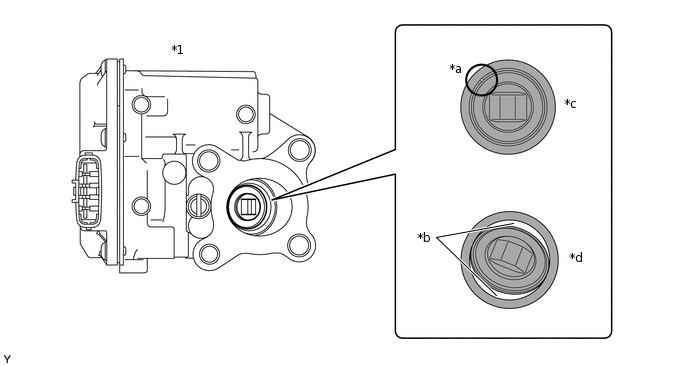
*1
Electric EGR Control Valve Assembly
-
-
*a
Part A
*b
Clearance
*c
OK
*d
NG
OK
No light passes through (there is no clearance between the valve and body).
If light passes through (there is clearance between the valve and body), replace the electric EGR control valve assembly.
Tip:Light passes through part A shown in the illustration even if the valve is completely closed, this is not a malfunction.
Remove the diesel throttle body assembly, intake air connector and EGR pipe connector.
Remove the deposits from the parts and clean them.
Note:When cleaning the electric EGR control valve assembly and the diesel throttle body assembly, use a piece of cloth with cleaning solvent. Spraying solvent directly onto these parts or soaking the parts in solvent may damage the parts.
Extreme care must be taken to prevent the removed deposits from falling into the engine unit during cleaning.
Tip:Remove the intake manifold from the cylinder head when it has to be cleaned.
Do not leave any deposits in the electric EGR control valve assembly when cleaning the valve.
Result
Proceed to
OK
NG
INSPECT ENGINE COOLANT TEMPERATURE SENSOR
Inspect the engine coolant temperature sensor.
Tip:Confirm that the engine coolant temperature is 60°C or higher using the GTS, and then leave the vehicle overnight (7 hours or more). The engine coolant temperature and atmosphere temperature should be very similar.
Result
Proceed to
OK
NG
READ VALUE USING GTS (MAP AND ATMOSPHERE PRESSURE)
Connect the GTS to the DLC3.
Turn the ignition switch to ON and turn the GTS on.
Enter the following menus: Powertrain / Engine and ECT / Data List / MAP and Atmosphere Pressure.
Powertrain > Engine and ECT > Data List
Tester Display
Atmosphere Pressure
MAP
Compare MAP to Atmosphere Pressure when the ignition switch is ON (do not start the engine).
Standard
The difference between MAP and Atmosphere Pressure is less than 7 kPa.
Tip:If MAP and Atmosphere Pressure have the same value, both are normal. If there is a difference of 7 kPa or higher, compare the values to the atmospheric pressure for that day. The sensor whose deviation is the greatest is malfunctioning.
Standard atmospheric pressure is 101 kPa. For every 100 m increase in altitude, pressure drops by 1 kPa. Atmosphere pressure varies with the weather (high atmospheric pressure, low atmospheric pressure).
Result
Result
Proceed to
MAP and Atmosphere Pressure have the same value
A
MAP is different from actual atmospheric pressure
B
Atmosphere Pressure is different from actual atmospheric pressure
C
READ VALUE USING GTS (ACCEL POSITION)
Connect the GTS to the DLC3.
Turn the ignition switch to ON and turn the GTS on.
Enter the following menus: Powertrain / Engine and ECT / Data List / Accel Position.
Powertrain > Engine and ECT > Data List
Tester Display
Accel Position
Read the value.
Standard
Condition
Standard Value
Accelerator pedal released
0%
Accelerator pedal depressed
95% or more
Accelerator pedal released → depressed*1
0 to 95% or more*1
Tip:*1: Make sure the Accel Position opening angle changes smoothly.
Result
Proceed to
OK
NG
READ VALUE USING GTS (INTAKE AIR AND INTAKE AIR TEMP (TURBO))
Leave the vehicle overnight (7 hours or more).
Connect the GTS to the DLC3.
Turn the ignition switch to ON and turn the GTS on.
Enter the following menus: Powertrain / Engine and ECT / Data List / Intake Air and Intake Air Temp (Turbo).
Powertrain > Engine and ECT > Data List
Tester Display
Intake Air
Intake Air Temp (Turbo)
OK
Intake Air is the same as Intake Air Temp (Turbo).
Result
Proceed to
OK
NG
NG REPLACE MALFUNCTIONING PARTS
TAKE SNAPSHOT WHILE ACCELERATING WITH ACCELERATOR FULLY OPEN
Connect the GTS to the DLC3.
Start the engine and allow it to idle until the engine coolant temperature sensor reaches 75°C (167°F) or higher.
Tip:The shift lever should be in neutral and the A/C switch and all accessory switches should be off.
Turn the GTS on.
Enter the following menus: Powertrain / Engine and ECT / Data List / All Data.
Take a snapshot of the following Data List items.
CAUTION:Obey all laws and regulations, and pay attention to driving conditions while driving the vehicle.
Tip:A snapshot can be used to compare vehicle data from the time of the malfunction to normal data and is very useful for troubleshooting. The data in the illustration below is that of a normal vehicle, but as the data varies between individual vehicles, this data should only be used for reference.
Accelerate the vehicle with the accelerator fully open in 2nd gear.
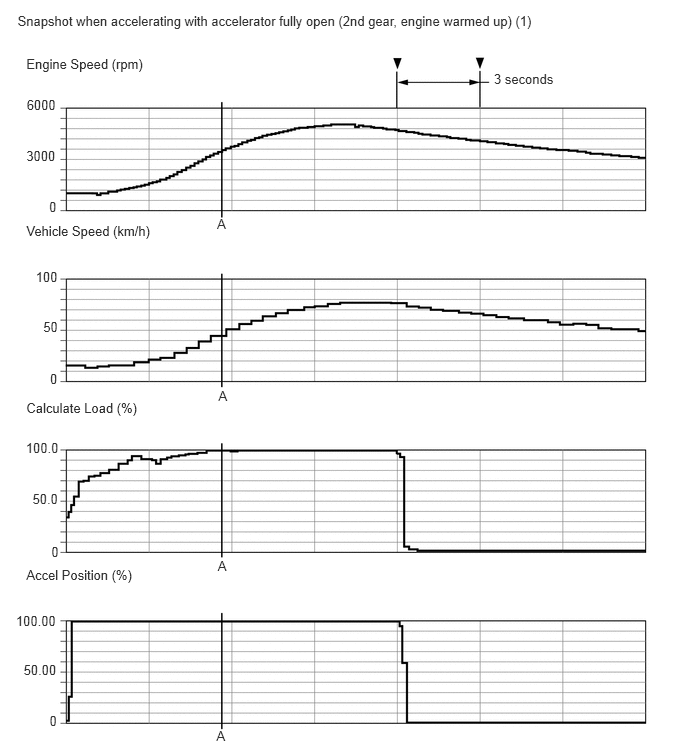
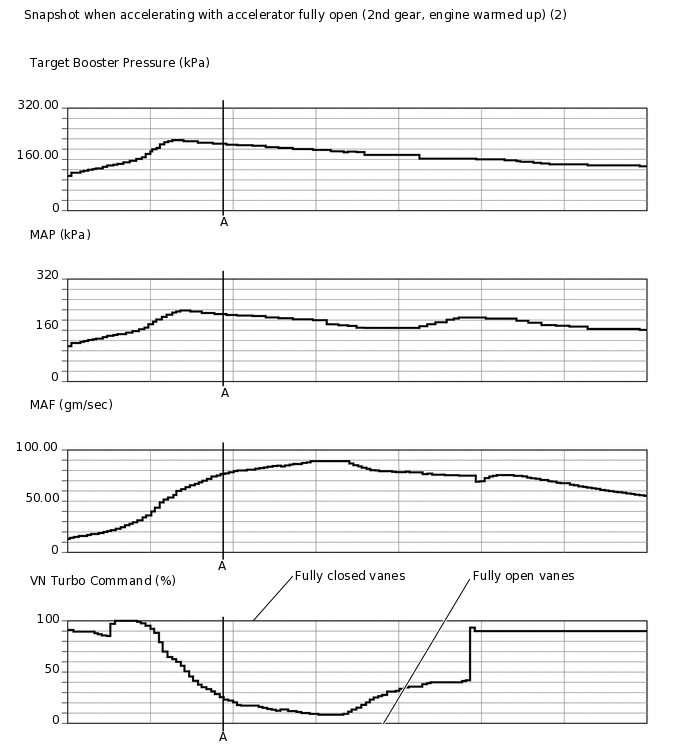
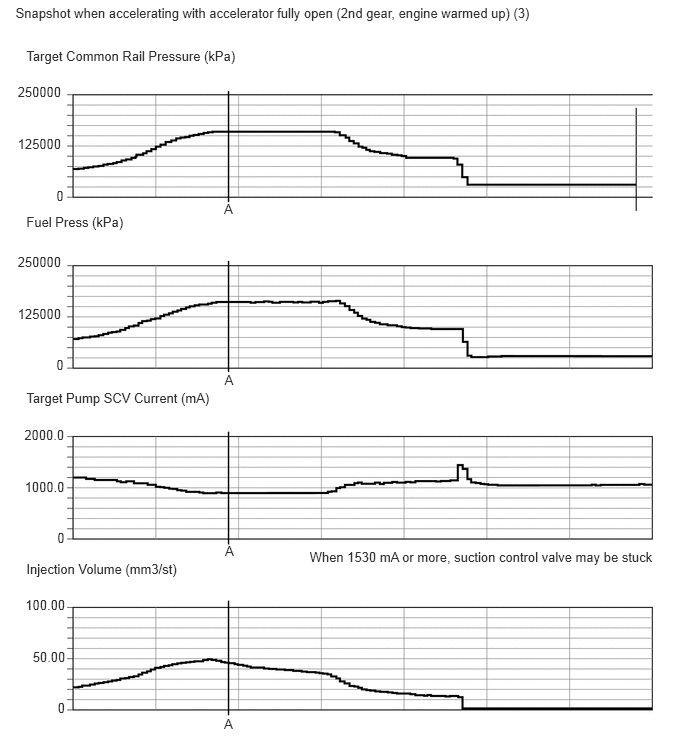
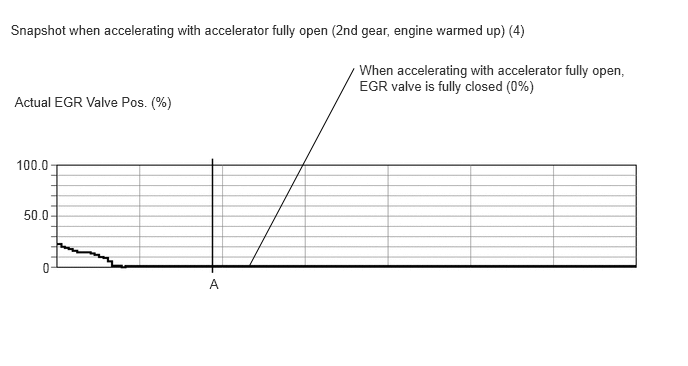
Table 13. Reference Values with Engine Speed at 2000 rpm Data List
Value
Unit
Vehicle Speed
32
km/h
Engine Speed
2000
rpm
Accel Position
99.60
%
Target Booster Pressure
201.46
kPa
MAP
155
kPa
MAF
37.22
gm/sec
Calculate Load
81.9
%
Target Common Rail Pressure
107800
kPa
Fuel Press
109670
kPa
Target Pump SCV Current
1140
mA
Injection Volume
31.28
mm3/st
VN Turbo Command
95
%
Actual EGR Valve Pos.
0.3
%
Actual Throttle Position
-1
%
Table 14. Reference Values with Engine Speed at 3000 rpm Data List
Value
Unit
Vehicle Speed
48
km/h
Engine Speed
3000
rpm
Accel Position
99.60
%
Target Booster Pressure
234.25
kPa
MAP
220
kPa
MAF
75.94
gm/sec
Calculate Load
98.8
%
Target Common Rail Pressure
155480
kPa
Fuel Press
156520
kPa
Target Pump SCV Current
965
mA
Injection Volume
45.48
mm3/st
VN Turbo Command
37
%
Actual EGR Valve Pos.
0.3
%
Actual Throttle Position
0
%
Table 15. Reference Values with Engine Speed at 3500 rpm (Point A) Data List
Value
Unit
Vehicle Speed
52
km/h
Engine Speed
3500
rpm
Accel Position
99.60
%
Target Booster Pressure
231.75
kPa
MAP
227
kPa
MAF
86.97
gm/sec
Calculate Load
100.0
%
Target Common Rail Pressure
158520
kPa
Fuel Press
159380
kPa
Target Pump SCV Current
952
mA
Injection Volume
42.28
mm3/st
VN Turbo Command
29
%
Actual EGR Valve Pos.
0.3
%
Actual Throttle Position
0
%
Table 16. Reference Values with Engine Speed at 4000 rpm Data List
Value
Unit
Vehicle Speed
66
km/h
Engine Speed
4000
rpm
Accel Position
99.60
%
Target Booster Pressure
223.45
kPa
MAP
219
kPa
MAF
90.16
gm/sec
Calculate Load
100.0
%
Target Common Rail Pressure
158940
kPa
Fuel Press
158720
kPa
Target Pump SCV Current
947
mA
Injection Volume
37.48
mm3/st
VN Turbo Command
19
%
Actual EGR Valve Pos.
0.3
%
Actual Throttle Position
0
%
Result
Proceed to
NEXT
CHECK SNAPSHOT (MAP AND TARGET BOOSTER PRESSURE)
Check the condition of the vehicle using the snapshot.
Result
Result
Proceed to
MAP is less than "Target Booster Pressure - 15 kPa" when accelerating with accelerator fully open
A
MAP and Target Booster Pressure values are almost the same
B
B PERFORM ENGINE SPEED ACCELERATION (CHECK FOR BLACK SMOKE)Click here
INSPECT VACUUM HOSE
Check the vacuum hose connection (diesel turbo pressure sensor).
OK
Vacuum hose is connected securely.
Result
Proceed to
OK
NG
NG REPAIR OR REPLACE VACUUM HOSE
CHECK INTAKE SYSTEM
Check for air leakage between the turbocharger and intake manifold.
Check for air leakage at intake manifold.
Tip:Check that there are no disconnected or leaking hoses or pipes.
Check that there are no modifications made by the user.
OK
No leakage.
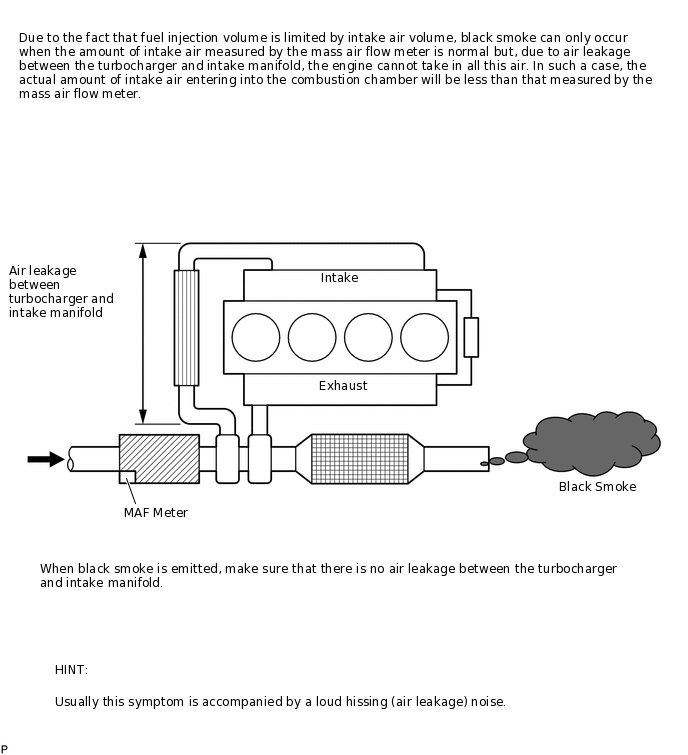
Result
Proceed to
OK
NG
NG REPAIR OR REPLACE MALFUNCTIONING PARTS
INSPECT TURBOCHARGER SUB-ASSEMBLY (MECHANICAL PROBLEM)
Inspect the turbocharger sub-assembly.
Result
Proceed to
OK
NG
PERFORM ENGINE SPEED ACCELERATION (CHECK FOR BLACK SMOKE)
Start the engine and drive the vehicle until the engine coolant temperature reaches 60°C (140°F) or higher.
Stop the vehicle and allow the engine to idle.
Fully depress the accelerator pedal for 5 seconds and then release it (A).
Repeat the above procedure A 10 times (B).
Check for black smoke emission during the above procedures A and B.
OK
Black smoke is emitted less than 5 times.
Tip:Even if the black smoke is very thin, count the black smoke emission if there is any visible smoke.
Result
Proceed to
OK
NG
OK END
BASIC INSPECTION
Check the fuel quality.
Check the fuel line for air.
Check the fuel system for blockages.
Check the air filter.
Check the engine oil.
Check the engine coolant.
Check the engine idling speed and maximum engine speed.
Check the vacuum pump.
OK
Each inspection result is normal.
Result
Proceed to
OK
NG
NG REPAIR OR REPLACE MALFUNCTIONING PARTS
REPLACE NO. 2 EXHAUST MANIFOLD CONVERTER SUB-ASSEMBLY (DPF CATALYTIC CONVERTER)
Replace the No. 2 exhaust manifold converter sub-assembly (DPF catalytic converter).
Clear the DPF deterioration record using the GTS.
Result
Proceed to
NEXT
CHECK INTAKE SYSTEM DEPOSIT
Check if 3 mm (0.12 in.) or more of carbon has accumulated on the intake manifold, cylinder head, etc. and if so, clean it off.
Result
Proceed to
NEXT
CONFIRM WHETHER MALFUNCTION HAS BEEN SUCCESSFULLY REPAIRED
Result
Proceed to
NEXT
NEXT END
REPLACE INJECTOR ASSEMBLY OF ALL CYLINDERS
Replace the injector assembly.
Result
Proceed to
NEXT
PERFORM REGISTRATION AND INITIALIZATION
Register the injector compensation codes.
Perform Pilot Quantity Learning Values Reset.
Result
Proceed to
NEXT
BLEED AIR FROM FUEL SYSTEM
Bleed the air from the fuel system.
Result
Proceed to
NEXT
CONFIRM WHETHER MALFUNCTION HAS BEEN SUCCESSFULLY REPAIRED
Result
Proceed to
NEXT
NEXT END
PERFORM ACTIVE TEST USING GTS (CONTROL THE SELECT CYLINDER FUEL CUT)
Tip:Use this Active Test to determine the malfunctioning cylinder.
Connect the GTS to the DLC3.
Start the engine and turn the GTS on.
Enter the following menus: Powertrain / Engine and ECT / Active Test / Control the Select Cylinder Fuel Cut.
Powertrain > Engine and ECT > Active Test
Tester Display
Control the Select Cylinder Fuel Cut
Tip:DTCs may be output after this Active Test. Make sure to check for DTCs after this Active Test. If any DTCs are output, make sure to clear them.
If the engine idle speed does not change when an injector assembly is disabled, the cylinder being tested is malfunctioning.
If the cylinder being tested is normal, there will be a significant change in idle speed when the fuel injection is stopped for that cylinder.
Result
Proceed to
NEXT
READ VALUE USING GTS (ENGINE SPEED OF CYL #1 TO #4)
Tip:The speed of each cylinder can be measured (compression test) by using the GTS.
For the compression test, perform Active Test using GTS (Check the Cylinder Compression) and crank the engine for approximately 10 seconds. At this time, the speed of each cylinder is measured. If the speed of one cylinder is higher than the other cylinders, the compression pressure of that cylinder is determined to be lower than the other cylinders.
Warm up the engine.
Turn the ignition switch off.
Connect the GTS to the DLC3.
Turn the ignition switch to ON and turn the GTS on.
Enter the following menus: Powertrain / Engine and ECT / Active Test / Check the Cylinder Compression / Data List / Engine Speed of Cyl #1, Engine Speed of Cyl #2, Engine Speed of Cyl #3, Engine Speed of Cyl #4 and Av Engine Speed of All Cyl.
Powertrain > Engine and ECT > Active Test
Active Test Display
Check the Cylinder Compression
Data List Display
Engine Speed of Cyl #1
Engine Speed of Cyl #2
Engine Speed of Cyl #3
Engine Speed of Cyl #4
Av Engine Speed of All Cyl
Push the snapshot button to turn the snapshot function on.
Tip:Using the snapshot function, data can be recorded during the Active Test.
While the engine is not running, press the ON button to Change the Cylinder Compression to ON.
Tip:After performing the above procedure, Check the Cylinder Compression will start. Fuel injection for all cylinders is prohibited and each cylinder engine speed measurement enters standby mode.
Crank the engine for about 10 seconds.
Monitor the engine speed (Engine Speed of Cyl #1 to #4, Av Engine Speed of All Cyl) displayed on the GTS.
Tip:After approximately 10 seconds of engine cranking, the engine speed measurement of each cylinder will change to the actual engine speed.
Note:Do not crank the engine continuously for 20 seconds or more.
If Check the Cylinder Compression needs to be performed after it is turned ON and performed once, press Exit to return to the Active Test menu screen. Then perform Check the Cylinder Compression again.
Use a fully-charged battery.
Stop cranking the engine, and then change "Check the Cylinder Compression" to OFF after the engine stops.
Note:If the Active Test is changed to OFF while the engine is being cranked, the engine will start.
Push the snapshot button to turn the snapshot function off.
Select "Stored Data" on the GTS screen, select the recorded data and display the data as a graph.
Tip:If the data is not displayed as a graph, the change of the values cannot be observed.
Check the change in engine speed values.
Result
Result
Proceed to
Except below
A
The values of Engine Speed Cyl #1 to #4 are within +/-10 rpm of each other.
B
Tip:When cranking, if the speed of a cylinder is approximately 100 rpm more than the other cylinders, there is probably a complete loss of compression in that cylinder.
B REPLACE INJECTOR ASSEMBLY OF MALFUNCTIONING CYLINDERClick here
CHECK CYLINDER COMPRESSION PRESSURE OF MALFUNCTIONING CYLINDER
Check the cylinder compression pressure.
OK
The cylinder compression pressure is within the standard range.
Result
Proceed to
OK
NG
NG CHECK ENGINE TO DETERMINE CAUSE OF LOW COMPRESSION
REPLACE INJECTOR ASSEMBLY OF MALFUNCTIONING CYLINDER
Replace the injector assembly of the malfunctioning cylinder.
Result
Proceed to
NEXT
PERFORM REGISTRATION AND INITIALIZATION
Register the injector compensation codes.
Perform Pilot Quantity Learning Values Reset.
Result
Proceed to
NEXT
BLEED AIR FROM FUEL SYSTEM
Bleed the air from the fuel system.
Result
Proceed to
NEXT
CONFIRM WHETHER MALFUNCTION HAS BEEN SUCCESSFULLY REPAIRED
Result
Proceed to
NEXT
NEXT END
PERFORM REGISTRATION AND INITIALIZATION
Register the injector compensation codes.
Perform Pilot Quantity Learning Values Reset.
Result
Proceed to
NEXT
CONFIRM WHETHER MALFUNCTION HAS BEEN SUCCESSFULLY REPAIRED
Result
Proceed to
NEXT
NEXT END
CHECK HARNESS AND CONNECTOR (SUCTION CONTROL VALVE - ECM)
Disconnect the suction control valve connector.
Disconnect the ECM connector.
Measure the resistance according to the value(s) in the table below.
Standard Resistance
Tester Connection
Condition
Specified Condition
B123-2 - B138-12 (PCV)
Always
Below 1 Ω
B123-2 or B138-12 (PCV) - Body ground
Always
10 kΩ or higher
Result
Proceed to
OK
NG
NG REPAIR OR REPLACE HARNESS OR CONNECTOR
CHECK IF FUEL IS BEING SUPPLIED TO SUPPLY PUMP ASSEMBLY
Disconnect the inlet hose from the supply pump assembly.
Operate the priming pump and check that fuel is being supplied to the supply pump assembly.
OK
Fuel is properly supplied to the supply pump assembly when the priming pump is operated.
Tip:When there is a lack of fuel, fuel pressure drops.
Check that the fuel filter is not clogged.
Result
Proceed to
OK
NG
NG CHECK AND REPLACE CLOGGED FUEL PIPE (INCLUDING FUEL FREEZING) (FUEL TANK - SUPPLY PUMP ASSEMBLY)Click here
REPLACE SUPPLY PUMP ASSEMBLY
Replace the supply pump assembly.
Result
Proceed to
NEXT
BLEED AIR FROM FUEL SYSTEM
Bleed the air from the fuel system.
Result
Proceed to
NEXT
CONFIRM WHETHER MALFUNCTION HAS BEEN SUCCESSFULLY REPAIRED
Result
Proceed to
NEXT
NEXT END
CHECK IF FUEL IS BEING SUPPLIED TO SUPPLY PUMP ASSEMBLY
Disconnect the inlet hose from the supply pump assembly.
Operate the priming pump and check that fuel is being supplied to the supply pump assembly.
OK
Fuel is properly supplied to the supply pump assembly when the priming pump is operated.
Tip:When there is a lack of fuel, fuel pressure drops.
Check that the fuel filter is not clogged.
Result
Proceed to
OK
NG
NG REPLACE SUPPLY PUMP ASSEMBLYClick here
CHECK AND REPLACE CLOGGED FUEL PIPE (INCLUDING FUEL FREEZING) (FUEL TANK - SUPPLY PUMP ASSEMBLY)
Check and replace the clogged fuel pipe.
Result
Proceed to
NEXT
BLEED AIR FROM FUEL SYSTEM
Bleed the air from the fuel system.
Result
Proceed to
NEXT
CONFIRM WHETHER MALFUNCTION HAS BEEN SUCCESSFULLY REPAIRED
Result
Proceed to
NEXT
NEXT END
REPLACE SUPPLY PUMP ASSEMBLY
Replace the supply pump assembly.
Result
Proceed to
NEXT
BLEED AIR FROM FUEL SYSTEM
Bleed the air from the fuel system.
Result
Proceed to
NEXT
PERFORM ACTIVE TEST USING GTS (TEST THE FUEL LEAK)
Connect the GTS to the DLC3.
Turn the ignition switch to ON and turn the GTS on.
Enter the following menus: Powertrain / Engine and ECT/ Active Test / Test the Fuel Leak / Data List / Fuel Press and Target Common Rail Pressure.
Powertrain > Engine and ECT > Active Test
Active Test Display
Test the Fuel Leak
Data List Display
Target Common Rail Pressure
Fuel Press
Take a snapshot with the GTS during the Active Test.
Maintain an engine speed of 3500 rpm, and then press the "Start" button.
Measure the difference between the target fuel pressure (Target Common Rail Pressure) and the actual fuel pressure (Fuel Press) when the Active Test / Test the Fuel Leak is performed.
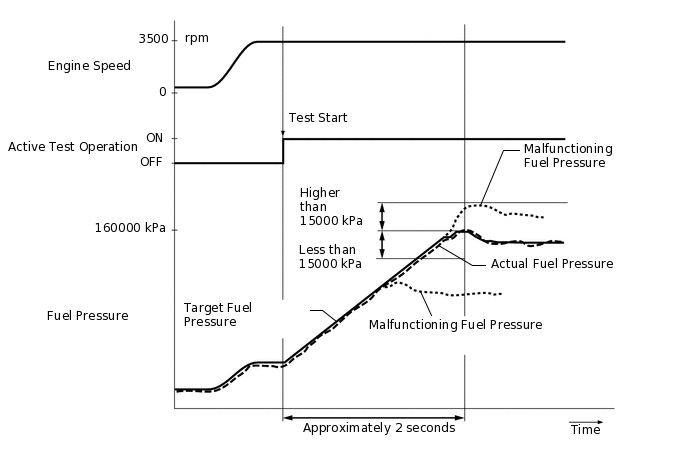 Tip:
Tip:The EPS, ABS and SRS warning lights may blink when the engine speed exceeds 3500 rpm during this test.
To ensure accurate measurements, perform the Active Test with measurements 5 times or more.
Standard
The difference between the target fuel pressure and the actual fuel pressure is less than 15000 kPa when the target fuel pressure reaches the maximum value approximately 2 seconds after the Active Test starts.
Result
Result
Proceed to
Difference between target fuel pressure and actual fuel pressure is 15000 kPa or higher
A
Difference between target fuel pressure and actual fuel pressure is less than 15000 kPa
B
B CONFIRM WHETHER MALFUNCTION HAS BEEN SUCCESSFULLY REPAIREDClick here
REPLACE COMMON RAIL ASSEMBLY
Replace the common rail assembly.
Result
Proceed to
NEXT
BLEED AIR FROM FUEL SYSTEM
Bleed the air from the fuel system.
Result
Proceed to
NEXT
CONFIRM WHETHER MALFUNCTION HAS BEEN SUCCESSFULLY REPAIRED
Result
Proceed to
NEXT
NEXT END