HYBRID CONTROL SYSTEM
-
SYSTEM CONTROL
-
Hybrid Vehicle Control
-
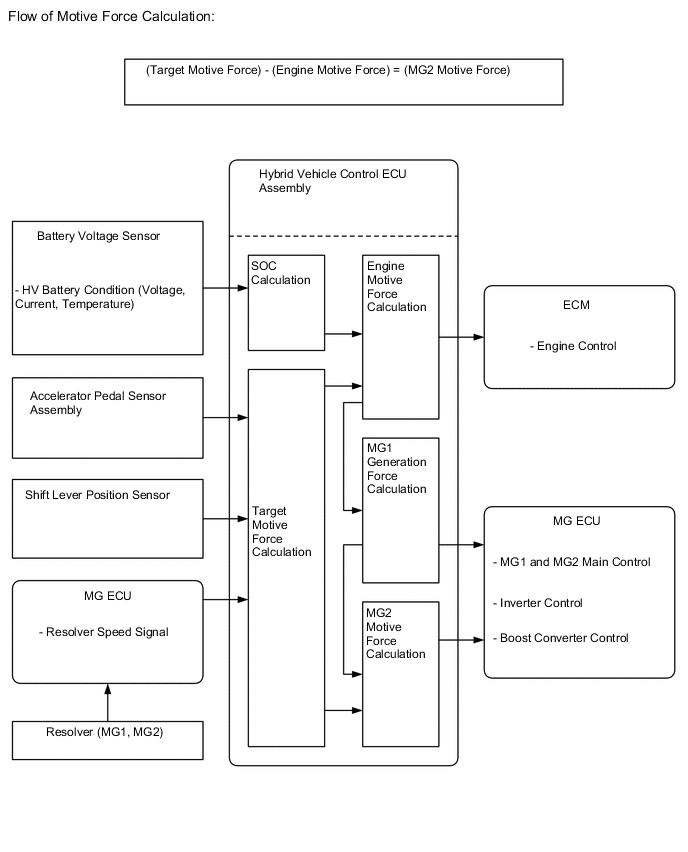
The hybrid vehicle control ECU assembly detects the degree to which the accelerator pedal is depressed using the signals from the accelerator pedal sensor assembly and detects the shift position signals from the shift lever position sensor. The hybrid vehicle control ECU assembly receives the speed signals from the generator (MG1) and motor (MG2) resolvers via the MG ECU. The hybrid vehicle control ECU assembly determines the driving conditions of the vehicle in accordance with this information, and optimally controls the motive forces of generator (MG1), motor (MG2) and the engine. Furthermore, the hybrid vehicle control ECU assembly optimally controls the output and torque of generator (MG1), motor (MG2) and the engine in order to deliver lower fuel consumption and cleaner exhaust emissions.
-
The hybrid vehicle control ECU assembly calculates the engine motive force based on the calculated target motive force, and by taking the SOC and the temperature of the HV battery into consideration. The value obtained by subtracting the engine motive force from the target motive force is the motor (MG2) motive force.
-
The ECM performs control of the engine in accordance with the target engine speed and required engine motive force received from the hybrid vehicle control ECU assembly. Furthermore, the hybrid vehicle control ECU assembly appropriately operates generator (MG1) and motor (MG2) in order to provide the required generator (MG1) generation force and the required motor (MG2) motive force.
-
-
SOC Control
-
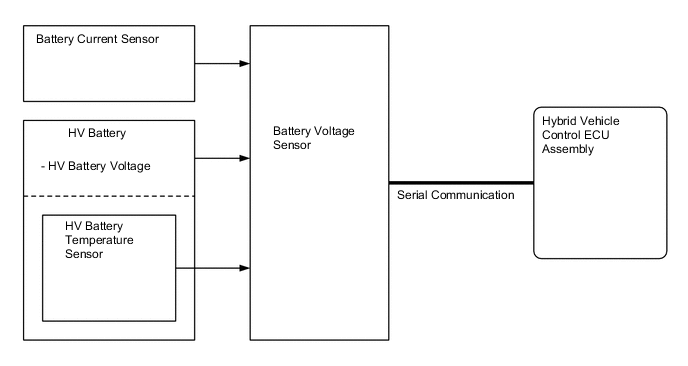
The hybrid vehicle control ECU assembly calculates the SOC of the HV battery based on the charge/discharge amperage detected by the battery current sensor. The hybrid vehicle control ECU assembly constantly performs charge/discharge control based on the calculated SOC in order to maintain the SOC within its target range.
-
While the vehicle is in motion, the HV battery undergoes repetitive charge/discharge cycles, as it becomes discharged by motor (MG2) during acceleration and charged by regenerative braking during deceleration.
-
When the SOC is below the lower level, the hybrid vehicle control ECU assembly increases the power output of the engine to operate generator (MG1), which charges the HV battery.
-
The battery voltage sensor converts the HV battery related signals (voltage, current and temperature) into digital signals, and transmits them to the hybrid vehicle control ECU assembly via serial communication. These signals are needed to determine the SOC that is calculated by the hybrid vehicle control ECU assembly.
-
-
Engine Control
-
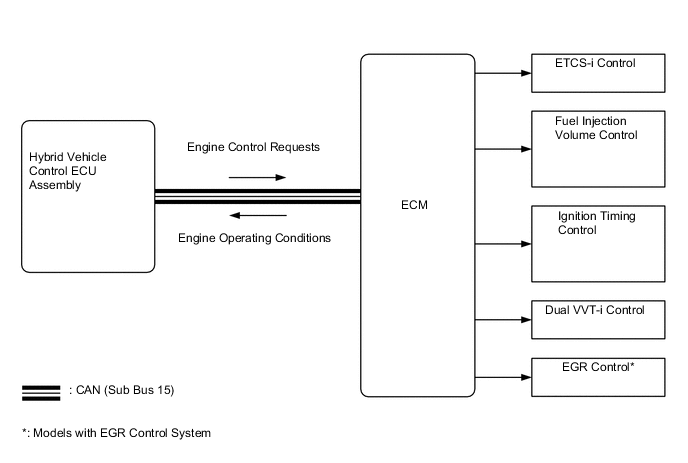
The ECM receives the target engine speed and required engine motive force, which were sent from the hybrid vehicle control ECU assembly, and controls the ETCS-i, fuel injection volume, ignition timing, Dual VVT-i and EGR*.
*: Models with EGR system
-
The ECM transmits the operating conditions of the engine to the hybrid vehicle control ECU assembly.
-
Upon receiving the engine stop signal from the hybrid vehicle control ECU assembly in accordance with the basic hybrid vehicle control, the ECM will stop the engine.
-
-
System Main Relay Control
-
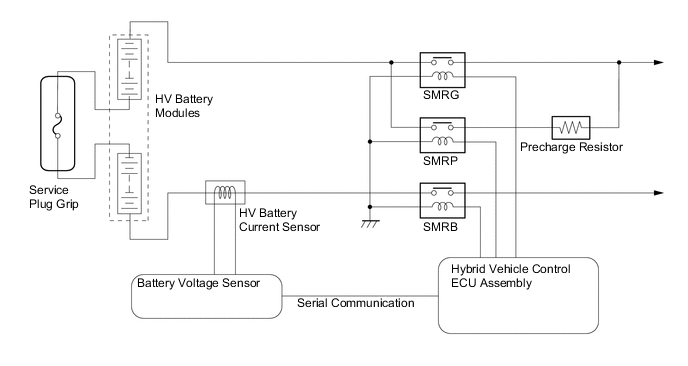
The hybrid vehicle control ECU assembly controls the system main relays to connect and disconnect the high-voltage circuit from the HV battery. The hybrid vehicle control ECU assembly also uses the timing of the operation of the system main relays to monitor the operation of the relay contacts.
-
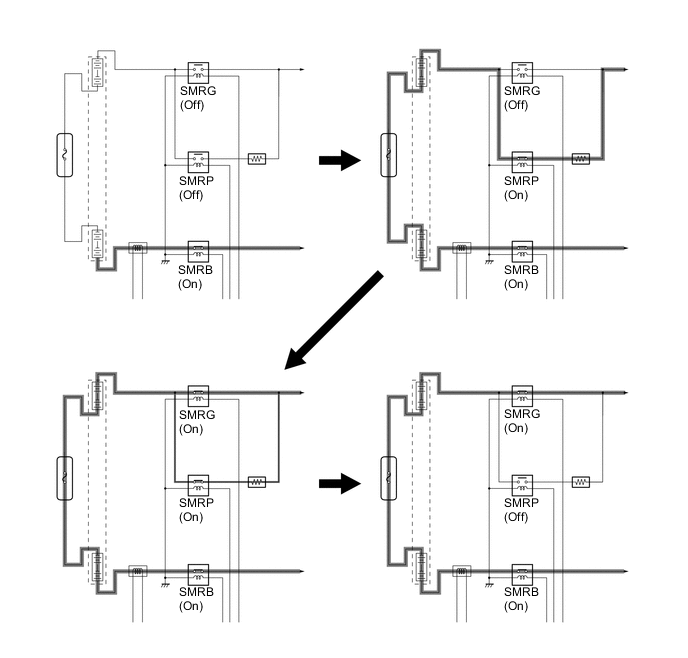
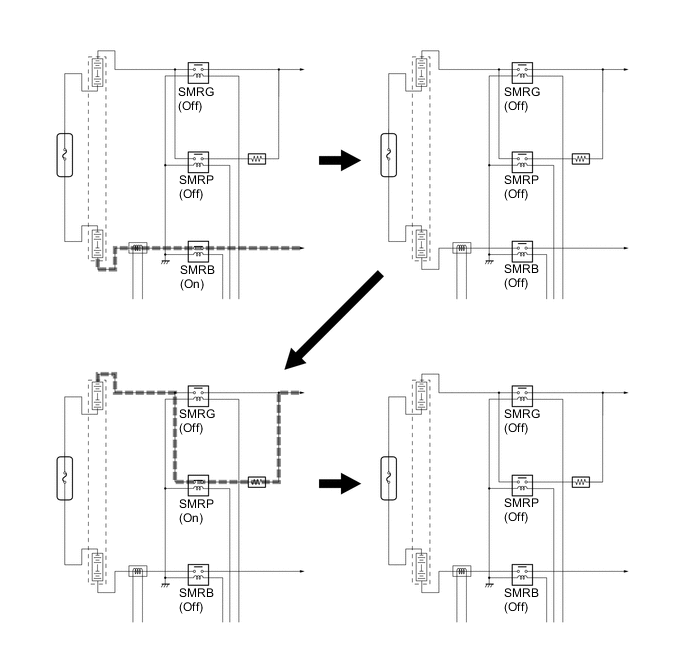
A total of 3 relays, 1 for the positive side (SMRB), and 2 for the negative side (SMRP, SMRG), are provided to ensure proper operation.
-
When the hybrid system changes to the READY-on state, the hybrid vehicle control ECU assembly turns on SMRB and SMRP in sequence, and applies the current through the precharge resistor. After that, it turns SMRG on, and applies the current by bypassing the precharge resistor. Then it turns SMRP off. As the controlled current is initially allowed to pass through the precharge resistor in this manner, the contact point in the circuit is protected from damage that could be caused by an inrush current.
-
When the hybrid system changes to a state other than the READY-on state, the hybrid vehicle control ECU assembly turns SMRG off first. Next, it turns SMRB off after determining whether or not SMRG is operating properly. After that, it turns on SMRP and then off after determining whether or not SMRB is operating properly. As a result, the hybrid vehicle control ECU assembly verifies that the respective relays have been properly turned off.
-
-
Cooling System Control for Inverter with Converter Assembly
-
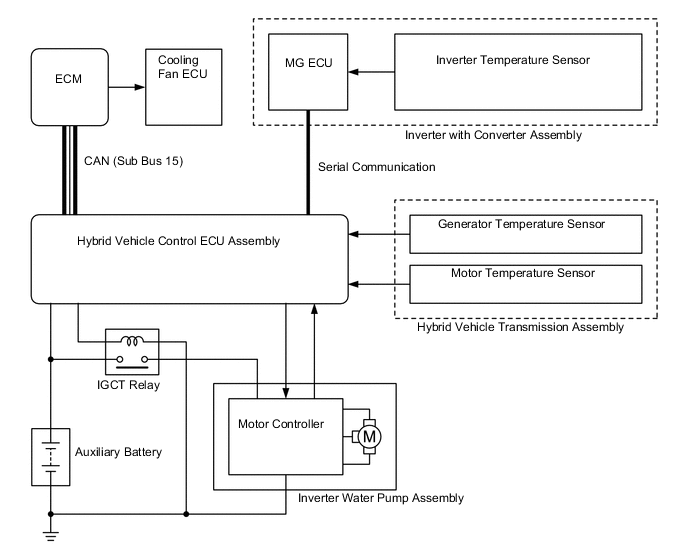
The hybrid vehicle control ECU assembly receives signals from the temperature sensors for the inverter with converter assembly, generator temperature sensor and motor temperature sensor. Then, the hybrid vehicle control ECU assembly actuates the inverter water pump assembly over 4 levels using duty cycle control, in order to cool the inverter with converter assembly, generator (MG1) and motor (MG2).
-
When the HV coolant temperature rises above a certain level, the hybrid vehicle control ECU assembly transmits a radiator fan drive request signal to the ECM. In response to that signal, the ECM actuates the radiator fan to restrain the HV coolant temperature increase, ensuring the cooling of the inverter with converter assembly, generator (MG1) and motor (MG2).
-
The MG ECU converts the temperature sensor signals into digital signals, and transmits them to the hybrid vehicle control ECU assembly via serial communication.
-
-