HYBRID CONTROL SYSTEM Cooling System
| DTC Code | DTC Name |
|---|---|
| Cooling System |
DESCRIPTION
The cause of the malfunction may be the cooling system.
Check whether the grille is blocked, whether coolant is leaking, the HV radiator fan operating condition and whether coolant has frozen.
Area |
Inspection |
Step |
|---|---|---|
Grille blockage, coolant amount, coolant hoses, HV radiator fan |
Check for overheating due to hybrid cooling system malfunction. |
1, 2, 3, 4 |
Inverter coolant temperature sensor (built-in inverter) |
Check for temperature sensor malfunction. |
5 |
Coolant freezing check |
Check freeze frame values to determine whether the hybrid coolant was frozen when the DTC was stored. |
6 |
SYSTEM DESCRIPTION
The inverter converts the high-voltage direct current of the HV battery into alternating current for the generator (MG1) and motor (MG2). The inverter generates heat during the conversion process. Therefore, the inverter is cooled by a special cooling system consisting of the inverter water pump assembly, the cooling fan, and a radiator. This cooling system is independent of the engine cooling system. The hybrid vehicle control ECU monitors the inverter water pump assembly, cooling fan and cooling system, and detects malfunctions.
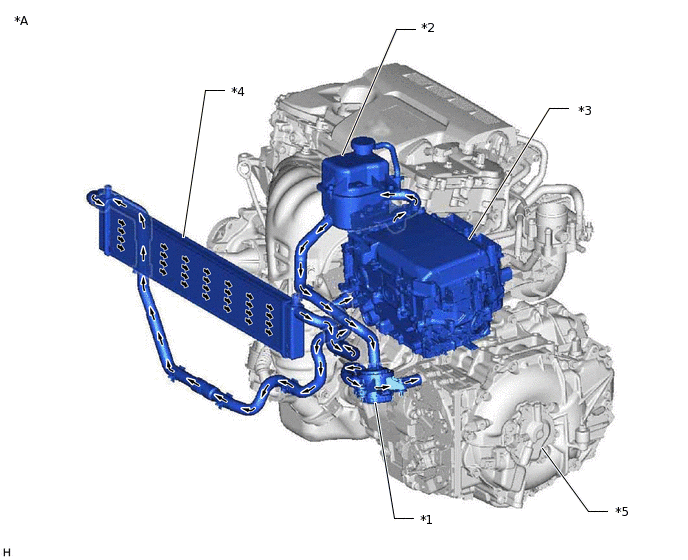
*A |
for 2WD |
- |
- |
*1 |
Inverter Water Pump Assembly |
*2 |
Inverter Reserve Tank Assembly |
*3 |
Inverter with Converter Assembly |
*4 |
Radiator Assembly (HV) |
*5 |
Hybrid Vehicle Transaxle Assembly |
- |
- |
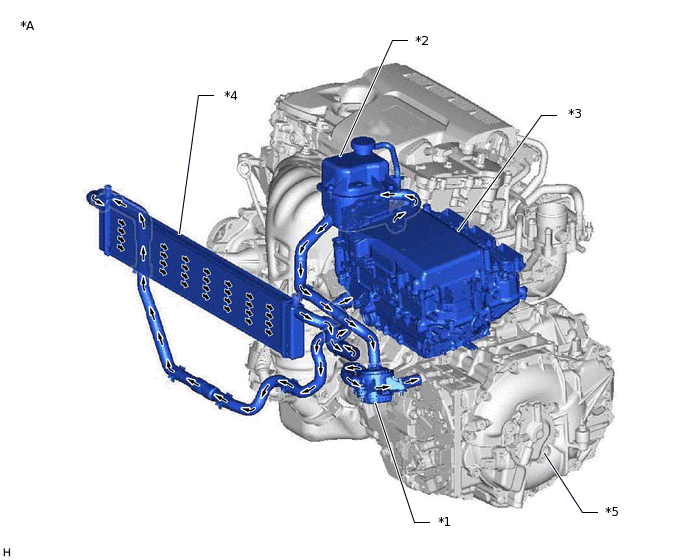
*A |
for AWD |
- |
- |
*1 |
Inverter Water Pump Assembly |
*2 |
Inverter Reserve Tank Assembly |
*3 |
Inverter with Converter Assembly |
*4 |
Radiator Assembly (HV) |
*5 |
Hybrid Vehicle Transaxle Assembly |
- |
- |
CAUTION / NOTICE / HINT
This step is referenced from the procedures for each DTC.
If the inspection results below are normal, perform the next procedure for the referenced DTC.
Before inspecting the high-voltage system or disconnecting the low voltage connector of the inverter with converter assembly, take safety precautions such as wearing insulated gloves and removing the service plug grip to prevent electrical shocks. After removing the service plug grip, put it in your pocket to prevent other technicians from accidentally reconnecting it while you are working on the high-voltage system.
After removing the service plug grip, wait for at least 10 minutes before touching any of the high-voltage connectors or terminals. After waiting for 10 minutes, check the voltage at the terminals in the inspection point in the inverter with converter assembly. The voltage should be 0 V before beginning work.
Tip:Waiting for at least 10 minutes is required to discharge the high-voltage capacitor inside the inverter with converter assembly.
After turning the power switch off, waiting time may be required before disconnecting the cable from the negative (-) auxiliary battery terminal. Therefore, make sure to read the disconnecting the cable from the negative (-) auxiliary battery terminal notices before proceeding with work.
PROCEDURE
CHECK VEHICLE CONDITION
Make sure that the front side of the radiator grille is not blocked with anything.
Ask the customer if the front side of the radiator grille was blocked with anything.
Result
Proceed to
Not blocked.
Is/was blocked.
Tip:If the radiator grille is blocked, the inverter coolant temperature will increase and this DTC may be stored.
Is/was blocked. IF EQUIPPED, EXPLAIN TO CUSTOMER THAT OPTIONAL COMPONENTS WILL BE REMOVED
CHECK QUANTITY OF HV COOLANT
Check the HV coolant level in the inverter reserve tank.
Check for HV coolant leaks.
Result
Result
Proceed to
No leaks are found and the HV coolant level in the inverter reserve tank assembly is above the low line.
A
No leaks are found and the HV coolant level in the inverter reserve tank assembly is below the low line.
B
HV coolant leaks are evident.
C
Tip:After repairing the HV coolant leaks and adding coolant, perform the "Activate the (Inverter) Water Pump" Active Test (HV Active Test item) and the "Control the Electric Cooling Fan" Active Test (Engine Active Test item) and make sure that there are no malfunctions.
The inverter water pump assembly will not malfunction due to coolant leaks.
B ADD HV COOLANT
C INSPECT FOR COOLANT LEAK AND ADD COOLANT
CHECK COOLANT HOSE
Check that the cooling system hoses are not kinked or clogged.
OK
The cooling system hoses are not kinked or clogged.
Result
Proceed to
OK
NG
NG REPAIR OR REPLACE COOLANT HOSE
PERFORM ACTIVE TEST USING GTS (CONTROL THE ELECTRIC COOLING FAN)
Connect the GTS to the DLC3.
Turn the power switch on (IG).
Enter the following menus: Powertrain / Engine and ECT / Active Test / Control the Electric Cooling Fan.
Perform the "Control the Electric Cooling Fan" Active Test.
Powertrain > Engine and ECT > Active Test
Tester Display
Control the Electric Cooling Fan
OK
The cooling fan rotates.
Turn the power switch off.
Result
Proceed to
OK
NG
READ VALUE USING GTS (DATA LIST)
Turn the power switch off and leave the vehicle for at least 1 hour.
Connect the GTS to the DLC3.
Turn the power switch on (IG).
Enter the following menus: Powertrain / Hybrid Control / Data List / Cnv Tmp (Upper), Cnv Temp (Lower), Inverter Coolant Water Temperature, Inverter Temp (MG1), Inverter Temp (MG2), Rear Inverter Temp.
Powertrain > Hybrid Control > Data List
Tester Display
Cnv Tmp (Upper)
Cnv Temp (Lower)
Inverter Coolant Water Temperature
Inverter Temp (MG1)
Inverter Temp (MG2)
Rear Inverter Temperature
Read the Data List.
Result
Result
Proceed to
Other than below.
A
"Inverter Coolant Water Temperature" value is higher than the displayed temperature of any other Data List item by 20°C (68°F) or more.
B
Tip:The lower limit temperature that can be displayed for "Inverter Temp- (MG1)", "Inverter Temp- (MG2)", "Rear Inverter Temp", "Cnv Tmp (Upper)" and "Cnv Temp (Lower)" is 15°C (59°F). The lower limit temperature for "Inverter Coolant Water Temperature" is -40°C (-40°F). The "Inverter Coolant Water Temperature" value displayed on the GTS may be lower than the others, but this is not a malfunction.
Turn the power switch off.
CHECK HV COOLANT (CHECK FOR CONDITIONS THAT MAY HAVE CAUSED FREEZING)
Connect the GTS to the DLC3.
Turn the power switch on (IG).
Enter the following menus: Powertrain / Hybrid Control / Trouble Codes.
Read the freeze frame data item Ambient Temperature using the GTS.
Powertrain > Hybrid Control > Trouble Codes
Check if the freeze frame data item Ambient Temperature is below the freezing temperature of the HV coolant.
Result
Result
Proceed to
Ambient Temperature value is above freezing temperature of the HV coolant.
A
Ambient Temperature value is below freezing temperature of the HV coolant.
B
Tip:HV coolant (SLLC) with a 30% concentration freezes at -15°C (5°F) and HV coolant (SLLC) with a 50% concentration freezes at -35°C (-31°F).
If the HV coolant freezes in the HV radiator or inverter water pump, the coolant temperature in the inverter with converter assembly rises because the HV coolant cannot circulate. As a result, a DTC may be stored.
A DTC is stored when the inverter water pump impeller cannot rotate due to freezing of the HV coolant.
If DTCs are output due to freezing of the LLC, the problem symptom cannot be reproduced. Check the LLC replacement history and whether the LLC was frozen based on the ambient temperature when the DTCs were stored.
Turn the power switch off.
A COOLING SYSTEM NORMAL (PERFORM NEXT STEP FOR REFERENCED DTC)