SFI SYSTEM(w/ Canister Pump Module), Diagnostic DTC:P0300,P0301,P0302,P0303 and P0304
| DTC Code | DTC Name |
|---|---|
| P0300 | Random / Multiple Cylinder Misfire Detected |
| P0301 | Cylinder 1 Misfire Detected |
| P0302 | Cylinder 2 Misfire Detected |
| P0303 | Cylinder 3 Misfire Detected |
| P0304 | Cylinder 4 Misfire Detected |
DESCRIPTION
When the engine misfires, high concentrations of hydrocarbons (HC) enter the exhaust gas. Extremely high hydrocarbon concentration levels can cause an increase in exhaust emission levels. Extremely high concentrations of hydrocarbons can also cause increases in the three-way catalytic converter temperature, which may cause damage to the three-way catalytic converter. To prevent this increase in emissions and to limit the possibility of thermal damage, the ECM monitors the misfire count. When the temperature of the three-way catalytic converter reaches the point of thermal degradation, the ECM blinks the MIL. To monitor misfires, the ECM uses both the camshaft position sensor and the crankshaft position sensor. The camshaft position sensor is used to identify any misfiring cylinders and the crankshaft position sensor is used to measure variations in the crankshaft rotation speed. Misfires are counted when the crankshaft rotation speed variations exceed predetermined thresholds. If the misfire count exceeds the threshold levels, and could cause emission control system performance deterioration, the ECM illuminates the MIL and stores a DTC.
DTC No. |
Detection Item |
DTC Detection Condition |
Trouble Area |
MIL |
Memory |
|---|---|---|---|---|---|
P0300 |
Random / Multiple Cylinder Misfire Detected |
Simultaneous misfiring of several cylinders occurs and one of the following conditions is met (2 trip detection logic).
|
|
Comes on/Blinks* *: The MIL flashes when a catalyst-damaging misfire is detected. |
DTC stored |
P0301 |
Cylinder 1 Misfire Detected |
Misfiring of a specific cylinder occurs and one of the following conditions is met (2 trip detection logic).
|
|
Comes on/Blinks* *: The MIL flashes when a catalyst-damaging misfire is detected. |
DTC stored |
P0302 |
Cylinder 2 Misfire Detected |
Misfiring of a specific cylinder occurs and one of the following conditions is met (2 trip detection logic).
|
|
Comes on/Blinks* *: The MIL flashes when a catalyst-damaging misfire is detected. |
DTC stored |
P0303 |
Cylinder 3 Misfire Detected |
Misfiring of a specific cylinder occurs and one of the following conditions is met (2 trip detection logic).
|
|
Comes on/Blinks* *: The MIL flashes when a catalyst-damaging misfire is detected. |
DTC stored |
P0304 |
Cylinder 4 Misfire Detected |
Misfiring of a specific cylinder occurs and one of the following conditions is met (2 trip detection logic).
|
|
Comes on/Blinks* *: The MIL flashes when a catalyst-damaging misfire is detected. |
DTC stored |
When DTCs for misfiring cylinders are randomly stored, but DTC P0300 is not stored, it indicates that misfires have been detected in different cylinders at different times. DTC P0300 is only stored when several misfiring cylinders are detected at the same time.
MONITOR DESCRIPTION
The ECM illuminates the MIL and stores a DTC when either one of the following conditions, which could cause emission deterioration, is detected (2 trip detection logic).
Within the first 1000 crankshaft revolutions after the engine starts, an excessive number of misfires (approximately 10 to 70 misfires per 1000 crankshaft revolutions) occurs once.
An excessive number of misfires (approximately 10 to 70 misfires per 1000 crankshaft revolutions) occurs a total of 4 times.
The ECM flashes the MIL (immediate detection logic) and stores a DTC (2 trip detection logic) when either one of the following conditions, which could cause damage to the three-way catalytic converter, is detected.
At a high engine speed, a sufficient number of misfires to damage the catalyst occurring within 200 crankshaft revolutions is detected once.
At a normal engine speed, a sufficient number of misfires to damage the catalyst occurring within 200 crankshaft revolutions is detected 3 times.
MONITOR STRATEGY
Required Sensors/Components (Main) |
Crankshaft position sensor Camshaft position sensor |
Required Sensors/Components (Related) |
Engine coolant temperature Intake air temperature sensor Mass air flow meter sub-assembly |
Frequency of Operation |
Continuous |
TYPICAL ENABLING CONDITIONS
Either of the following conditions is met |
A or B |
A. Engine coolant temperature at engine start |
Higher than -7°C (19°F) |
B. Engine coolant temperature |
Higher than 20°C (68°F) |
First 1000 revolutions after engine start, or during check mode |
Crankshaft 1000 revolutions |
Except above |
Crankshaft 1000 revolutions x 4 |
All of the following conditions 1, 2, 3 and 4 met |
Crankshaft 200 revolutions x 3 |
Except above (MIL blinks immediately) |
Crankshaft 200 revolutions |
1. Driving cycles |
1st |
2. Check mode |
Off |
3. Engine speed |
Less than 2450 rpm |
4. Intake air amount per revolution |
Less than 0.95 g/rev |
TYPICAL MALFUNCTION THRESHOLDS
Misfire rate |
1.493% or higher |
Number of misfires per 200 revolutions |
130 or more (varies with intake air amount and engine speed) |
CONFIRMATION DRIVING PATTERN
Connect the GTS to the DLC3.
Turn the engine switch on (IG).
Turn the GTS on.
Record the DTC(s) and freeze frame data.
Clear the DTCs (even if no DTCs are stored, perform the clear DTC procedure).
Using the GTS, switch the ECM from normal mode to check mode.
Read the misfire counts of each cylinder, Cylinder #1 Misfire Count to Cylinder #4 Misfire Count, with the engine idling. If any misfire count is displayed, skip the following confirmation driving pattern.
Drive the vehicle so that the vehicle conditions displayed in Misfire RPM and Misfire Load of the Data List are the same as the freeze frame data. Perform this step several times.
Tip:In order to store misfire DTCs, it is necessary to operate the vehicle for the period of time shown in the table below, confirm the Misfire RPM and Misfire Load in the Data List.
Engine speed
Duration
Idling
8.0 minutes or more
1000
4.5 minutes or more
2000
2.5 minutes or more
3000
1.5 minutes or more
Check whether misfires have occurred by checking DTCs and freeze frame data.
Tip:Do not turn the engine switch off until the output DTC(s) and freeze frame data have been recorded. When the ECM returns to normal mode (default), the stored DTC(s), freeze frame data and other data are cleared.
Record the DTC(s), freeze frame data and misfire counts.
Turn the engine switch off and wait for at least 30 seconds.
Clear the DTCs (even if no DTCs are stored, perform the clear DTC procedure).
WIRING DIAGRAM
CAUTION / NOTICE / HINT
Inspect the fuses for circuits related to this system before performing the following procedure.
If any DTCs other than misfire DTCs are output, troubleshoot those DTCs first.
Read freeze frame data using the GTS. The ECM records vehicle and driving condition information as freeze frame data the moment a DTC is stored. When troubleshooting, freeze frame data can help determine if the vehicle was moving or stationary, if the engine was warmed up or not, if the air fuel ratio was lean or rich, and other data from the time the malfunction occurred.
If the misfire does not recur when the vehicle is brought to the workshop, reproduce the conditions stored in the ECM as freeze frame data.
If the misfire still cannot be reproduced even though the conditions stored in the ECM as freeze frame data have been reproduced, one of the following factors is considered to be a possible cause of the problem:
-
There was insufficient fuel in the tank.
Improper fuel was used.
The spark plugs have been contaminated.
The problem requires further diagnosis.
After finishing repairs, check the misfire counts of the cylinders (Cylinder #1 Misfire Count to Cylinder #4 Misfire Count).
Be sure to confirm that no misfiring cylinder DTCs are stored again by conducting the confirmation driving pattern after finishing repairs.
When one of Short FT #1 or Long FT #1 in the freeze frame data is outside the range of +/-15%, the air fuel ratio may be rich (-15% or less) or lean (+15% or higher).
When Coolant Temp in the freeze frame data is below 75°C (167°F), the misfires have occurred only while warming up the engine.
An extremely imbalanced drive wheel which causes body vibration may cause misfire DTCs to be stored.
PROCEDURE
CHECK FOR ANY OTHER DTCS OUTPUT (IN ADDITION TO MISFIRE DTCS)
Connect the GTS to the DLC3.
Turn the engine switch on (IG).
Turn the GTS on.
Enter the following menus: Powertrain / Engine and ECT / Trouble Codes.
Read the DTCs.
Powertrain > Engine and ECT > Trouble Codes
Result
Result
Proceed to
DTC P0300, P0301, P0302, P0303 and/or P0304 are output
A
DTC P0300, P0301, P0302, P0303 and/or P0304 and other DTCs are output
B
Tip:If any DTCs other than P0300, P0301, P0302, P0303 and P0304 are output, troubleshoot those DTCs first.
CHECK PCV HOSE CONNECTIONS
Check the PCV hose connections
OK
PCV valve and hose are correctly connected and are not damaged.
Result
Proceed to
OK
NG
NG REPAIR OR REPLACE PCV HOSE
READ VALUE USING GTS (MISFIRE RPM AND MISFIRE LOAD)
Connect the GTS to the DLC3.
Turn the engine switch on (IG).
Turn the GTS on.
Enter the following menus: Powertrain / Engine and ECT / Data List / Ptrl Misfire / Misfire RPM and Misfire Load.
Powertrain > Engine and ECT > Data List
Tester Display
Misfire RPM
Misfire Load
Read and note the Misfire RPM and Misfire Load values.
Tip:The Misfire RPM and Misfire Load values indicate the vehicle conditions under which the misfire occurred.
Result
Proceed to
NEXT
READ VALUE USING GTS (CATALYST OT MF F/C)
Connect the GTS to the DLC3.
Turn the engine switch on (IG).
Turn the GTS on.
Enter the following menus: Powertrain / Engine and ECT / Data List / Ptrl Misfire / Catalyst OT MF F/C.
Powertrain > Engine and ECT > Data List
Tester Display
Catalyst OT MF F/C
Read the value displayed on the GTS.
Result
Data List
GTS Display
Proceed to
Catalyst OT MF F/C
Avail
A
Not Avl
B
B READ VALUE USING GTS (CYLINDER MISFIRE COUNT)Click here
PERFORM ACTIVE TEST USING GTS (PROHIBIT THE CATALYST OT MISFIRE PREVENT F/C)
Connect the GTS to the DLC3.
Turn the engine switch on (IG).
Turn the GTS on.
Enter the following menus: Powertrain / Engine and ECT / Active Test / Prohibit the Catalyst OT Misfire Prevent F/C.
Powertrain > Engine and ECT > Active Test
Tester Display
Prohibit the Catalyst OT Misfire prevent F/C
Perform the Active Test.
Note:When performing the Active Test, make sure the vehicle is stopped and the engine is either idling or being revved within 3000 rpm.
Result
Proceed to
NEXT
READ VALUE USING GTS (CYLINDER MISFIRE COUNT)
Connect the GTS to the DLC3.
Turn the engine switch on (IG).
Turn the GTS on.
Enter the following menus: Powertrain / Engine and ECT / Data List / Ptrl Misfire / Cylinder #1 Misfire Count, Cylinder #2 Misfire Count, Cylinder #3 Misfire Count and Cylinder #4 Misfire Count.
Powertrain > Engine and ECT > Data List
Tester Display
Cylinder #1 Misfire Count
Cylinder #2 Misfire Count
Cylinder #3 Misfire Count
Cylinder #4 Misfire Count
Start the engine and allow the engine to idle.
Read each value for Cylinder #1 Misfire Count to Cylinder #4 Misfire Count displayed on the GTS. If no misfire counts occur in any cylinders, perform procedure [A] and [B] and then check the misfire counts again.
Drive the vehicle with the Misfire RPM and Misfire Load noted in the "Read Value Using GTS (Misfire RPM and Misfire Load)" procedures above [A].
Read the Cylinder #1 Misfire Count to Cylinder #4 Misfire Count or DTCs displayed on the GTS [B].
Result
Result
Proceed to
Most misfires occur in only 1 or 2 cylinders
A
3 cylinders or more have equal misfire counts
B
Tip:If it is difficult to reproduce misfires for each cylinder, check the Data List item called Misfire Margin. Try to find vehicle driving conditions that lower the Misfire Margin value. Values above 30% are considered normal.
If the freeze frame data record of the engine coolant temperature is below 75°C (167°F), the misfire may be detected only when the engine is cold.
If the freeze frame data record of the Engine Run Time is below 120 seconds, the misfire may be detected immediately after the engine is started.
B CHECK INTAKE SYSTEMClick here
INSPECT SPARK PLUG
Inspect the spark plug of the misfiring cylinder.
Result
Proceed to
OK
NG
CHECK FOR SPARK (SPARK TEST)
Perform a spark test.
Tip:If the result of the spark test is normal, proceed to the next step.
Perform "Inspection After Repair" after repairing or replacing the ignition system.
Result
Proceed to
NEXT
CHECK CYLINDER COMPRESSION PRESSURE
Measure the cylinder compression pressure of the misfiring cylinder.
Result
Proceed to
OK
NG
NG CHECK ENGINE TO DETERMINE CAUSE OF LOW COMPRESSION
CHECK TERMINAL VOLTAGE (POWER SOURCE OF FUEL INJECTOR ASSEMBLY)
-
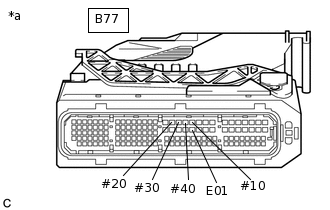
*a
Front view of wire harness connector
(to ECM)
Disconnect the ECM connector.
Turn the engine switch on (IG).
Measure the voltage according to the value(s) in the table below.
Standard Voltage
Tester Connection
Switch Condition
Specified Condition
B77-20 (#10) - B77-50 (E01)
Engine switch on (IG)
11 to 14 V
B77-17 (#20) - B77-50 (E01)
Engine switch on (IG)
11 to 14 V
B77-18 (#30) - B77-50 (E01)
Engine switch on (IG)
11 to 14 V
B77-19 (#40) - B77-50 (E01)
Engine switch on (IG)
11 to 14 V
Result
Proceed to
OK
NG
-
CHECK FUEL INJECTOR OF MISFIRING CYLINDER
Check the fuel injector assembly injection (whether fuel volume is high or low, and whether injection pattern is poor).
Result
Proceed to
OK
NG
CHECK INTAKE SYSTEM
Check the intake system for vacuum leaks.
OK
No leaks from intake system.
Result
Proceed to
OK
NG
NG REPAIR OR REPLACE INTAKE SYSTEM
CHECK INTAKE AIR CONTROL VALVE ACTUATOR (FOR TUMBLE CONTROL VALVE)
Check the intake air control valve actuator (for tumble control valve).
Result
Proceed to
OK
NG
CHECK FUEL PRESSURE
Check the fuel pressure.
Result
Proceed to
OK
NG
NG CHECK FUEL LINEClick here
READ VALUE USING GTS (COOLANT TEMP)
Result
Proceed to
OK
NG
READ VALUE USING GTS (MAF)
Result
Proceed to
OK
NG
NG CHECK HARNESS AND CONNECTOR (MASS AIR FLOW METER SUB-ASSEMBLY CONNECTOR CONNECTION)Click here
CHECK VALVE TIMING (CHECK FOR LOOSE TIMING CHAIN AND JUMPED TEETH)
Result
Proceed to
OK
NG
OK CHECK HARNESS AND CONNECTOR (MASS AIR FLOW METER SUB-ASSEMBLY CONNECTOR CONNECTION)Click here
CHECK INTAKE SYSTEM
Check the intake system for vacuum leaks.
OK
No leaks from intake system.
Result
Proceed to
OK
NG
NG REPAIR OR REPLACE INTAKE SYSTEM
CHECK INTAKE AIR CONTROL VALVE ACTUATOR (FOR TUMBLE CONTROL VALVE)
Check the intake air control valve actuator (for tumble control valve).
Result
Proceed to
OK
NG
CHECK FUEL PRESSURE
Check the fuel pressure.
Result
Proceed to
OK
NG
NG CHECK FUEL LINEClick here
READ VALUE USING GTS (COOLANT TEMP)
Result
Proceed to
OK
NG
READ VALUE USING GTS (MAF)
Result
Proceed to
OK
NG
NG CHECK HARNESS AND CONNECTOR (MASS AIR FLOW METER SUB-ASSEMBLY CONNECTOR CONNECTION)Click here
CHECK VALVE TIMING (CHECK FOR LOOSE TIMING CHAIN AND JUMPED TEETH)
Result
Proceed to
OK
NG
INSPECT SPARK PLUG
Inspect the spark plug of the misfiring cylinder.
Result
Proceed to
OK
NG
CHECK FOR SPARK (SPARK TEST)
Perform a spark test.
Tip:If the result of the spark test is normal, proceed to the next step.
Perform "Inspection After Repair" after repairing or replacing the ignition system.
Result
Proceed to
NEXT
CHECK CYLINDER COMPRESSION PRESSURE
Measure the cylinder compression pressure of the misfiring cylinder.
Result
Proceed to
OK
NG
NG CHECK ENGINE TO DETERMINE CAUSE OF LOW COMPRESSION
CHECK TERMINAL VOLTAGE (POWER SOURCE OF FUEL INJECTOR ASSEMBLY)
-
*a
Front view of wire harness connector
(to ECM)
Disconnect the ECM connector.
Turn the engine switch on (IG).
Measure the voltage according to the value(s) in the table below.
Standard Voltage
Tester Connection
Switch Condition
Specified Condition
B77-20 (#10) - B77-50 (E01)
Engine switch on (IG)
11 to 14 V
B77-17 (#20) - B77-50 (E01)
Engine switch on (IG)
11 to 14 V
B77-18 (#30) - B77-50 (E01)
Engine switch on (IG)
11 to 14 V
B77-19 (#40) - B77-50 (E01)
Engine switch on (IG)
11 to 14 V
Result
Proceed to
OK
NG
-
CHECK FUEL INJECTOR OF MISFIRING CYLINDER
Check the fuel injector assembly injection (whether fuel volume is high or low, and whether injection pattern is poor).
Result
Proceed to
OK
NG
CHECK HARNESS AND CONNECTOR (MASS AIR FLOW METER SUB-ASSEMBLY CONNECTOR CONNECTION)
Check the connection and terminal contact pressure of connectors and wire harnesses between the mass air flow meter sub-assembly and ECM.
Tip:Repair any problems.
Result
Proceed to
NEXT
CHECK WHETHER DTC OUTPUT RECURS (MISFIRE DTCS)
Connect the GTS to the DLC3.
Turn the engine switch on (IG).
Turn the GTS on.
Clear the DTCs.
Powertrain > Engine and ECT > Clear DTCs
Turn the engine switch off and wait for at least 30 seconds.
Turn the engine switch on (IG).
Turn the GTS on.
Start the engine and warm it up.
Drive the vehicle in accordance with the driving pattern described in Confirmation Driving Pattern.
Enter the following menus: Powertrain / Engine and ECT / Utility / All Readiness.
Powertrain > Engine and ECT > Utility
Tester Display
All Readiness
Input the DTC: P0300, P0301, P0302, P0303 or P0304.
Check the DTC judgment result.
Result
Result
Proceed to
ABNORMAL
(DTC P0300, P0301, P0302, P0303 or P0304 is output)
A
NORMAL
(DTC is not output)
B
B END
CHECK HARNESS AND CONNECTOR (MASS AIR FLOW METER SUB-ASSEMBLY - ECM)
Result
Proceed to
OK
NG
NG REPAIR OR REPLACE HARNESS OR CONNECTOR
REPLACE MASS AIR FLOW METER SUB-ASSEMBLY
Replace the mass air flow meter sub-assembly.
Tip:If the results of the inspections performed in steps 16 and 22 indicated no problem, proceed to the next step without replacing the mass air flow meter sub-assembly.
Perform "Inspection After Repair" after replacing the mass air flow meter sub-assembly.
Result
Proceed to
NEXT
CONFIRM WHETHER MALFUNCTION HAS BEEN SUCCESSFULLY REPAIRED
Connect the GTS to the DLC3.
Turn the engine switch on (IG).
Turn the GTS on.
Clear the DTCs.
Powertrain > Engine and ECT > Clear DTCs
Turn the engine switch off and wait for at least 30 seconds.
Turn the engine switch on (IG).
Turn the GTS on.
Start the engine and warm it up.
Drive the vehicle in accordance with the driving pattern described in Confirmation Driving Pattern.
Enter the following menus: Powertrain / Engine and ECT / Utility / All Readiness.
Powertrain > Engine and ECT > Utility
Tester Display
All Readiness
Input the DTC: P0300, P0301, P0302, P0303 or P0304.
Check the DTC judgment result.
Result
Result
Proceed to
NORMAL
(DTC is not output)
A
ABNORMAL
(DTC P0300, P0301, P0302, P0303 or P0304 is output)
B
A END
CHECK FUEL LINE
Check the fuel lines for leaks or blockage.
Result
Proceed to
OK
NG
NG REPAIR OR REPLACE FUEL LINE